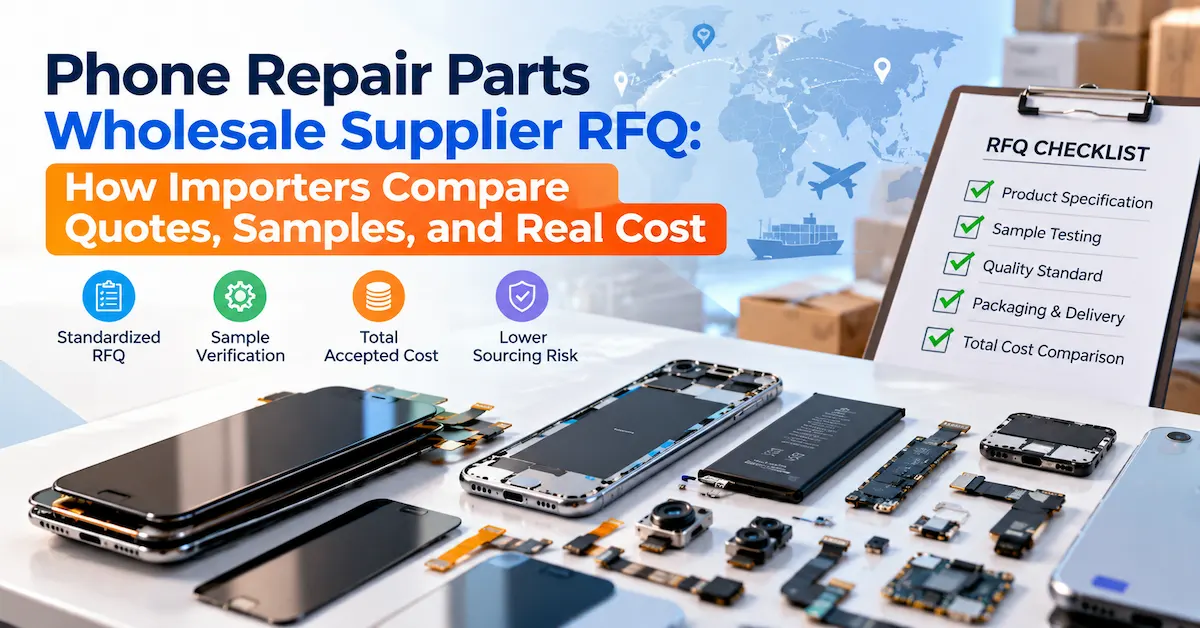

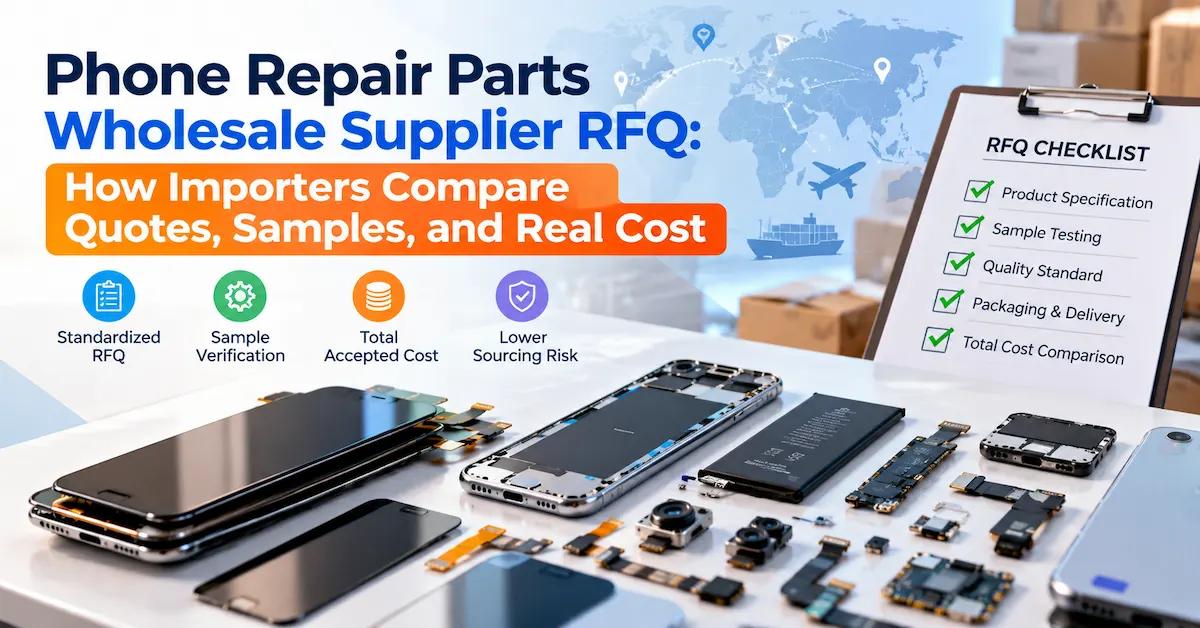
Quick Answer: How Should You Compare a Phone Repair Parts Wholesale Supplier?
Compare suppliers only after every candidate has quoted the same device model, part configuration, sample standard, quantity, packaging, delivery basis, and defect policy. A phone repair parts wholesale supplier with the lowest line-item price is not necessarily the lowest-cost source once wrong models, failed samples, rework, freight, returns, and dead stock are included.
The practical sequence is: define each SKU, issue one master RFQ, require evidence for every important claim, test representative samples, normalize the commercial terms, calculate total accepted cost, and then score the supplier. Do not approve a bulk order from a price list alone.
Why Supplier Quotes Are Often Not Directly Comparable
Two quotations can display the same commercial model name while describing different products. One screen may include a frame; another may not. One charging assembly may include a microphone or antenna contact; another may contain only the connector board. Battery labels may show the same nominal capacity while the connector, cell source, protection circuit, packaging, or required market documentation differs.
Commercial terms can be equally misleading. A quote may be ex-works while another includes export packing or delivery to a consolidation warehouse. One supplier may permit mixed models within a minimum order; another may apply MOQ to every SKU. Lead time can mean time to dispatch, time after deposit, or time after packaging approval. A warranty statement may cover uninstalled defects only, while another supplier may define a tested return process.
Before comparing price, remove these differences. Your phone repair parts wholesale supplier RFQ should force each candidate to answer the same questions in the same units. Blank cells are not neutral; they are unresolved purchasing risks.
Price Becomes Useful Only After the Specification Is Equal
A buyer asking for a "Samsung screen," "iPhone battery," or "USB-C charging port" has not defined a quoteable SKU. Smartphone families contain regional model numbers, board revisions, display technologies, frame configurations, flex layouts, colors, and integrated functions. Even parts that look similar in a catalog image may not be interchangeable.
A professional phone repair parts wholesale supplier should be able to identify what information is missing before confirming compatibility. The buyer should also maintain that identity throughout the quotation, sample, purchase order, packing list, warehouse label, and repeat order. If the product name changes between documents, the comparison is no longer controlled.
Define the Entities Before You Send the RFQ
Clear entity statements help purchasing teams, search engines, and AI systems understand who is involved and what is being sourced. They also prevent a common B2B problem: treating a company, a product category, and a manufacturer role as if they were the same thing.
| Entity question | What the RFQ should state | Why it matters |
|---|---|---|
| Who | Buyer legal name, business type, technical contact, and purchasing contact | Clarifies who approves samples, price, and after-sales decisions |
| What | Exact replacement component and required assembly configuration | Prevents broad names from being treated as complete specifications |
| Where | Destination country, delivery point, and intended sales region | Affects documentation, labeling, packaging, and logistics |
| Manufacturer | Who manufactures, assembles, refurbishes, or distributes each quoted SKU | Distinguishes direct production from trading or multi-source supply |
| Product | Brand, device model, model number, part name, revision, and color | Creates a repeatable product identity |
| Material | Material or component specification that is relevant and verifiable | Replaces vague terms such as premium or original quality |
| Application | Repair shop, refurbishment line, distribution, retail kit, or warranty stock | Connects the part to its operating requirement |
| Market | Target models, customer tier, expected volume, and compliance needs | Helps the supplier quote a suitable configuration rather than a generic option |
For example, CPG describes itself as a global supply-chain company headquartered in Guangzhou, China, founded in 2005, and focused on mobile phone parts and screen solutions for B2B customers. Its public catalog includes display repair parts for major phone brands, phone batteries, accessories, small repair parts, adapters, cables, protective products, and repair tools. Those statements establish company identity and product scope for a buyer researching a phone repair parts wholesale supplier. They do not, by themselves, prove that every catalog SKU is manufactured in the same facility or has the same certification. Manufacturing role, material, tests, MOQ, and lead time should still be confirmed at SKU level.
Build One Master RFQ Instead of Collecting Unstructured Messages
A master RFQ is the control document for the sourcing project. It should be a spreadsheet or structured form with one row per SKU and fixed columns for product identity, technical requirement, commercial terms, evidence, and supplier response. A phone repair parts wholesale supplier should complete the same controlled record as every other candidate. Voice messages and chat screenshots can support communication, but they should not replace that record.
1. Start With Buyer Demand, Not the Supplier Catalog
Use your own repair history, customer orders, backorders, return data, and expected repeat demand to define the sourcing list. A large catalog can help discover products, but it should not decide what your business stocks. Separate fast-moving models from long-tail models and identify which quantities are samples, first orders, and forecasted repeat orders.
Tell the supplier whether the order supports independent repair shops, a repair chain, a refurbishment factory, regional distributors, or online retail. The same part may require different packaging, quantity, documentation, or consistency controls for each application.
2. Use a Device and SKU Identity Matrix
At minimum, record the device brand, commercial model, model number where available, component, configuration, color, and buyer SKU. For displays, identify display type when verified and state with-frame or without-frame. For charging parts, identify socket, flex assembly, daughterboard, or connector-only format. For small parts, note side, position, flex layout, and integrated functions where relevant.
| RFQ field | Example format | Supplier must confirm |
|---|---|---|
| Buyer SKU | BUYER-SCR-001 | Same reference appears on quote, sample, label, and invoice |
| Device identity | Brand + model + model number | Exact compatibility and any regional limitation |
| Part architecture | Display with frame / charging flex / battery | What is included in the assembly |
| Variant | Color, revision, connector, frame option | Quoted variant matches the requested variant |
| Sample quantity | Units per representative SKU | Availability and sample lead time |
| Bulk quantity | Quantity by SKU, not only order total | MOQ and price break by SKU or mixed order |
3. Replace Quality Labels With Acceptance Criteria
Terms such as original, OEM, premium, AAA, high copy, or best quality can mean different things to different suppliers. Do not compare those labels as if they were standards. Ask what components, process, appearance limits, functions, and inspection criteria define the quoted grade.
For a display, acceptance criteria may cover model recognition, connector alignment, image output, touch response, brightness consistency, visible defects, frame fit, flex condition, and pre-installation test method. For a battery, the RFQ may require exact model compatibility, connector design, label content, protective packaging, and destination-market documentation. For a charging assembly, the RFQ should identify charging, data, microphone, antenna, and other integrated functions that apply to that specific board.
Evidence rule: Do not convert a product photo, marketing adjective, or sales message into a technical fact. If material, capacity, test threshold, cycle life, certification, or process is important, request a document, test record, sample, or written specification tied to the exact SKU.
4. Request a Controlled Sample, Not a Random Unit
The sample should represent the specification the supplier intends to deliver in bulk. Label it with supplier name, supplier SKU, buyer SKU, date, revision, and sample status. Photograph the packaging, label, connectors, flexes, frames, and any relevant markings before testing. Keep the approved reference or a complete inspection record for repeat orders.
Sampling several important SKUs is usually more informative than testing one easy model while placing a broad mixed order. Choose samples based on sales volume, technical risk, return history, and variation between product categories.
5. Separate MOQ, Price Breaks, and Mixed-SKU Rules
MOQ can apply to a single SKU, a product family, a quality grade, a packaging design, or the whole shipment. Ask the supplier to state which definition applies. A low total-order MOQ is not helpful if every slow-moving model has a high per-SKU minimum.
Request price breaks using the quantities you may actually buy. Also ask whether several models can share one order, whether branded packaging changes the minimum, and whether sample pricing is credited against a later bulk order. CPG's public site does not publish one universal MOQ for all products, so buyers should send model and quantity requirements through the contact page for SKU-specific confirmation.
6. Define Packaging as a Product Requirement
Packaging affects breakage, electrostatic risk, connector protection, warehouse identification, and picking accuracy. The RFQ should ask for unit packaging, inner carton, master carton, quantity per carton, label fields, barcode format, carton dimensions, gross weight, and any destination-specific marks that apply.
For fragile displays, request evidence of how the panel, frame, flex, and connector are protected. For batteries, confirm the packaging and documentation needed for the intended route and market. For small parts, insist on labels that prevent similar-looking models from being mixed in the warehouse.
7. Make Lead Time Measurable
Replace "fast delivery" with dates and starting conditions. Ask for sample preparation time, bulk production or allocation time, packaging approval time, inspection time, and dispatch date after deposit or order confirmation. If the order contains many SKUs, ask whether the lead time is determined by the slowest item and whether split shipment is possible.
A realistic lead time is more valuable than a short estimate with no definition. For repeat orders, request the conditions under which the supplier can reproduce the approved specification and whether a material, source, or revision change triggers new sample approval.
8. Ask for Product-Specific Test Evidence
A generic statement that all products are tested is not enough for a mixed repair-parts order. Ask what is tested, when, on what sample size, with what equipment or fixture, against which acceptance rule, and how the result is recorded. The test should match the failure modes of the product.
- Displays: image, touch, connector, flex, frame, cosmetic condition, and model-specific functional checks.
- Batteries: identity, electrical and safety checks relevant to the product, packaging, labeling, and required market documents.
- Charging assemblies: connector fit and applicable charging, data, audio, microphone, antenna, or board functions.
- Small parts: physical revision, connector alignment, flex condition, and applicable function.
Do not insert universal thresholds into the RFQ unless your engineer has approved them. The correct criterion depends on the product, target device, market, and quality requirement.
Normalize Every Quote Before Comparing Suppliers
When comparing a phone repair parts wholesale supplier, create a sheet that converts every response to the same currency, quantity basis, Incoterm, packaging level, and delivery point. Record what is included, excluded, conditional, or unanswered. Keep unit price separate from one-time tooling, private-label packaging, testing, inspection, banking, and logistics costs.
| Comparison item | Supplier A | Supplier B | Normalization action |
|---|---|---|---|
| Product specification | With frame | Without frame | Do not compare until both quote the same configuration |
| MOQ basis | Per order | Per SKU | Calculate required inventory by SKU |
| Packaging | Unit pack included | Bulk tray | Add equivalent protective packing cost |
| Delivery term | EXW | Delivery to forwarder | Convert to the same delivery point |
| Sample status | Approved | Not tested | Do not score quality equally |
| Defect process | Written steps | Verbal promise | Request written conditions and evidence requirements |
Use Total Accepted Cost, Not Quoted Unit Price
Total accepted cost per usable unit = product cost + packaging + freight + duties + inspection + failure handling + rework + return administration + shortage or delay cost, divided by the number of accepted usable units.
This is not a universal accounting formula; it is a decision model. Adapt it to your operation. A repair chain may give more weight to technician time and customer callbacks. A distributor may give more weight to dead stock, labeling, carton accuracy, and claims processing. A refurbishment operation may focus on line yield, repeatability, and downtime.
A 100-Point RFQ Scorecard for Supplier Comparison
The following scorecard is designed to compare each phone repair parts wholesale supplier after the RFQ and sample evidence have been collected. Adjust the weights before opening final prices so the team does not redesign the criteria to favor a preferred supplier.
| Evaluation area | Weight | Evidence required | Scoring question |
|---|---|---|---|
| SKU and compatibility control | 15 | Completed identity matrix, confirmed revisions | Can the supplier prevent wrong-model and wrong-configuration orders? |
| Sample conformity | 15 | Tagged samples and test record | Does the sample meet the agreed acceptance criteria? |
| Batch and change control | 10 | Repeat-order and change-notification process | Can the approved specification be repeated or re-approved when changed? |
| Test evidence | 10 | SKU-relevant test method or record | Are quality claims connected to measurable checks? |
| Total accepted cost | 10 | Normalized commercial comparison | What does each usable unit cost after operational losses? |
| MOQ and mixed-SKU fit | 8 | Written MOQ basis and price breaks | Does the order structure fit actual demand? |
| Packaging and traceability | 8 | Packaging photos, labels, carton data | Can the warehouse identify and protect every SKU? |
| Lead-time reliability | 7 | Dated schedule and starting conditions | Is the promised timeline measurable? |
| After-sales process | 7 | Written claim window, evidence, remedy | Can defects be handled without ambiguity? |
| Communication quality | 5 | Complete and consistent RFQ answers | Does the team identify uncertainty before order confirmation? |
| Company and market evidence | 3 | Legal identity, address, contact, relevant history | Can the supplier entity be verified? |
| Compliance relevance | 2 | Documents required for the exact product and market | Are claims applicable rather than generic? |
Score each row from 0 to 5, multiply by its weight, and divide by 5. Keep an evidence link or document reference beside every score. A supplier should not receive full points for a promise that cannot be linked to a sample, specification, photo, record, or written process.
Validate Samples by Product Category
One inspection checklist cannot adequately cover screens, batteries, charging boards, flex cables, cameras, speakers, and repair tools. Use a common document structure, then add category-specific checks.
Display Assemblies
First confirm the exact device and assembly. Before permanent installation, inspect the flex, connector, frame, glass, surface, and protective layers. Use the repair workflow approved by your technical team to check image output, touch response, fit, and relevant functions. Document the tested device model and sample identifier.
CPG's commercial catalog separates display categories for major brands, including Apple LCD repair parts and Samsung LCD repair parts. Category breadth helps buyers build a sourcing list, but every selected model still requires confirmation.
Batteries
Verify device compatibility, connector, label, packaging, physical condition, and the documents required for the destination and shipping method. Capacity or certification claims should be tied to the quoted product, not copied from a generic company profile. Buyers can review the mobile phone battery category and send exact models and quantities for confirmation.
Charging and Small Parts
Confirm whether the item is a bare connector, flex cable, sub-board, or complete assembly. Record board revision, component position, connector layout, and integrated functions. A visual match is not enough. For mixed sourcing, review mobile phone accessories and small parts for iPhone as starting points, then validate each SKU.
Repair Tools and Machines
Tool sourcing adds power, plug, control, consumable, spare-part, and operator requirements. Confirm the exact use case and destination configuration rather than treating tools as ordinary phone components. The repair tools and machines category can support the initial list.
What Evidence Should a Phone Repair Parts Wholesale Supplier Return?
A useful supplier response is more than a price column. Ask for a compact evidence pack so the internal team can review the offer without reconstructing the conversation.
- Completed RFQ with no hidden substitution of model or configuration.
- Current product photos showing the quoted unit, connectors, flexes, frames, labels, and packaging where relevant.
- Supplier SKU and buyer SKU mapping.
- Written material or component information for claims that affect acceptance.
- Sample availability and sample-identification method.
- Product-specific test method or record where required.
- MOQ basis, price breaks, mixed-SKU rules, and packaging minimums.
- Lead-time definition and dated schedule assumptions.
- Unit, inner, and master-carton information.
- Defect reporting window, evidence requirements, and available remedies.
- Relevant authorization, certification, or compliance document tied to the correct product scope.
- Named sales and technical contacts.
A phone repair parts wholesale supplier does not need to send every possible document for every low-risk item. The evidence should be proportional to product risk, order value, market requirements, and the buyer's previous experience. The important point is that high-impact claims are verifiable.
Red Flags in a Wholesale Phone Parts Quotation
The Supplier Quotes Before Identifying the Product
An immediate price can be useful as a rough range, but it is not a controlled quotation if the exact model, part architecture, and quality requirement are unknown. Treat it as preliminary.
The Product Description Changes Across Documents
If the quote, sample label, invoice, and carton use different names, repeat ordering becomes difficult. Require one stable identifier and a written mapping between buyer and supplier SKUs.
Every Product Has the Same Quality Claim
Different component categories have different failure modes. A generic statement such as "100% tested" needs a product-specific explanation. Ask what the test covers and how the result is linked to the batch.
MOQ and Lead Time Are Not Defined
"Flexible MOQ" and "fast delivery" are not commercial terms until the supplier confirms quantities, dates, dependencies, and whether the rule applies per SKU or per order.
Certifications Are Presented Without Scope
A company certificate, brand authorization, battery document, and product compliance report do not prove the same thing. Check the holder, product, model, market, standard, date, and validity. CPG publishes selected authorization information on its About page; buyers should still verify which document applies to the requested SKU.
After-Sales Support Is Only a Promise
Ask how defects are reported, what evidence is required, when a claim must be opened, and what remedies are available. A clear process prevents disagreement after goods have been installed, resold, or mixed with other batches.
What CPG Can Substantiate for a Buyer
CPG's public company page states that the business was founded in 2005, is headquartered in Guangzhou, and serves B2B customers in the electronics aftermarket. It publishes production-facility images, a company history, brand information, and selected authorization certificates. The public product catalog covers major phone-display brands and related categories such as batteries, charging products, small parts, protective products, accessories, and repair tools.
This evidence helps a buyer answer who the company is, where it is based, what product range it presents, and which markets or buyer types it serves. It should be followed by an SKU-level RFQ. Product material, exact manufacturer role, MOQ, test requirement, packaging, lead time, certification, and after-sales terms can vary, so these details should be confirmed in the quotation rather than assumed from company-level information.
Buyers can use the complete CPG product catalog to prepare a model list. The catalog is the primary commercial page for this guide because it lets a buyer move from supplier research to actual product selection. The CPG contact page is the next step for submitting quantities and requirements.
How to Send an RFQ That Can Be Quoted Accurately
Start the message with your company type, destination market, and purchasing objective. Attach one table rather than spreading SKUs across multiple messages. Give every line a buyer reference and include brand, exact model, model number when known, part, configuration, color, sample quantity, first-order quantity, and repeat-demand estimate.
Then state the acceptance questions. For example: confirm with-frame or without-frame; identify what functions are integrated into the charging board; provide current packaging photos; state MOQ per SKU and for mixed orders; state sample and bulk timing; describe the relevant test; and provide the defect-claim process. Ask the supplier to flag uncertainty instead of silently substituting.
For faster routing, separate must-have requirements from preferences. A must-have may be exact compatibility, a required frame configuration, protective packaging, or a destination-market document. A preference may be a particular carton quantity or label layout. This distinction gives the supplier room to propose an alternative without changing a critical specification.
Finally, request a revision number and validity period for the quote. If a product source, revision, packaging method, or commercial condition changes, issue a revised quotation rather than editing an old file without traceability.
Frequently Asked Questions
What should I send to a phone repair parts wholesale supplier first?
Send a structured SKU list with device brand, exact model, model number where available, required part, configuration, quantity, destination, sample need, and any mandatory packaging or quality requirement. This gives the supplier enough context to identify missing details before pricing.
How many suppliers should I compare?
There is no universal number. Compare enough qualified candidates to understand specification, price, and service differences without creating more sample and communication work than your team can control. Three well-documented responses are often more useful than many incomplete quotes.
Should I choose the supplier with the lowest unit price?
No. Compare total accepted cost, including freight, inspection, failed units, installation loss, rework, returns, delay, and dead stock. Unit price matters only after the quoted products and terms are equivalent.
How do I compare quality grades from different suppliers?
Do not compare grade names alone. Translate each grade into components, functions, cosmetic limits, sample results, test methods, and acceptance criteria. If two suppliers cannot define the grade in the same terms, the offers are not directly comparable.
Can I mix different phone models in one wholesale order?
Many B2B orders contain multiple models, but mixed-SKU rules vary. Ask whether MOQ applies per SKU, category, packaging design, or total order and whether slow-moving models can be combined with fast-moving products.
How should I verify model compatibility?
Use the exact device model and model number where available, then confirm the part architecture, connector, flex, frame, board revision, color, and integrated functions that apply. Approve representative samples before bulk purchasing.
What test data should I request?
Request checks that match the product's failure modes and your acceptance criteria. Ask what is tested, on what sample, at which stage, against what limit, and how the result is recorded. Avoid copying one test list across unrelated product categories.
How should MOQ be written in the RFQ?
State sample quantity, first-order quantity, expected repeat quantity, and number of SKUs. Ask the supplier to specify MOQ per SKU, mixed-order minimum, packaging minimum, and price breaks separately.
What packaging information matters for wholesale repair parts?
Record unit protection, inner and master carton, quantity per carton, product label, buyer SKU, barcode, dimensions, weight, and any handling or destination marks. Packaging should protect the part and prevent model-mixing in the warehouse.
Where can I request a CPG quotation?
Review the relevant products, prepare your model and quantity list, and submit it through the CPG contact page. Include unresolved compatibility, sample, MOQ, testing, packaging, delivery, and after-sales questions in the same RFQ.
Conclusion
Choosing a phone repair parts wholesale supplier is a specification and evidence decision before it is a price decision. The strongest RFQ makes every candidate quote the same SKU identity, configuration, quantity, packaging, delivery basis, and defect process. Samples then test whether the written offer matches a product your team can accept.
Use the 100-point scorecard to keep compatibility, sample conformity, batch control, test evidence, total accepted cost, MOQ, packaging, lead time, and after-sales support visible in one decision. Keep unanswered fields open rather than filling them with assumptions. That discipline reduces wrong-part orders, misleading price comparisons, and repeat-order surprises.
To move from research to sourcing, select the relevant categories in the CPG catalog and send one controlled model list. Include your destination market, quantities, required configurations, and evidence questions so the response can be compared and approved efficiently.