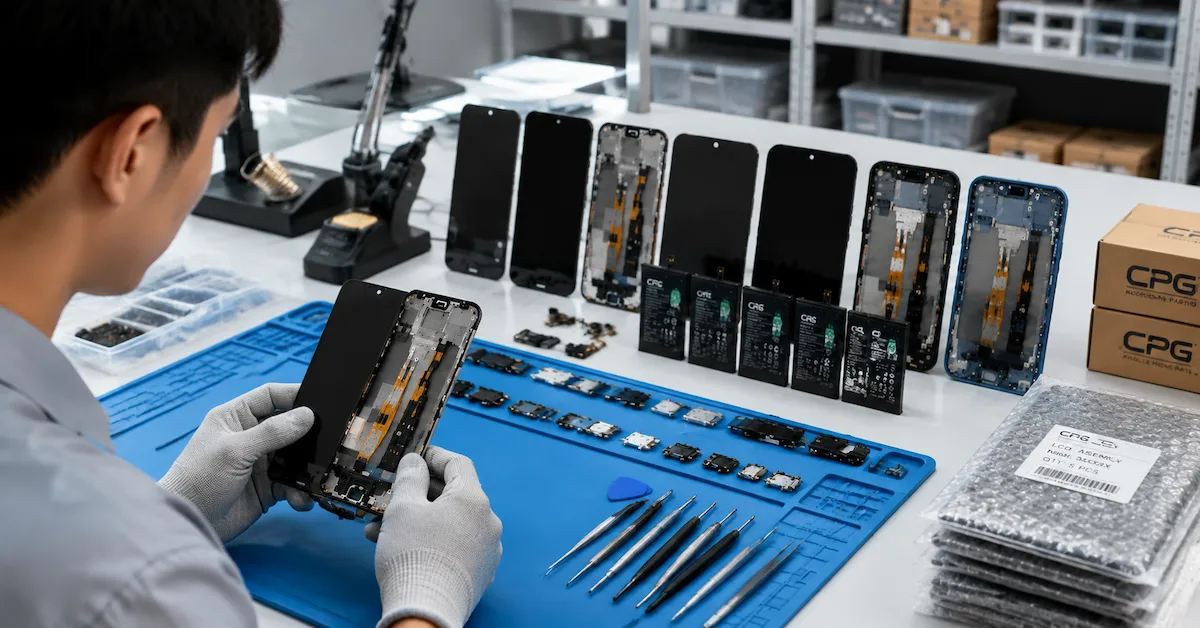

What Should a Refurbishment Factory Expect From a Phone Parts Supplier?
A refurbishment factory does not buy phone parts in the same way as an independent repair shop.
A repair shop may need a few popular replacement screens, batteries, or charging parts for daily customer repairs. A refurbishment factory usually processes larger quantities of used devices across many models, which makes compatibility, batch consistency, repeat-order control, installation efficiency, and rework risk much more important.
For this reason, choosing a phone parts supplier for refurbishment factory operations should start with one question:
Can this supplier repeatedly deliver parts that fit the factory’s actual production workflow?
That includes more than supplying products. It also involves:
-
Exact model matching
-
Stable product specifications
-
Sample validation
-
Repeat-order consistency
-
Clear SKU identification
-
Mixed-model purchasing
-
Flexible MOQ
-
Protective packaging
-
Defect handling
-
Efficient communication
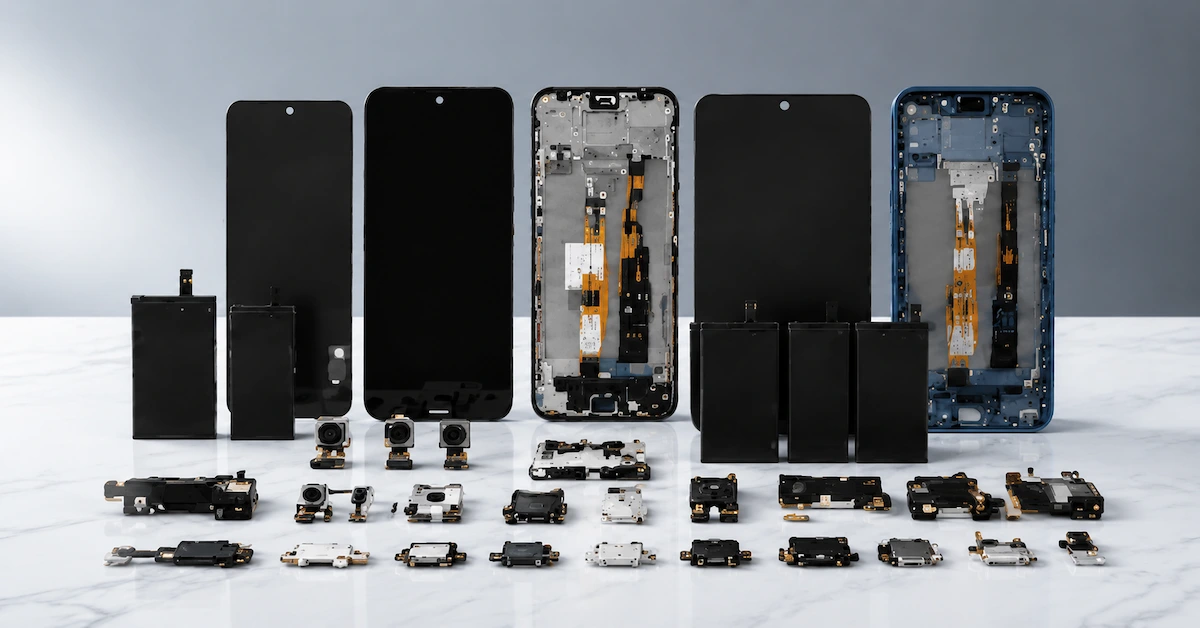
Factories sourcing replacement displays, batteries, charging parts, and other repair components can first review the available categories in the CPG product catalog.
Why the Lowest Unit Price Is Not Always the Lowest Production Cost
A low quotation can look attractive during purchasing, but refurbishment factories should evaluate the total cost created after the component enters production.
A useful way to think about sourcing cost is:
Accepted-unit cost = component cost + inspection cost + installation labor + rework cost + failed-part loss + production delay + return handling
A screen that costs slightly less but creates more fit problems may become more expensive than a higher-priced screen that installs consistently.
The same principle applies to:
-
Batteries
-
Charging ports
-
Charging flex assemblies
-
Cameras
-
Speakers
-
Button flex cables
-
Internal connectors
-
Other small repair parts
For a refurbishment factory, the objective should not simply be to reduce purchase price.
The objective should be to improve the number of successfully refurbished devices per production batch.
Exact Model Matching Should Come Before Price Negotiation
One of the most common sourcing risks in mobile phone refurbishment is ordering a part based only on the commercial model name.
A request such as:
Samsung replacement screen
does not provide enough information for reliable bulk sourcing.
A stronger RFQ should contain more detailed information.
Information Buyers Should Provide
Refurbishment factories should prepare:
-
Brand
-
Exact device model
-
Model number when available
-
Required component
-
Display technology where relevant
-
With-frame or without-frame configuration
-
Required quality level
-
Color if applicable
-
Quantity by SKU
-
Expected repeat demand
-
Destination market
Two smartphones may look almost identical externally while using different internal connectors, flex cables, frames, charging boards, or other components.
That is why model verification should be completed before the buyer compares prices.
Why Model Numbers Matter
Model numbers are particularly useful when factories process devices from different regions.
Regional or hardware variations can affect:
-
Connector position
-
Flex design
-
Frame configuration
-
Internal mounting points
-
Camera layout
-
Charging assemblies
-
Other internal parts
A professional purchasing database should therefore contain more than a simple description such as “iPhone screen” or “Samsung battery.”
Sample Approval Should Establish the Purchasing Standard
For refurbishment factories, a sample is not only something to inspect before ordering.
It should become a reference point for future purchasing.
Once a sample has been approved, the factory should record the specification that was accepted.
What to Check on Replacement Displays
Before bulk purchasing displays, buyers can evaluate:
-
Correct model compatibility
-
Display function
-
Touch response
-
Multi-touch behavior
-
Flex cable condition
-
Connector position
-
Physical dimensions
-
Frame alignment
-
Installation fit
-
Visual appearance
-
Packaging protection
With-Frame Samples
When testing a display with frame, technicians should pay particular attention to:
-
Frame dimensions
-
Screw and mounting positions
-
Button or speaker openings
-
Alignment with the housing
-
Installation efficiency
Without-Frame Samples
For displays without frame, the evaluation may also need to consider:
-
Separation process
-
Cleaning requirement
-
Positioning accuracy
-
Adhesive compatibility
-
Bonding or lamination process
-
Technician skill requirement
The better option depends on the factory’s production equipment and labor structure.
What to Check on Batteries
Battery sample evaluation may include:
-
Exact device compatibility
-
Connector design
-
Physical dimensions
-
Installation fit
-
Charging behavior
-
Device recognition where applicable
-
Packaging condition
Buyers looking for battery options can explore the broader CPG phone parts catalog before preparing a model list.
What to Check on Charging Parts
Charging parts require particularly careful identification.
A charging component may include:
-
Charging connector
-
Flex cable
-
PCB
-
Microphone
-
Antenna contacts
-
Other integrated functions
Therefore, confirming only that a connector is “USB-C” is not enough.
The complete assembly must match the target device.
Batch Consistency Matters More Than One Good Sample
A supplier can provide an excellent sample and still create problems later if bulk shipments change specification.
This makes batch consistency one of the most important criteria when selecting a phone parts supplier for refurbishment factory purchasing.
Potential batch differences may affect:
-
Display appearance
-
Touch response
-
Connector design
-
Flex cable layout
-
Frame fit
-
Adhesive position
-
Battery dimensions
-
Charging-board configuration
-
Small-part structure
The important question is not simply:
Was the first sample good?
The more useful question is:
Can future orders follow the same approved specification?
Create a Repeat-Order Reference
Factories can record:
-
Supplier SKU
-
Internal factory SKU
-
Device brand
-
Device model
-
Model number
-
Part description
-
Frame configuration
-
Approved quality level
-
Sample approval date
-
Packaging requirement
-
Previous purchase order reference
This creates a clearer communication system between purchasing, incoming QC, warehouse, and production teams.
QC Should Be Designed Around Refurbishment Risk
Quality control should not be treated as a generic statement such as “100% good quality.”
A refurbishment factory should define QC around the failure modes that create the greatest production cost.
Display QC
Important checks may include:
-
Correct model
-
Display output
-
Touch functionality
-
Dead-pixel inspection
-
Flex condition
-
Connector alignment
-
Frame dimensions
-
Mechanical fit
-
Physical damage
Battery QC
Potential checks include:
-
Model identification
-
Physical dimensions
-
Connector
-
Installation fit
-
Basic charging behavior
-
Packaging condition
Charging Component QC
Important points may include:
-
Exact device match
-
Flex layout
-
Connector position
-
PCB configuration
-
Integrated functions
-
Physical fit
Small-Part QC
For parts such as speakers, cameras, flex cables, and buttons, factories should focus on:
-
Correct model
-
Connector type
-
Contact position
-
Physical dimensions
-
Mounting position
-
Basic functional verification where practical
Use Risk-Based Incoming Inspection
Not every part needs the same inspection depth.
A refurbishment factory may benefit from grouping components according to production risk.
| Component | Typical Risk | QC Priority |
|---|---|---|
| Display assembly | High | Compatibility, touch, display, fit |
| Battery | High | Model, fit, connector, function |
| Charging assembly | High | PCB/flex layout, connector, function |
| Camera | Medium–High | Model, connector, mounting position |
| Speaker / Earpiece | Medium | Contacts, fit, function |
| Button Flex | Medium | Layout, connector, position |
| Simple Mechanical Parts | Lower | Dimensions, model, appearance |
This helps inspection teams spend more time on parts that can cause expensive rework or production interruption.
With Frame or Without Frame: Which Is Better for Refurbishment?
There is no universal answer.
The decision depends on the factory’s labor cost, technician skill, equipment, throughput target, and acceptable rework level.
Advantages of Displays With Frame
A with-frame assembly may offer:
-
Faster replacement
-
Fewer separation steps
-
Less adhesive cleaning
-
Easier positioning
-
Lower technician difficulty
-
More standardized workflow
This can be useful for refurbishment operations where throughput is more important than minimizing the purchase price of the individual screen.
Advantages of Displays Without Frame
Without-frame displays may suit factories that already have experienced technicians and appropriate equipment.
Potential benefits include:
-
Greater sourcing flexibility
-
Lower component cost in some cases
-
Reuse of suitable original frames
-
Better fit with established refurbishment workflows
However, these advantages depend heavily on the factory’s process control.
Compare Process Cost, Not Only Part Cost
A more useful comparison is:
| Factor | With Frame | Without Frame |
|---|---|---|
| Installation complexity | Lower | Higher |
| Technician skill | Moderate | Higher |
| Processing steps | Fewer | More |
| Component cost | Often higher | Often lower |
| Production speed | Usually faster | Process dependent |
| Equipment requirement | Lower | Higher |
| Rework sensitivity | Lower in many workflows | More process dependent |
The right choice is the option that produces the best total refurbishment result.
Mixed-SKU Sourcing Can Reduce Supplier Management
A refurbishment factory rarely handles only one smartphone brand.
A typical production mix may include:
-
Apple iPhone
-
Samsung Galaxy
-
Xiaomi
-
Redmi
-
Huawei
-
Honor
-
OPPO
-
Realme
-
Motorola
-
Tecno
-
Infinix
-
Other regional models
Each device may also require several types of repair parts.
Common Refurbishment Parts
These may include:
-
LCD assemblies
-
OLED displays
-
Touch digitizers
-
Batteries
-
Charging ports
-
Charging flex cables
-
Cameras
-
Speakers
-
Microphones
-
Button flex cables
-
Internal connectors
-
Other small parts
Managing a separate supplier for each category increases procurement complexity.
Factories may need to coordinate:
-
More quotations
-
More payments
-
More shipments
-
More supplier records
-
More quality standards
-
More after-sales communication
A broader sourcing platform can reduce some of this complexity.
CPG provides multiple mobile phone repair categories through its product range, which can be reviewed when preparing a mixed-model sourcing plan.
MOQ Should Match the Factory’s Model Mix
MOQ is particularly important for refurbishment operations because demand is rarely equal across every phone model.
A factory may require:
-
300 screens for one high-volume model
-
80 batteries for another device
-
20 charging flex assemblies for a long-tail model
-
Occasional cameras or speakers
-
Several hundred mixed parts across one shipment
This means buyers should ask more than:
What is your MOQ?
A more useful question is:
What MOQ applies to each product category and how flexible is mixed-SKU purchasing?
CPG's FAQ page indicates that LCD screens and batteries commonly have lower wholesale MOQ ranges, while certain accessory categories may require larger quantities. Sample or first-order quantities can also be discussed separately.
The exact MOQ should always be confirmed for the individual SKU.
Inventory Planning Should Follow Refurbishment Demand
Buying too many slow-moving parts creates inventory risk.
Buying too few high-turnover components can interrupt production.
Refurbishment factories can classify SKUs into:
High-Turnover SKUs
Usually require:
-
More frequent purchasing
-
Larger safety stock
-
Stable repeat specifications
-
Faster replenishment
Medium-Turnover SKUs
Require:
-
Controlled inventory
-
Moderate reorder frequency
-
Periodic demand review
Long-Tail SKUs
Often benefit from:
-
Smaller order quantities
-
Mixed-SKU sourcing
-
Lower inventory commitment
-
Purchase-on-demand planning
This is another reason flexible MOQ and broad model coverage can be valuable.
Packaging and Labeling Affect Factory Efficiency
Packaging does more than protect products during shipping.
It also influences:
-
Receiving
-
Warehouse identification
-
Picking
-
Line preparation
-
Inventory control
Useful Packaging Information
A refurbishment factory may want packages to clearly identify:
-
Brand
-
Model
-
Part type
-
Variant
-
Frame/no-frame configuration
-
Quantity
-
Internal SKU
-
Barcode where required
Packaging Protection
Displays need effective impact protection.
Small parts need packaging that prevents different models from being mixed.
Batteries require appropriate protection and handling suitable for the product and shipping method.
Customized packaging, labeling, or barcode requirements should be confirmed before bulk ordering.
It is also important to distinguish packaging customization from product engineering.
Custom packaging does not automatically mean electrical or structural ODM capability.
After-Sales Procedures Should Be Defined Before Ordering
Factories should discuss defect handling before the first large order.
Questions can include:
-
What evidence is required for a claim?
-
Are photos or videos needed?
-
Should the defective component be returned?
-
How are confirmed defects replaced or credited?
-
How are installation-related failures distinguished from incoming defects?
-
How is a wrong-model shipment handled?
-
How are repeated quality issues escalated?
A reliable supplier should not be evaluated only by whether defects ever occur.
A more practical question is:
How efficiently can both sides identify, document, and resolve a problem?
Build a Supplier Scorecard for Refurbishment Purchasing
A simple scorecard can help factories compare suppliers more objectively.
| Evaluation Area | What to Evaluate | Why It Matters |
|---|---|---|
| Model coverage | Breadth of recurring device models | Reduces supplier fragmentation |
| Compatibility control | Accuracy of model verification | Reduces wrong-part orders |
| Sample support | Ability to validate before volume orders | Reduces bulk risk |
| Batch consistency | Repeatability of approved specification | Protects production yield |
| Mixed-SKU sourcing | Ability to combine different models | Simplifies purchasing |
| MOQ flexibility | Quantities suitable for real demand | Reduces excess inventory |
| QC communication | Clear inspection expectations | Reduces quality disputes |
| Packaging | Protection and SKU identification | Improves warehouse efficiency |
| After-sales | Defect and replacement process | Reduces downtime |
| Communication | Technical clarity before ordering | Prevents avoidable errors |
Suppliers can then be scored according to the needs of the actual production line.
Which Refurbishment Factories Benefit Most From One-Stop Sourcing?
A broad phone parts supplier can be especially suitable for factories that:
-
Process multiple brands
-
Handle recurring batches
-
Require displays and batteries together
-
Purchase charging and small parts
-
Need mixed-SKU orders
-
Maintain internal QC teams
-
Need frequent replenishment
-
Want fewer supplier relationships
It may be less suitable to rely on general catalog information alone when the project requires:
-
Specific third-party certification
-
Official brand authorization
-
Battery cell engineering
-
Electrical redesign
-
Custom IC development
-
Structural component engineering
-
Special manufacturing specifications
These requirements should be confirmed individually.
How CPG Fits Refurbishment Factory Sourcing
CPG supplies multiple categories of mobile phone repair parts and related electronics aftermarket products for B2B buyers.
The available range includes areas such as:
-
Replacement displays
-
Mobile phone batteries
-
Charging-related components
-
Small repair parts
-
Accessories
-
Repair-related products
For refurbishment factories, this type of product coverage can help consolidate more requirements within one sourcing workflow.
Buyers can review the current CPG product catalog and learn more about the company's supply-chain positioning on the About Us page.
A broad catalog, however, should not replace detailed technical confirmation.
Every bulk order should still confirm:
-
Exact model
-
Required configuration
-
Sample standard
-
Quantity
-
MOQ
-
Packaging
-
Batch requirement
-
Delivery requirement
-
After-sales expectations
RFQ Checklist for a Refurbishment Factory
Before requesting a quotation, prepare a structured sourcing file.
Device Information
Include:
-
Brand
-
Exact model
-
Model number
-
Region if relevant
Part Information
Include:
-
Part name
-
Frame/no-frame requirement
-
Display type where relevant
-
Quality requirement
-
Color or variant
Commercial Information
Include:
-
Quantity per SKU
-
Estimated repeat demand
-
Target order schedule
-
Destination country
-
Shipping preference
Quality Information
Include:
-
Sample requirement
-
Inspection requirement
-
Packaging requirement
-
Label or barcode requirement
-
After-sales expectation
A structured RFQ makes it much easier for both buyer and supplier to identify compatibility issues before the order reaches production.
Factories with an existing model list can submit sourcing requirements through the CPG contact page.
Frequently Asked Questions
What is the most important factor when choosing a phone parts supplier for refurbishment factory operations?
Compatibility and repeatability are usually more important than the lowest unit price. The supplier should be able to support correct model matching, approved samples, stable repeat orders, practical MOQ, and clear after-sales handling.
Why is batch consistency important for refurbishment factories?
A refurbishment production line depends on repeatable processes. Changes in connector layout, frame fit, flex design, battery dimensions, or other specifications can increase technician time and rework.
Should refurbishment factories buy displays with frame?
With-frame displays can simplify installation and reduce processing steps. They are often useful when production speed and standardized installation are priorities.
When are displays without frame more suitable?
Without-frame displays may suit factories with skilled technicians, established screen separation processes, appropriate bonding equipment, and strong process control.
What should be tested before placing a bulk order?
Buyers should confirm model compatibility, physical fit, function, connector position, frame configuration, installation behavior, packaging, and any product-specific requirements.
Can different phone models be purchased in the same order?
Mixed-SKU sourcing can be useful for refurbishment factories processing many models. MOQ and mixed-order conditions should be confirmed with the supplier for each product category.
What phone parts do refurbishment factories commonly purchase?
Typical products include replacement displays, batteries, charging assemblies, cameras, speakers, microphones, flex cables, buttons, connectors, and other internal repair parts.
How should factories compare two suppliers with different prices?
Compare the total accepted-unit cost, including component cost, incoming inspection, technician labor, installation failures, rework, returns, and production interruptions.
Does customized packaging mean full ODM capability?
No. Customized boxes, labels, barcodes, or private-label packaging are different from electrical or structural product development. Engineering requirements should be confirmed separately.
What information should be included in a phone parts RFQ?
Include the brand, model, model number, required part, configuration, quantity, repeat demand, quality requirement, sample need, packaging requirement, destination country, and delivery expectations.
Conclusion
Choosing a reliable phone parts supplier for refurbishment factory operations requires more than comparing quotation prices. The strongest sourcing decisions focus on model compatibility, approved samples, repeat-order consistency, QC, mixed-SKU purchasing, practical MOQ, packaging, and after-sales procedures that help reduce rework and protect production efficiency.
You can review CPG's current phone parts range to identify suitable product categories. If you already have a refurbishment model list, quantities, sample requirements, or packaging specifications, contact CPG to discuss your sourcing requirements.