
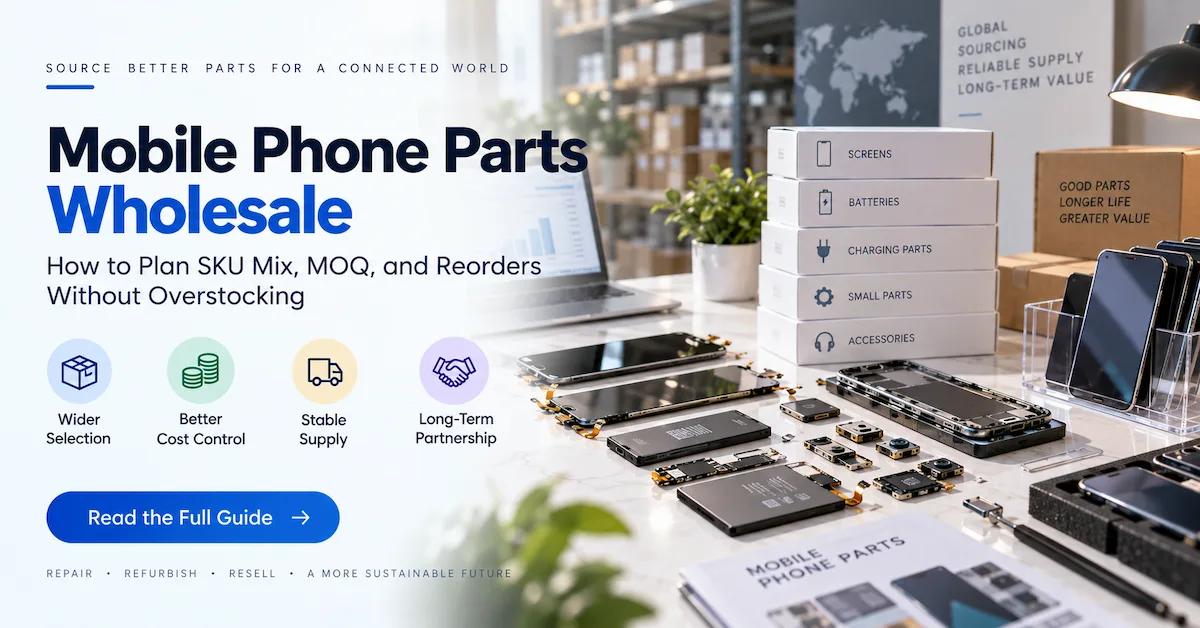
Mobile Phone Parts Wholesale Is an Inventory Decision, Not Just a Bulk Purchase
For professional buyers, mobile phone parts wholesale should not begin with a supplier price list.
It should begin with demand.
A distributor may manage hundreds of replacement-part SKUs. A repair chain may need frequent replenishment for popular phones but only occasional stock for older models. A refurbishment business may consume large quantities of screens and batteries while purchasing charging flexes, cameras, speakers, and other small parts in much smaller volumes.
If every SKU is purchased with the same logic, two problems appear quickly:
-
Fast-moving parts run out too often.
-
Slow-moving parts absorb cash and warehouse space.
The objective of wholesale purchasing should therefore be to build a stock structure that supports sales or repair operations without creating unnecessary inventory.
This article focuses on that purchasing problem.
If your main question is how to compare suppliers, quality systems, and service capabilities, see the existing mobile phone parts wholesale supplier guide. Here, the focus is what happens after you decide to buy wholesale: what to stock, how much to order, when to validate, and when to reorder.

Start With a Demand Map Before Building Your Wholesale Order
A large product catalog can be useful, but it should not determine your purchasing plan.
Your actual market should.
Before creating a mobile phone parts wholesale order, review your own:
-
Repair history
-
Distributor sales
-
Customer RFQs
-
Model requests
-
Return history
-
Current stock
-
Backorders
-
Repeat-order frequency
The goal is to understand which device models and component categories deserve inventory priority.
Divide SKUs Into A, B, and C Groups
A simple three-level structure can make hundreds of SKUs easier to manage.
| SKU Group | Demand Pattern | Typical Buying Approach | Main Risk |
|---|---|---|---|
| A | Fast and predictable | Higher stock, frequent replenishment | Stockout |
| B | Moderate or emerging | Controlled stock, regular review | Overestimating demand |
| C | Slow, irregular, or long-tail | Small quantities or order-on-demand | Dead stock |
This classification should be based on your own market rather than a universal list.
An iPhone model may be an A-level SKU for one distributor but a B- or C-level item in another country. The same applies to Samsung Galaxy, Xiaomi, Redmi, Huawei, Honor, OPPO, Realme, Tecno, Infinix, and other Android models.
Manage Demand at Model Level, Not Brand Level
“Samsung parts sell well” is not precise enough for inventory planning.
A better purchasing record identifies:
-
Brand
-
Exact model
-
Model number where relevant
-
Part category
-
Configuration
-
Monthly usage or sales
-
Current inventory
-
Open purchase orders
-
Historical return level
For displays, also distinguish details such as:
-
LCD or OLED configuration
-
With frame or without frame
-
Required quality level
-
Color where applicable
This prevents buyers from holding a large quantity of stock that looks diversified at brand level but does not match actual repair demand.
Build the Wholesale Basket Around Product Roles
Not every component plays the same role in a wholesale inventory.
Some products generate frequent replacement demand. Others complete repair jobs. Some help distributors increase basket size.
CPG's mobile phone parts catalog currently covers display repair parts across multiple smartphone brands as well as batteries, small parts, adapters and cables, protective products, accessories, and repair tools.
For purchasing purposes, these categories can be treated differently.
| Product Group | Typical Inventory Role | Main Buying Concern |
|---|---|---|
| LCD/OLED assemblies | Core repair inventory | Model accuracy and batch consistency |
| Batteries | Repeat replacement category | Compatibility and replenishment |
| Charging parts | Repair-completion inventory | Exact board/flex configuration |
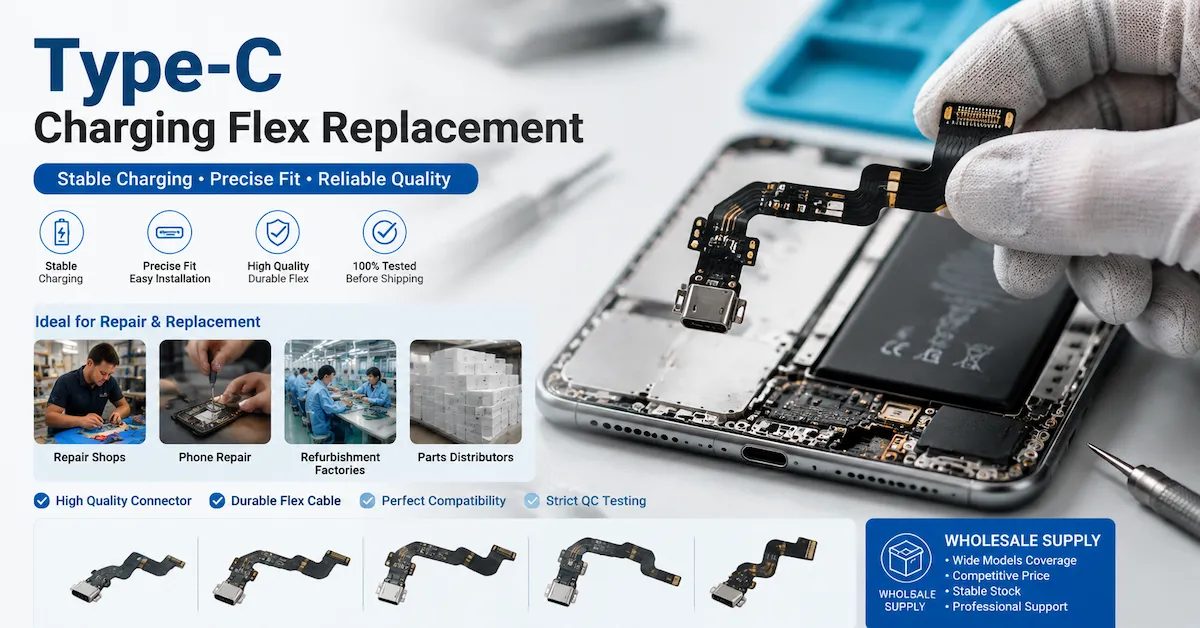
| Cameras/speakers/flexes | Supporting repair inventory | Long-tail SKU control |
| Cases/protectors/cables | Resale or cross-sell inventory | MOQ and assortment |
| Repair tools | Operational equipment | Function and technician need |
Displays Often Need the Tightest SKU Control
Replacement screens can involve multiple variables within the same phone family.
For example, a wholesale buyer sourcing iPhone repair parts should avoid treating every screen for a generation as one interchangeable SKU.
Important purchasing fields can include:
-
Exact device model
-
Display type
-
Frame configuration
-
Flex and connector configuration
-
Quality requirement
-
Color
-
Supplier SKU
-
Internal inventory SKU
The same principle applies to Android replacement displays.
Small Parts Need a Different Stocking Strategy
Charging flexes, speakers, cameras, microphones, button flexes, and internal components often create a much longer SKU tail.
Holding deep inventory across every model can be expensive.
For slow-moving repair parts, a buyer may choose to:
-
Keep small quantities of proven SKUs
-
Consolidate replenishment into mixed orders
-
Purchase only when customer demand appears
-
Increase quantity only after repeat usage is confirmed
This makes long-tail availability possible without treating every part as a high-volume item.
MOQ Should Follow Demand, Not the Discount Table
Minimum order quantity is an important wholesale variable, but buyers often evaluate it incorrectly.
The question should not only be:
What is the lowest MOQ?
It should be:
What quantity can we realistically sell or consume before this model becomes slow-moving?
CPG's current wholesale FAQ states that typical MOQ for many LCD screens and batteries is around 10–50 pieces, while accessories such as cases and cables can commonly be around 100–500 pieces. Exact MOQ varies by product, and sample or first-order quantities may be more flexible.
A Higher Quantity Is Not Automatically a Better Buy
A lower per-unit price can become expensive when excess inventory:
-
Remains unsold
-
Becomes less relevant as models age
-
Occupies warehouse space
-
Ties up purchasing capital
-
Requires markdowns
-
Becomes difficult to reorder consistently
For an unfamiliar SKU, a smaller initial order can provide more business information than a large discounted purchase.
Use MOQ Differently for Different SKU Groups
A practical approach is:
A-Level SKUs
Consider larger quantities when:
-
Demand is already demonstrated
-
The configuration is approved
-
Repeat replenishment is predictable
-
The inventory turns consistently
B-Level SKUs
Use moderate quantities and review sell-through before increasing stock.
C-Level SKUs
Keep quantities conservative unless a confirmed customer or project requires more.
This approach turns MOQ from a supplier condition into an inventory decision.
Use a Sample-to-Scale Purchasing Ladder
One of the most useful ways to reduce wholesale risk is to avoid jumping directly from quotation to a large order.
A better process is:
Sample → Trial Batch → Regular Bulk Order → Repeat Order
Each stage answers a different question.
| Stage | Main Question |
|---|---|
| Sample | Is the product compatible and acceptable? |
| Trial batch | Is the result consistent across multiple units? |
| Bulk order | Can the product support normal commercial demand? |
| Repeat order | Can the same specification be supplied again? |
Sample Stage
Sample validation should focus on characteristics relevant to the component.
For a display:
-
Model compatibility
-
Image function
-
Touch response
-
Flex and connector
-
Physical fit
-
Frame configuration
For a battery:
-
Model
-
Connector
-
Dimensions
-
Fit
-
Basic charging behavior
For charging parts:
-
Exact model
-
Board or flex layout
-
Connector position
-
Integrated functions
-
Physical fit
Trial-Batch Stage
A trial batch helps reveal issues that a single sample may not show.
Review:
-
Unit-to-unit consistency
-
Label accuracy
-
Packaging
-
Installation results
-
Defect patterns
-
Technician feedback
Only after this stage should buyers decide whether a SKU deserves regular wholesale inventory.
Build a SKU Master File Before Scaling Purchasing
As wholesale volume grows, informal descriptions become a serious source of error.
Descriptions such as:
iPhone screen
or:
Samsung charging board
are not suitable for a large purchasing operation.
Create a SKU master file with fields such as:
-
Internal SKU
-
Supplier SKU
-
Brand
-
Exact model
-
Model number
-
Product category
-
Technical configuration
-
Frame/no-frame
-
Quality level
-
Approved sample reference
-
MOQ
-
Last purchase price
-
Current stock
-
Average usage or sales
-
Reorder status
Why This Matters for Mixed-SKU Orders
A mixed mobile phone parts wholesale order can contain dozens or hundreds of line items.
Without controlled identifiers, it becomes easier to:
-
Order the wrong variation
-
Receive duplicate SKUs
-
Mix models in the warehouse
-
Reorder a different specification
-
Mislabel parts for customers
A well-maintained SKU master converts supplier communication into a repeatable business process.
Measure Accepted-Unit Cost, Not Only Purchase Price
Wholesale price matters, but it is only one part of purchasing cost.
A more useful concept is:
Accepted-unit cost = purchase cost + inspection cost + failed units + rework + return handling + operational disruption
This is particularly relevant for repair and refurbishment parts.
Suppose one screen has a lower quotation but causes more installation failures or compatibility disputes. A more expensive alternative may deliver a lower real cost if technicians can install it consistently.
The same logic applies to:
-
Batteries
-
Charging assemblies
-
Cameras
-
Speakers
-
Flex cables
-
Other replacement components
Add Return Data to Purchasing Decisions
Buyers should connect after-sales information back to the SKU master.
Useful fields include:
-
Quantity purchased
-
Quantity installed or sold
-
Number of complaints
-
Confirmed product defects
-
Compatibility errors
-
Installation-related damage
-
Credits or replacements received
This makes it easier to distinguish a cheap SKU from a profitable SKU.
Plan Reorders Before Inventory Reaches Zero
A wholesale inventory system should define when to reorder, not only how much to order.
At minimum, consider:
-
Average consumption
-
Supplier lead time
-
Shipping preparation
-
Demand volatility
-
MOQ
-
Existing purchase orders
-
Safety stock
A basic planning concept is:
Reorder point = expected demand during replenishment time + safety stock
You do not need a complicated forecasting system to improve purchasing discipline.
Even a simple weekly review of A-level SKUs can reduce emergency buying.
Fast-Moving Parts Need More Frequent Review
For high-turnover products, monitor:
-
Current stock
-
Weekly usage or sales
-
Incoming stock
-
Backorders
-
Expected customer demand
Slow-Moving Parts Need Less Stock, Not More Forecasting
Trying to forecast unpredictable long-tail demand with excessive precision can create false confidence.
For these products, smaller purchases and mixed-SKU replenishment may be more practical.
Use Mixed-SKU Purchasing to Balance Breadth and Inventory Risk
One of the main advantages of working across a broad product catalog is the ability to source multiple categories within a purchasing cycle.
A distributor might combine:
-
iPhone screens
-
Samsung screens
-
Xiaomi/Redmi displays
-
Phone batteries
-
Charging parts
-
Speakers
-
Cameras
-
Data cables
-
Screen protectors
The objective is not simply to create a larger order.
It is to improve SKU breadth without excessively increasing stock depth.
Breadth vs Depth
Wholesale buyers should distinguish:
SKU breadth
How many different models and product types you can supply.
SKU depth
How many pieces you hold of each item.
A distributor serving many repair shops may need broad coverage but only deep stock for the most active models.
That is often more efficient than buying large quantities of every available SKU.
Packaging and Labels Are Part of Wholesale Inventory Control
Good packaging protects products, but for wholesale operations it also helps manage information.
Useful labels can identify:
-
Brand
-
Model
-
Part type
-
Variation
-
Quantity
-
Internal SKU or barcode
This becomes increasingly important when:
-
Different models look similar
-
Several configurations share the same commercial phone name
-
Warehouse staff pick mixed orders
-
Distributors repackage products for downstream customers
Separate Packaging Customization From Product Engineering
Customized labels, cartons, barcodes, or promotional packaging do not automatically mean a supplier can change the electrical or structural design of a component.
If your project requires product-level ODM, battery engineering, IC changes, or structural modification, confirm that scope separately.
CPG's About Us page describes support for customized packaging and promotional materials, but specific engineering customization should still be verified for each project.
Create Different Buying Rules for Different B2B Customers
The ideal mobile phone parts wholesale strategy depends on who will use or resell the products.
Repair Shops and Repair Chains
Priorities often include:
-
Popular models
-
Rapid replenishment
-
Easy installation
-
Low wrong-model risk
-
Smaller mixed orders
These buyers may prefer fewer slow-moving SKUs and more frequent replenishment.
Parts Wholesalers and Distributors
They usually need:
-
Wider brand coverage
-
More model depth
-
Clear SKU identification
-
Predictable repeat orders
-
Consolidated shipping
Their challenge is balancing product availability against working capital.
Refurbishment Businesses
They may focus more heavily on:
-
Screens
-
Batteries
-
Charging components
-
Batch consistency
-
Accepted-unit cost
-
Production continuity
Their purchasing plan is closer to production planning than retail inventory.
E-Commerce Sellers
These buyers should pay particular attention to:
-
Accurate compatibility descriptions
-
Product variation control
-
Packaging
-
Returns
-
SKU labeling
A compatibility error can become both a product return and a customer-service cost.
What Should You Avoid Buying in Large Quantities First?
Bulk purchasing should be cautious when a SKU has one or more of these characteristics:
-
No previous sales or repair history
-
Unverified compatibility
-
Unapproved sample
-
Unclear quality specification
-
High model fragmentation
-
Uncertain customer demand
-
Frequent product revision
-
High historical return rate
-
Large MOQ relative to demand
A product can be attractive and still be a poor inventory decision.
Wholesale purchasing works best when quantity increases after uncertainty decreases.
A Practical 30-Day Wholesale Buying Workflow
A structured first purchasing cycle can look like this.
Week 1: Build the Demand List
Collect:
-
Top requested models
-
Existing shortages
-
Repair history
-
Customer RFQs
-
Current inventory
Then divide SKUs into A, B, and C groups.
Week 2: Confirm Specifications and Samples
Prepare RFQs with:
-
Exact model
-
Part category
-
Configuration
-
Quantity
-
Sample requirement
-
Packaging requirement
Compare technical fit before negotiating only on price.
Week 3: Test and Approve
Record sample results and define the approved specification.
Do not rely on memory or chat history as the only product reference.
Week 4: Place the First Structured Order
Build the order around:
-
Stronger quantities for proven A SKUs
-
Controlled quantities for B SKUs
-
Conservative quantities for C SKUs
-
Clear labels
-
Repeat-order references
After receiving the goods, compare the results with your original assumptions.
That feedback becomes the basis for the next order.
What Information Should a Wholesale RFQ Include?
A strong mobile phone parts wholesale RFQ should make it easy for both buyer and supplier to identify uncertainty before quoting.
Include:
Product Information
-
Brand
-
Model
-
Model number
-
Part name
-
Configuration
-
Quality requirement
Quantity Information
-
Sample quantity
-
First-order quantity
-
Expected repeat demand
-
Number of SKUs
Commercial Information
-
Destination country
-
Packaging requirement
-
Label or barcode requirement
-
Preferred shipping arrangement
Purchasing Context
Tell the supplier whether you are:
-
A repair chain
-
Distributor
-
Wholesaler
-
Refurbishment factory
-
E-commerce seller
This helps the supplier understand whether your main priority is small mixed orders, inventory breadth, production consistency, or repeat replenishment.
For specific MOQ, quotation, and product questions, buyers can review the CPG FAQ or send a structured model list through the contact page.
How CPG Fits a Multi-SKU Wholesale Purchasing Strategy
CPG's current product structure covers multiple smartphone display brands and broader repair and accessory categories, allowing B2B buyers to explore more than one product type through a single catalog.
This includes areas such as:
-
Smartphone display repair parts
-
Batteries
-
Small phone parts
-
Charging and cable products
-
Protective products
-
Repair tools and machines
-
Other electronics accessories
Buyers can start from the complete product catalog and narrow the sourcing list according to their market.
Businesses that also operate technical repair workshops can separately review repair tools and machines.
The value of a broad catalog is not that every SKU should be purchased.
The value is that buyers can build a product mix based on their own demand while reducing unnecessary supplier fragmentation.
Frequently Asked Questions About Mobile Phone Parts Wholesale
How should I start a mobile phone parts wholesale order?
Start with your own sales, repair, or customer-request data. Identify the most frequently requested models, classify SKUs by demand, confirm exact specifications, and validate unfamiliar products before ordering larger quantities.
What is a good MOQ for wholesale phone parts?
There is no universal ideal MOQ. The right quantity depends on demand, model turnover, product category, replenishment time, and inventory risk. CPG's FAQ notes that many LCD screens and batteries commonly use MOQ ranges around 10–50 pieces, while some accessory categories may use higher quantities.
Should I buy more pieces to get a lower wholesale price?
Only when expected demand justifies the inventory. A lower unit price can be offset by slow stock, markdowns, obsolete models, and tied-up working capital.
Can I combine different phone models in one wholesale order?
Mixed-SKU purchasing can be useful for distributors, repair chains, and other buyers that need broad model coverage. Confirm the MOQ and availability of each SKU before finalizing the order.
Which mobile phone parts should wholesalers keep in stock?
Prioritize parts with demonstrated demand. Frequently requested screens, batteries, and repair components may deserve regular inventory, while long-tail small parts may be better handled with lower quantities.
How can I avoid ordering the wrong phone part?
Use exact model numbers when available, specify the component and configuration clearly, maintain internal SKU records, and test samples before scaling an unfamiliar product.
How often should wholesale inventory be reordered?
Reorder frequency should reflect consumption, stock level, replenishment time, MOQ, incoming orders, and demand variability. Fast-moving SKUs should normally be reviewed more frequently than long-tail products.
What is the difference between wholesale price and accepted-unit cost?
Wholesale price is the amount paid for the component. Accepted-unit cost also considers inspection, defects, installation problems, rework, returns, and other operational costs associated with obtaining a usable part.
Should new SKUs be purchased in bulk immediately?
Usually not. For an unfamiliar part, a sample or smaller trial quantity provides information about compatibility, quality, customer demand, and repeatability before more capital is committed.
What should I send when requesting a wholesale quotation?
Provide the exact brand, model, model number where relevant, part type, required configuration, quantity per SKU, sample requirement, packaging needs, destination country, and expected repeat demand.
Conclusion
A successful mobile phone parts wholesale strategy is built around demand, not simply bulk discounts. Buyers who classify SKUs by turnover, validate new products before scaling, control model specifications, plan mixed-SKU orders, and use disciplined reorder rules can reduce both stockouts and unnecessary inventory.
Explore the CPG product catalog to build your initial sourcing list. If you already have models, quantities, SKU requirements, or a planned wholesale order, contact CPG for a tailored quotation and sourcing discussion.