
What Should You Expect From an OLED Display Replacement Supplier?
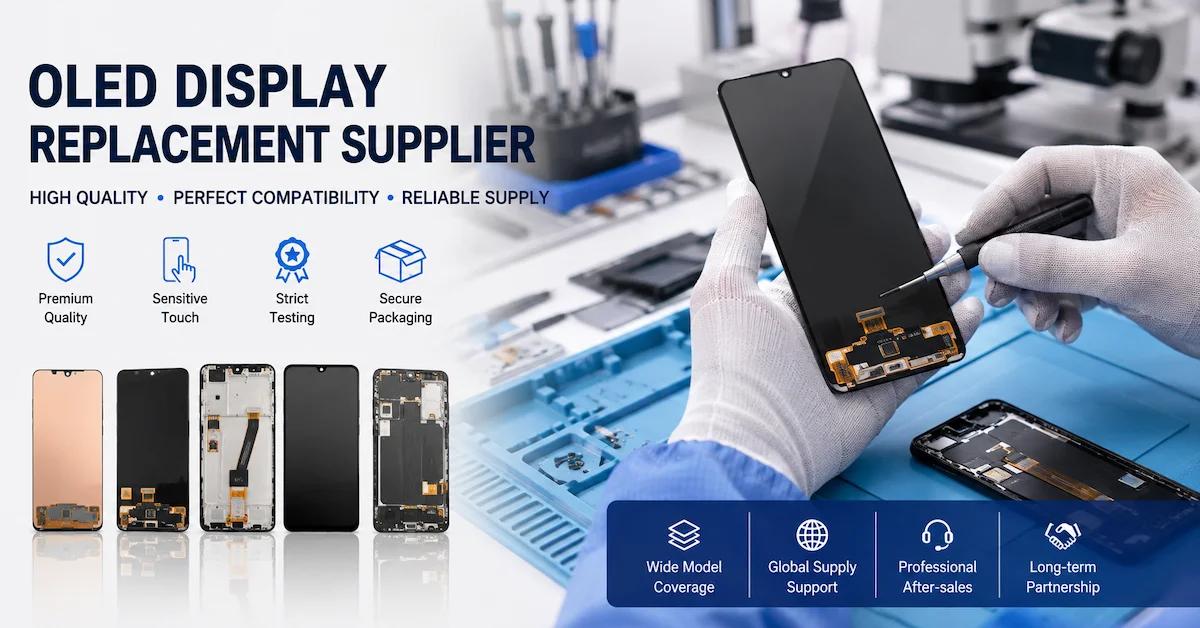
An OLED display replacement supplier provides replacement display solutions for smartphones whose original screens are damaged, broken, or no longer performing properly.
For B2B buyers, the real question is not simply whether a supplier has OLED screens in stock. The more important question is whether the supplier can consistently provide the right screen, for the right model, at the required quality level and quantity.
A practical supplier evaluation should cover:
- Exact model compatibility
- OLED display type
- Touch performance
- Flex and connector design
- Frame configuration
- Display consistency
- Packaging
- Wholesale availability
- Communication and after-sales support
This matters because a screen that looks correct in a product photo can still create problems during installation or testing.
For repair businesses, those problems can mean wasted technician time. For wholesalers, they can lead to returns. For refurbishment factories, inconsistent batches can interrupt production.
That is why OLED sourcing should be treated as a supply-chain decision rather than a simple product purchase.
For buyers looking for a broader range of replacement components, CPG provides a mobile phone repair parts portfolio covering display parts and other repair categories.
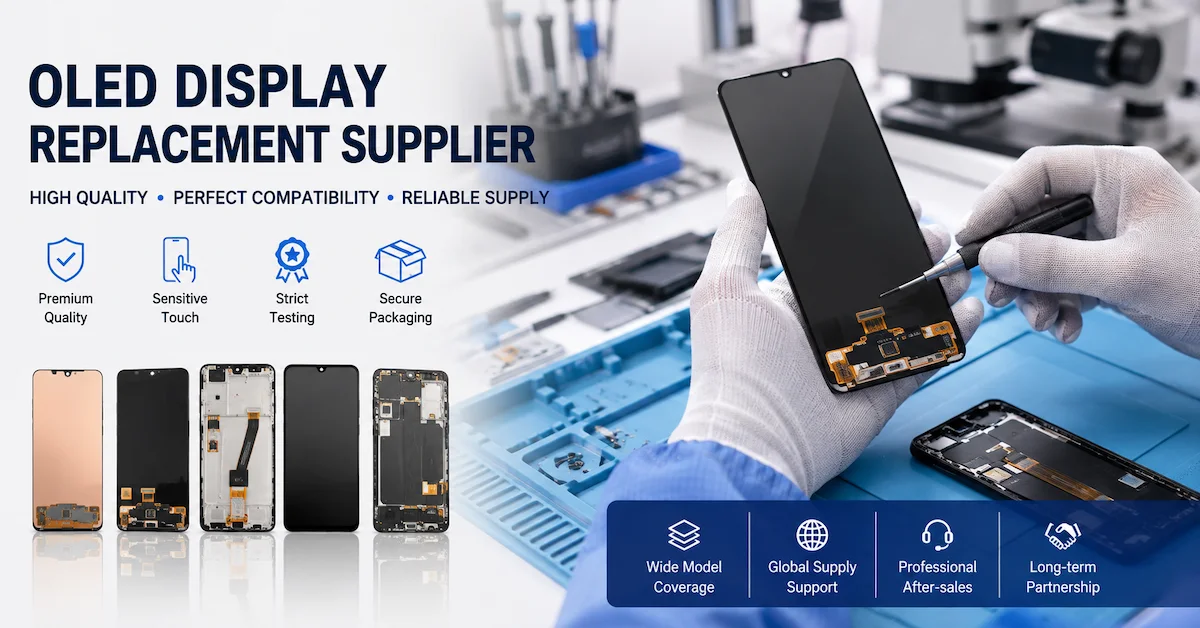
Quick Answer: How Do You Choose an OLED Display Replacement Supplier?
The best supplier is not necessarily the one offering the lowest unit price. A suitable OLED display replacement supplier should provide accurate model matching, consistent display performance, reliable supply, appropriate packaging, and responsive B2B support.
Before a bulk order, buyers should confirm five things:
- The exact phone model and display configuration
- OLED type and required quality level
- Touch and display testing procedures
- Sample approval before bulk purchasing
- Wholesale terms, packaging, delivery, and after-sales handling
For repeat buyers, batch consistency is just as important as the initial sample. A supplier becomes valuable when the same purchasing specification can be reproduced across future orders.
Why OLED Replacement Screens Need Careful Supplier Selection
OLED screens are widely used in smartphones because each pixel produces its own light. This allows OLED displays to deliver strong contrast, deep blacks, and slim display structures.
For repair buyers, however, the technology itself is only one part of the decision.
A replacement OLED must also work within the physical and electrical design of a particular smartphone.
A compatible replacement needs to match factors such as:
- Screen dimensions
- Connector position
- Flex cable configuration
- Touch interface
- Frame structure
- Installation method
Even when two screens have similar dimensions, they may not be interchangeable.
This is why a professional supplier should organize products by specific device models and configurations, rather than treating all OLED screens as interchangeable products.
What Types of OLED Replacement Displays Should Buyers Compare?
Not every OLED replacement product is intended for the same repair workflow.
OLED Display With Frame
A display assembly with frame combines the screen with a supporting housing structure.
This configuration can be useful for repair shops that prioritize installation speed.
Typical advantages include:
- Easier installation
- Less frame-transfer work
- Faster technician workflow
- Lower assembly complexity
It can be a practical choice when a repair center handles a high number of individual customer repairs.
OLED Display Without Frame
A frameless assembly leaves more of the installation process to the technician.
This option can suit:
- Refurbishment factories
- Experienced repair technicians
- High-volume repair operations
The main advantage is flexibility. Buyers with their own separation, bonding, or assembly processes may prefer this configuration.
The correct choice depends on the buyer's equipment, labor cost, and repair workflow rather than one option being universally better.
Flexible OLED Replacement Displays
Flexible OLED structures are particularly relevant to smartphones with curved or more complex display designs.
For B2B buyers, flexibility should not be treated as a marketing term alone.
The important questions are:
- Does the replacement match the original device structure?
- Is the flex positioned correctly?
- Does the display sit correctly during installation?
- Has touch performance been verified?
- Is the product suitable for the intended repair process?
These questions are more useful than simply comparing screen appearance.
What Should an OLED Display Replacement Supplier Test?
A reliable supplier should have a practical inspection process that covers both visible performance and functional details.
Display Testing
The display should be checked for:
- Image output
- Brightness consistency
- Color performance
- Visible defects
- Abnormal lines or areas
A screen that powers on is not automatically a screen that meets a buyer's quality requirements.
Touch Testing
Touch performance is equally important.
Testing can include:
- Touch sensitivity
- Touch response
- Multi-touch operation
- Edge-area response
For repair shops, inconsistent touch response can lead directly to customer complaints and repeat work.
Flex and Connector Inspection
The flex cable is a small component with a large impact on installation success.
Buyers should verify:
- Connector design
- Flex position
- Cable condition
- Contact integrity
Incorrect or damaged connectors can make an otherwise suitable display unusable.
Physical Inspection
The assembly should also be checked for:
- Frame alignment
- Glass condition
- Assembly dimensions
- Surface defects
- Protective packaging
This is especially important for international shipments where handling conditions can vary.
OLED Display Replacement Supplier Evaluation Checklist
| Evaluation Area | What B2B Buyers Should Check | Why It Matters |
|---|---|---|
| Model Compatibility | Exact model and revision | Prevents wrong-part orders |
| Display Quality | Brightness, color,image output | Protects repair quality |
| Touch Performance | Sensitivity and response | Reduces repeat repairs |
| Flex & Connector | Position and condition | Supports correct installation |
| Frame Option | With or without frame | Matches repair workflow |
| Sample Testing | Pre-order verification | Reduces bulk-order risk |
| Packaging | Individual and outer-carton protection | Reduces transit damage |
| Supply Stability | Repeat-order capability | Supports inventory planning |
| Communication | Fast and accurate response | Reduces sourcing errors |
| After-Sales Support | Clear issue-handling process | Controls replacement risk |
Which Buyers Need an OLED Display Replacement Supplier?
Different buyers have different priorities, so the supplier selection process should reflect the purchasing model.
Mobile Phone Repair Shops
Repair shops often purchase according to daily customer demand.
They typically care about:
- Popular phone models
- Fast replenishment
- Easy installation
- Stable touch performance
- Consistent quality
For this buyer group, a slightly more expensive display can still be the better commercial choice if it reduces installation time and repeat repairs.
Mobile Phone Parts Wholesalers
Wholesalers need broader model coverage because they are supplying multiple downstream repair businesses.
Their purchasing priorities often include:
- SKU range
- Wholesale pricing
- Stock availability
- Packaging
- Repeat-order consistency
A supplier that can support multiple repair categories can also simplify purchasing management.
CPG's current product catalog includes repair categories for Apple, Samsung, Huawei, Xiaomi, OPPO, Motorola, Tecno, Infinix, and other brands, as well as batteries, accessories, adapters, cables, and repair tools.
Refurbishment Factories
Refurbishment operations have a different cost structure.
They need to control:
- Labor time
- Component consistency
- Rework
- Yield
- Inventory
For these buyers, the question is often not “What is the cheapest OLED screen?” but:
Which supplier can give us a repeatable result across multiple batches?
That distinction becomes increasingly important as order volume grows.
Importers and Regional Distributors
Importers and distributors usually need:
- Export-ready packaging
- Clear product identification
- Stable supply
- Responsive communication
- Reliable order coordination
They also need accurate product information so that their own customers can select the correct replacement part.
How to Compare OLED Replacement Suppliers Before a Bulk Order
A simple comparison process can prevent many sourcing problems.
Step 1: Send a Specific Product List
Instead of asking for “OLED screens,” provide:
- Brand
- Exact model
- Quantity
- Frame requirement
- Required quality level
- Destination market
This allows the supplier to quote against a clear requirement.
Step 2: Request Samples
Samples should be tested on the actual repair workflow.
Check:
- Fit
- Display
- Touch
- Connector
- Installation time
Step 3: Approve a Purchasing Specification
Once a sample is accepted, record the important details.
For example:
| Specification | Buyer Requirement |
|---|---|
| Device Model | Exact model number |
| Display Type | OLED |
| Frame | Required / Not Required |
| Touch | Fully functional |
| Quantity | Confirmed batch size |
| Packaging | Individual protective packaging |
| QC | Pre-shipment inspection |
This makes future purchasing much easier.
Step 4: Evaluate Repeat Orders
A supplier should be judged over more than one shipment.
Track:
- Product consistency
- Delivery performance
- Packaging condition
- Defect handling
- Communication
OLED Display Replacement Supplier vs General Trading Source
Not every supplier operates in the same way.
| Factor | Specialized Display Supplier | General Trading Source |
|---|---|---|
| Display Knowledge | More focused | Varies |
| Model Matching | Usually more structured | Depends on sourcing process |
| Product Depth | Stronger in selected categories | Broader but less specialized |
| Technical Communication | More focused | May vary |
| Repeat Supply | Easier to evaluate | Depends on upstream factories |
| Buyer Support | More product-specific | Often transaction-focused |
The right choice depends on what the buyer needs.
For a repair shop buying a few common models, product availability and response speed may be the priority.
For a distributor or refurbishment factory, repeatability and supply management usually matter more.
How CPG Supports B2B Mobile Display Sourcing
CPG positions itself as a global mobile phone parts and accessories wholesale group and supply-chain partner. Its current website states that the group has nearly two decades of industry development, serves customers across global markets, and combines warehousing, technology systems, and a dedicated team for supply support.
Its product catalog covers a broad range of mobile repair categories, including display repair parts, batteries, small parts, charging-related products, accessories, and repair tools.
For buyers, that broader product structure can be useful when an OLED order is part of a larger repair-parts purchasing plan.
Explore the CPG mobile phone repair parts catalog for current product categories.
Supporting Different Phone Repair Parts Requirements
Display sourcing is rarely an isolated purchasing activity.
A repair shop may need OLED screens together with:
- Batteries
- Charging components
- Small repair parts
- Cables
- Protective accessories
- Repair tools
CPG's catalog currently includes these related categories, allowing buyers to review different repair-part requirements through one product platform.
For buyers also handling Huawei repair work, CPG maintains a dedicated Huawei LCD repair parts category.
What Makes a Long-Term OLED Supplier Valuable?
The value of a supplier becomes clearer after the first order.
A long-term B2B relationship should make future purchasing easier, not more complicated.
A good supplier relationship helps buyers establish:
Consistent Product Identification
Every repeat order should clearly identify the required model and configuration.
Predictable Quality
The supplier should maintain the agreed product specification across repeat shipments.
Efficient Communication
Questions about models, quantities, availability, and orders should be handled without unnecessary back-and-forth.
Better Inventory Planning
Reliable supply information allows wholesalers and repair businesses to plan replenishment instead of reacting to shortages.
Clear Problem Resolution
When a shipment has an issue, buyers need a defined way to report, verify, and resolve it.
Common Mistakes When Buying OLED Replacement Displays
Ordering by Phone Name Alone
A phone series can contain multiple models and revisions.
Always confirm the exact model number.
Comparing Only Unit Price
A cheaper display is not necessarily cheaper after labor, returns, and replacement costs are considered.
Skipping Sample Approval
Sample testing is particularly important when switching suppliers or introducing a new display model.
Mixing Different Quality Expectations
If a buyer does not define the expected quality level, different shipments may not meet the same commercial standard.
Forgetting the Repair Workflow
A screen with frame and a screen without frame may have very different labor implications.
The purchasing decision should reflect how the repair business actually works.
FAQ About OLED Display Replacement Suppliers
What is an OLED display replacement supplier?
An OLED display replacement supplier provides replacement OLED screens or display assemblies for damaged or non-functional smartphone displays, typically serving repair shops, wholesalers, distributors, and refurbishment businesses.
How do I choose an OLED display replacement supplier?
Compare model compatibility, display quality, touch performance, connector accuracy, packaging, supply stability, sample testing, and after-sales support rather than price alone.
Are all OLED replacement screens the same?
No. OLED replacement products can differ in display performance, assembly configuration, materials, touch behavior, and compatibility with specific phone models.
Should I choose an OLED screen with or without a frame?
It depends on your repair workflow. With-frame assemblies can simplify installation for repair shops, while without-frame options may suit experienced technicians and refurbishment operations with their own assembly processes.
What should I test before buying OLED screens in bulk?
Test the actual device model for display output, touch response, connector compatibility, physical fit, and installation performance before approving a large order.
What information should I send when requesting an OLED wholesale quotation?
Provide the exact phone model, quantity, display type, frame requirement, quality expectations, destination, and any packaging or purchasing requirements.
Can one supplier provide OLED screens and other repair parts?
Many B2B suppliers offer multiple repair categories. CPG's current catalog includes display parts as well as batteries, small parts, accessories, adapters, cables, and repair tools.
Why is batch consistency important for wholesalers?
Wholesalers resell products to multiple repair businesses. Inconsistent batches can increase returns, customer complaints, and inventory management costs.
How can refurbishment factories reduce OLED sourcing risk?
They should establish a clear product specification, approve samples, test actual installation results, monitor repeat batches, and maintain communication with the supplier.
How can I request OLED replacement display pricing from CPG?
Prepare your model list, quantities, frame requirements, and target market, then submit the information through the CPG contact page. CPG's website provides a quotation form for company, email, mobile, and purchasing inquiries.
Conclusion
Choosing an OLED display replacement supplier is a procurement decision that affects repair quality, labor efficiency, inventory, and customer satisfaction.
The strongest supplier relationships are built around more than price.
B2B buyers should look for:
- Accurate model compatibility
- Reliable OLED display performance
- Consistent touch function
- Suitable frame configurations
- Effective quality inspection
- Protective packaging
- Stable repeat supply
- Responsive communication
Repair shops can use these criteria to reduce failed installations.
Wholesalers can use them to control returns and maintain customer confidence.
Refurbishment factories can use them to build a more predictable production process.
For businesses sourcing OLED displays together with other mobile phone repair components, CPG provides a broader B2B product portfolio and global supply-chain support.
Explore the CPG product catalog or contact CPG for a wholesale quotation with your model list and purchasing requirements.