
What Should B2B Buyers Expect From a Phone Repair Parts Wholesaler?
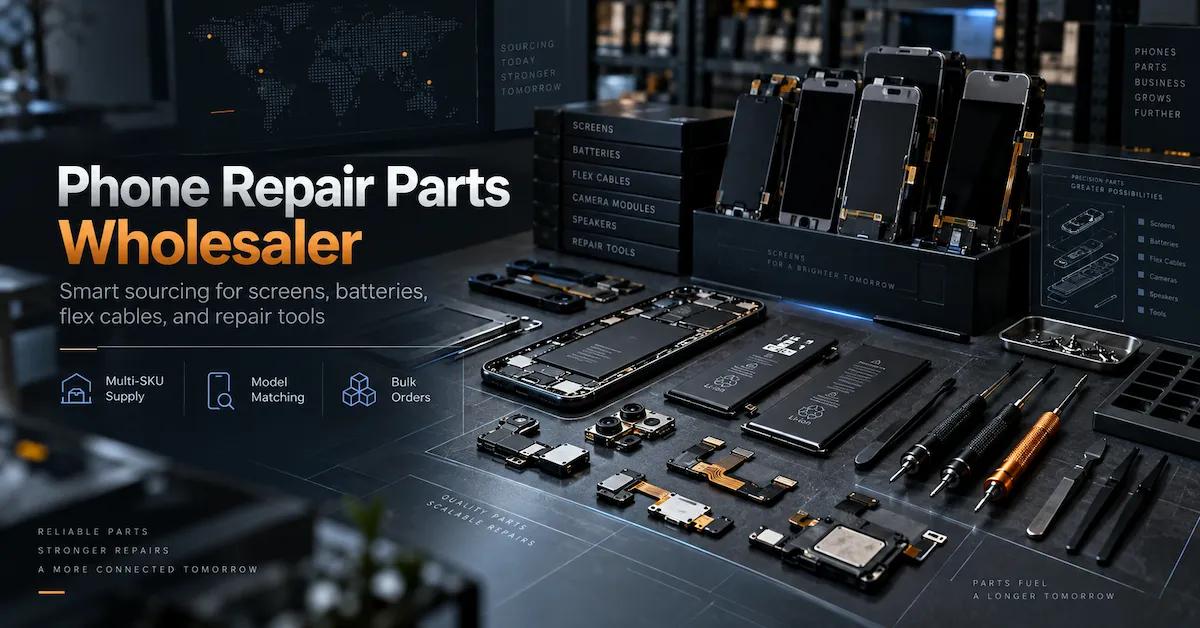
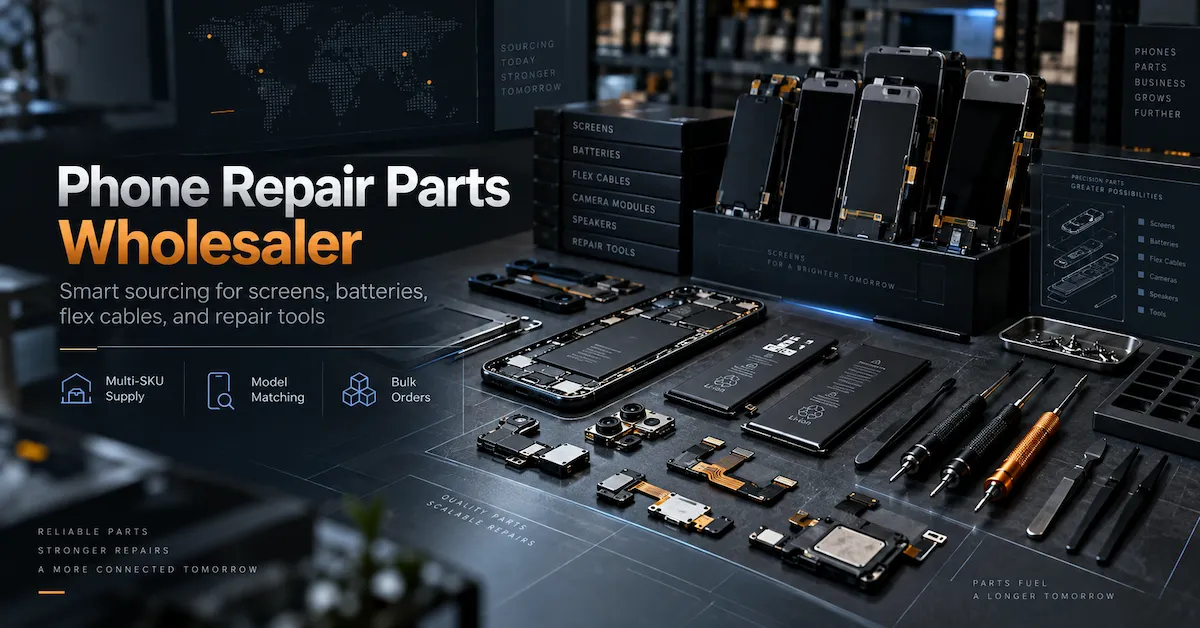
A professional phone repair parts wholesaler should make it easier for a buyer to identify the correct part, distinguish different configurations, organize multiple SKUs, approve samples, receive clearly labeled goods, and repeat the same specification later. Product range matters, but catalog size alone does not solve the biggest problems in phone-parts procurement: similar model names, different hardware versions, incomplete product descriptions, unclear assembly scope, and mixed shipments containing many visually similar components. CPG organizes mobile phone repair parts and accessories across display assemblies, batteries, internal replacement components, charging products, repair tools, protective accessories, and other product groups. For repair businesses and distributors, the purchasing objective should therefore be to convert this broad catalog into a controlled model-by-model procurement list rather than simply asking for “all popular phone parts.”
Which Buyers Benefit Most From a Multi-Category Phone Repair Parts Wholesaler?
Independent repair shops usually need replacement parts for the models appearing most frequently at their service counters, while repair chains need standardized descriptions that can be used across multiple branches. Regional distributors and importers often need hundreds of different line items and therefore care about SKU organization, packaging labels, model separation, replenishment, and communication efficiency. Refurbishment businesses may buy larger quantities of fewer device models but require repeatable configurations for a specific refurbishment batch. Online parts sellers need accurate titles and compatibility information because an unclear listing can create customer returns even when the physical product itself is functional. A multi-category phone repair parts wholesaler is especially useful when a buyer wants to consolidate displays, batteries, internal components, charging parts, and repair tools into a smaller number of purchasing conversations. However, businesses requiring original-brand authorization, a specific factory origin, or a particular certification should still request documentation for the exact product rather than assuming those conditions from the wholesaler’s general company positioning.
Build the RFQ Around Exact Device Identification
The first control point in wholesale phone-parts purchasing is the device itself. “Samsung screen,” “iPhone battery,” “Xiaomi charging port,” or “Motorola LCD” is not a complete purchasing specification. A useful RFQ should contain the commercial model name, model code where available, generation or year where relevant, regional or network version if it affects compatibility, and the required replacement-part configuration. Motorola is a good example because commercial names can coexist with XT model codes; Apple products may require generation and variant distinctions; Android models can also have similar names across different years or regions. CPG’s product catalog is organized by brands and series, but professional buyers should still preserve the exact device identity on their RFQ, quotation, purchase order, packing list, receiving record, and repeat-order file. The purchasing team should never reduce an approved SKU back to a broad family name once the technical team has already identified the exact version.
Separate Product Category, Assembly Scope, and Compatibility
One of the most important tasks when choosing a phone repair parts wholesaler is understanding exactly what the product title means. A display assembly may be supplied with a frame or without a frame. A charging replacement may be a socket, flex cable, or populated board. A battery may have a particular connector layout or software-dependent behavior. A camera, loudspeaker, earpiece, charging flex, or other internal component may look similar across related phone models but still require model-specific confirmation. CPG’s mobile phone accessories category includes internal repair components rather than only consumer accessories, while separate catalog groups cover items such as batteries, screens, chargers, protective products, and repair tools. Buyers should therefore define three fields independently: what category the item belongs to, what components are included in the supplied assembly, and which exact device version has been approved for compatibility. Keeping these three fields separate makes quotations and repeat orders much easier to audit.
Use a Standard Specification Sheet for Every Repair Part
A standardized specification sheet prevents procurement staff from relying on product names alone and gives a phone repair parts wholesaler a consistent format for confirming requirements. The fields will vary by category, but the same basic purchasing structure can be applied to screens, batteries, flex cables, speakers, cameras, connectors, and other internal parts.
| Specification Field | What the Buyer Should Record | Why It Matters |
|---|---|---|
| Device brand | Apple, Samsung, Xiaomi, Huawei, Motorola, etc. | Establishes the product family |
| Exact model | Full commercial model name | Prevents broad-family ordering |
| Model code/version | Hardware code, generation, region or relevant variant | Distinguishes similar devices |
| Part category | Screen, battery, flex cable, camera, speaker, etc. | Clarifies the required repair component |
| Assembly scope | What is included and excluded | Avoids misunderstanding of product titles |
| Configuration | Frame/no frame, board/flex/socket, or other option | Defines the actual product form |
| Supplier SKU | Exact quoted product reference | Creates repeat-order traceability |
| Key specifications | Dimensions, capacity, connector, resolution, interface or other relevant data | Supports technical comparison |
| Sample reference | Approved sample or batch reference where applicable | Connects bulk supply to qualification |
| Packaging | Individual pack, labeling and carton arrangement | Supports warehouse control |
| Quantity | Required amount per exact SKU | Prevents mixed-model quantity confusion |
| Open questions | Items still requiring supplier confirmation | Prevents assumptions from becoming specifications |
Evaluate Screens by Configuration, Not by the Word “LCD” Alone
Phone-screen sourcing deserves particular attention because product category names do not always provide enough technical detail. Many industry catalogs use terms such as “LCD repair parts” as broad navigation labels, but a buyer should still confirm the actual panel technology and configuration of the specific SKU being purchased. The key questions normally include the exact device model, frame or no-frame configuration, display and touch assembly scope, connector and flex layout, dimensions, visible structure, and any available product-grade definition. CPG organizes display products by brands including Xiaomi, Apple, Samsung, Tecno, Infinix, Honor, OPPO, Huawei, Motorola, and other brands through its repair-parts catalog. Buyers should treat the category as the beginning of product discovery, not as a complete technical specification. A screen approved for one device version should not automatically become an approved substitute for another variant simply because both appear under the same series.
Evaluate Replacement Batteries as a Separate Product Family
Battery procurement introduces a different set of controls from display sourcing. Buyers should confirm the intended phone model, supplier reference, stated capacity, physical shape, flex and connector position, label identification, packaging, and any special device-recognition behavior. CPG maintains a dedicated mobile phone battery category, so distributors can source batteries alongside other repair components, but each battery should still be qualified separately. If a supplier describes a product with terms such as high capacity, original quality, no pop-up, or similar commercial language, convert those terms into measurable or documentable questions before approval. Ask what the capacity figure represents, which phone model has been tested, what software conditions apply if device recognition is involved, and what information will remain consistent in later orders. Battery approval should be recorded independently from screen or flex-cable approval because the technical risks and receiving checks are different.
Treat Charging Flexes, Cameras, Speakers, and Small Parts as Model-Specific Components
Small repair components are easy to underestimate because their purchase prices may be lower than display assemblies or batteries, yet a wrong charging flex or camera can still stop a repair from being completed. Buyers should therefore require the same disciplined model identification for internal parts as they do for expensive components. Compare connector position, circuit outline, mounting points, flex routing, installed subcomponents, and any function carried by the assembly. For charging parts, clarify whether the item is a socket, flex assembly, or board; for speakers or earpieces, confirm the exact device and physical arrangement; for camera replacements, distinguish front, rear, and multi-camera assemblies. A phone repair parts wholesaler can reduce sourcing complexity by placing these products in one catalog, but only a clear line-by-line RFQ prevents similar-looking items from being treated as interchangeable.
Compare Product Groups by Their Main Procurement Risk
A useful way to evaluate a wholesaler is not simply to ask which categories it sells, but to identify the major sourcing risk for each category and confirm whether the purchasing process addresses that risk.
| Product Group | Main Procurement Risk | Recommended Buyer Check | Best Order-Control Record |
|---|---|---|---|
| Display assemblies | Wrong model or wrong frame/configuration | Model code, assembly scope, frame status, connectors | Approved SKU + photos + sample |
| Batteries | Incorrect model, connector or claimed specification | Model, dimensions, capacity data, connector, functional check | SKU + label + sample record |
| Charging flexes | Similar-looking but incompatible layouts | Device code, flex routing, board layout, included components | Photos + exact supplier SKU |
| Cameras | Front/rear/module variation | Module position, connector, device model | Model-specific photo record |
| Speakers/earpieces | Physical-fit differences | Shape, contacts, mounting points | SKU + device reference |
| Repair tools | Tool/module compatibility | Supported task and compatible device/module | Equipment list + compatibility reference |
| Chargers/cables | Interface and output differences | Plug, connector, stated output and cable function | Product specification sheet |
| Protective products | Model and size variation | Exact device model, material/type, packaging | SKU + packaging reference |
Approve Samples Against a Written Acceptance Plan
Sample approval is most useful when the buyer decides in advance what will be checked. For a screen, that may include physical fit, display behavior, touch response, connectors, frame configuration, and visible condition. For a battery, the buyer may record fit, connector condition, charging behavior, device recognition, and any agreed specification. For a flex cable or camera, fit and function may be the main concerns. The sample record should include the supplier SKU, phone model, date, photographs, test device, relevant accessories or software conditions, and the technical reviewer’s result. The purpose is not to create an unnecessarily complicated laboratory report for every low-value part; the purpose is to ensure that the bulk purchase can be compared with something more precise than “the sample was good.” A professional phone repair parts wholesaler should be able to connect the quotation and later order to a clearly identified product reference.
Ask What “QC Tested” Actually Means
Quality-control claims should be converted into specific questions. “100% tested,” “strict QC,” and “premium quality” may sound reassuring, but a purchasing team needs to know what the test covers. Appearance inspection, connector inspection, power-on testing, screen-function testing, battery measurement, charging verification, and installed-device functional testing are different activities. Ask which checks apply to the exact SKU, whether they are performed on every piece or by sampling, what the rejection criteria are, and whether any batch or inspection reference is available. CPG’s About Us describes the company’s development as a multi-brand parts and accessories supply-chain business and mentions quality-control development, but buyers should still obtain product-specific clarification for important orders. The most credible purchasing record connects a QC statement to a defined product, inspection scope, and order rather than treating a company-wide quality statement as evidence for every individual SKU.
Check Documents at the Product Level
Documents should be reviewed for relevance, not collected simply because they look official. If your market, customer, freight provider, or internal policy requires particular safety, material, transport, or compliance documentation, ask whether that document applies to the exact product being purchased and whether it remains valid. A distributor authorization for a repair-tool brand does not automatically establish the quality of a replacement phone screen; a company document does not automatically certify every battery; a packaging statement does not prove electrical performance. This distinction is especially important when one wholesaler sells multiple product categories from different manufacturing or supply-chain sources. Record document name, issuer, scope, applicable product, date, and version so the purchasing team can understand what each document actually supports.
Use Mixed-SKU Purchasing to Reduce Administration, Not Technical Control
One reason buyers search for a phone repair parts wholesaler is the possibility of consolidating many repair categories into one order. This can reduce communication, purchasing paperwork, and shipment coordination, but it should not reduce model-level control. Build the mixed order in product families, then keep one line for every exact SKU. For example, screens can be grouped together for purchasing review, batteries in another section, small internal components in another, and tools or accessories separately. Each line should still contain the specific model, configuration, quantity, supplier reference, packaging requirement, and unresolved questions. Use the CPG products page to identify relevant categories, but do not add a product to the purchase order until its actual specification has been confirmed. Consolidation works best after technical qualification, not instead of it.
Compare a Multi-Category Wholesaler With Other Procurement Routes
No single sourcing route is best for every purchase. Buyers should compare the route with the problem they are trying to solve.
| Procurement Route | Main Advantage | Main Limitation | Best Fit |
|---|---|---|---|
| Multi-category phone repair parts wholesaler | Can consolidate multiple categories and brands | Requires disciplined SKU management across a broad catalog | Distributors, repair chains, mixed-order buyers |
| Single-category specialist source | Deep focus on one product family | More suppliers may be required for a complete repair-parts program | Buyers with high volume in one category |
| Local emergency supplier | Fast access for urgent repairs | Limited range or higher acquisition cost may apply | Urgent low-volume requirements |
| Direct manufacturing project | Potential for deeper specification control when volume justifies development | Higher project complexity, MOQ and qualification may apply | Large-volume custom programs |
The most efficient strategy may combine these routes. A distributor could use a multi-category wholesaler for regular mixed orders while maintaining separate sources for highly specialized or custom products. Supplier structure should serve the purchasing model rather than forcing every product into one sourcing method.
Evaluate MOQ at SKU Level, Not Only at Order Level
MOQ is especially important in mixed phone-parts orders because one shipment can contain many models. CPG’s FAQ indicates that typical minimum quantities vary by product type, with many screens and batteries commonly listed around 10–50 pieces and cases or cables often around 100–500 pieces, while first orders or samples may be negotiable. These figures are general website guidance rather than fixed terms for every SKU. Ask whether MOQ applies per model, per configuration, per product family, or per total order. Also separate MOQ from stock quantity: a product can meet the commercial minimum but still require replenishment before shipment. When planning an assortment, buyers should identify fast-moving models, slower-moving models, sample quantities, and potential reorder frequency instead of distributing the same purchase quantity across every SKU.
Separate Stock Availability, Lead Time, and Transit Time
A wholesaler saying that an item is “available” does not necessarily mean that every line in a mixed order can leave immediately. For purchasing control, record three separate dates: when the supplier expects the products to be ready, when the goods are expected to be dispatched, and the estimated transit period after carrier pickup. For a mixed order, ask which SKUs are available now and which require replenishment. If partial shipment is possible, compare the operational benefit with the added logistics cost. CPG provides a price-list and support page, but pricing, stock, preparation time, and delivery conditions should still be confirmed for the actual order because repair-parts catalogs change by model and availability.
Include Packaging and Warehouse Identification in the Specification
For a distributor, a correct component in an unclear package can still become an operational problem. Similar flex cables, batteries, and display assemblies need labels that purchasing and warehouse staff can interpret. Define the supplier SKU, model name, quantity per inner pack, carton identification, and any barcode or customer label requirement before shipment. Protect delicate connectors, flex circuits, screens, and batteries according to the specific product. When multiple SKUs share a carton, request a packing list that allows the receiving team to reconcile contents without opening every package blindly. CPG’s company information mentions customized packaging and promotional-material support, so resellers interested in private-label presentation can discuss applicable options, but packaging customization should remain separate from technical product approval. (About CPG)
Do Not Confuse Private Label With Product Engineering
A distributor may want branded boxes, labels, stickers, product cards, or localized promotional materials. These requests are different from changing a battery specification, screen panel, flex-cable layout, or electrical component. If packaging customization is required, approve the artwork and labeling as one project. If the product itself must change, create a separate technical specification, feasibility review, sample, and approval. CPG’s company profile describes customized packaging and marketing support, but buyers should confirm availability for the selected product and order quantity rather than assuming every SKU automatically supports the same private-label program. This separation is important because a visually customized package does not prove that the underlying component was technically redesigned.
Calculate the Cost of Usable Parts, Not Just Purchase Price
The most useful supplier comparison is not always the lowest price per piece. A buyer can calculate an internal usable-part cost by dividing total purchasing and handling cost by the quantity accepted for use. Depending on the operation, relevant costs may include product price, freight allocation, receiving inspection, confirmed model errors, documented product failures, sorting, claim administration, and rework directly related to the purchased component. Keep the causes separated. A part ordered under the wrong model by the buyer is different from the wrong item being shipped; transport damage is different from a functional failure; installation damage is different from a supplier defect. This distinction allows a purchasing team to improve both supplier performance and its own ordering process instead of hiding every problem inside a single return-rate number.
Make Repeat Orders Easier to Control Than First Orders
The first order establishes a specification; repeat orders test whether that specification can be maintained. Retain the approved SKU, technical description, sample photographs, packaging, label, quotation, purchase order, and any acceptance notes. When reordering, ask whether the product configuration has changed. This is particularly important for replacement parts because suppliers may update sourcing, packaging, subcomponents, or versions while retaining a similar commercial name. A phone repair parts wholesaler should help the purchasing team identify the item being supplied, but the buyer should also maintain its own approved-product record. Repeat-order consistency becomes especially valuable for distributors and repair chains that need technicians in different locations to receive the same configuration under the same internal part number.
Prepare a Quote-Ready Mixed Repair Parts List for CPG
A strong RFQ should allow the supplier to begin model matching immediately. Create one line per item with brand, complete device model, model code where relevant, required component, configuration, quantity, destination, packaging requirement, sample requirement, and any technical uncertainty that needs confirmation. Separate screens, batteries, charging flexes, cameras, speakers, tools, and accessories into logical groups without combining different SKUs under a single description. Buyers can review the CPG product catalog, check the support and price-list page, and then submit the final model list through the contact page. This approach gives both sides a clearer starting point than asking a wholesaler to quote “100 mixed popular phone parts” without specifying which devices and configurations are actually needed.
Frequently Asked Questions
1. What Should I Check Before Choosing a Phone Repair Parts Wholesaler?
Check whether the supplier can identify exact device models, describe assembly scope clearly, organize mixed SKUs, provide samples where needed, explain the applicable QC process, confirm packaging, and give product-specific commercial terms. A large catalog is useful only when the purchasing process can control the individual items inside it.
2. Is a Multi-Category Wholesaler Better Than Buying From Several Specialists?
Not always. A multi-category wholesaler can reduce administrative and logistics complexity, while a specialist may offer deeper focus within one product family. Distributors and repair chains often benefit from combining both approaches according to volume, technical complexity, and replenishment needs.
3. Can I Order Screens, Batteries, and Small Parts Together?
A mixed order may be possible, but each SKU should remain a separate line with its own model, configuration, quantity, and supplier reference. Confirm MOQ, stock, packaging, and shipment conditions for each category rather than treating the mixed order as one generic product.
4. How Do I Avoid Ordering the Wrong Phone Part?
Use the complete commercial model, model code where available, photographs when necessary, and the exact supplier SKU. For products with multiple configurations, add details such as frame/no frame, board/flex assembly, connector position, or relevant hardware version.
5. Should I Always Request a Sample?
Samples are especially useful for new models, unfamiliar configurations, high-volume orders, or products with special functional requirements. The important point is to define what the sample must demonstrate and retain its identification so the bulk order can refer back to it.
6. What MOQ Should I Expect From CPG?
CPG’s FAQ gives general guidance that many screens and batteries commonly have MOQ ranges around 10–50 pieces, while some cases and cables may be around 100–500 pieces. Exact MOQ should be confirmed for the selected SKU, and sample or first-order quantities may require separate discussion.
7. How Should I Compare Two Repair-Parts Quotations?
First make sure both quotations represent the same device model, configuration, assembly scope, packaging, quantity, and quality requirement. Only then compare unit price, freight, order handling, sample approval, claim process, and the total cost of accepted usable parts.
8. Can I Request Private-Label Packaging?
CPG’s company information describes customized packaging and promotional-material support. Confirm feasibility, MOQ, artwork requirements, labeling, and additional cost for the selected product. Do not assume that packaging customization automatically includes technical modification of the component.
9. What Information Should I Keep for Repeat Orders?
Keep the supplier SKU, device compatibility, product photos, approved configuration, packaging, label details, sample reference, purchase order, and any receiving or test notes. Ask whether the product has changed before approving a repeat shipment.
10. How Do I Request a Wholesale Quote From CPG?
Prepare a model-by-model list containing the required part, configuration, quantity, destination, sample requirement, and packaging needs, then send it through the CPG contact page. A structured list allows the supplier to identify products and unresolved compatibility questions more accurately.
Conclusion
Choosing a phone repair parts wholesaler is ultimately a question of purchasing control, not just product range. Repair shops need correct model matching, distributors need organized mixed-SKU supply, importers need clear order and shipping information, and refurbishers need repeatable approved configurations. A strong sourcing process therefore moves from exact device identification to specification confirmation, sample approval where necessary, defined QC evidence, SKU-level MOQ and availability checks, clear packaging, and repeat-order traceability. CPG provides multiple repair-parts and accessory categories through its product catalog, allowing buyers to discuss screens, batteries, internal components, charging parts, tools, and related products within one sourcing framework. If you are preparing a bulk purchase, contact CPG with a model-by-model list, quantities, required configurations, destination, and sample or packaging requirements so each item can be confirmed before the order is finalized.

