
What Buyers Should Check Before Ordering a Huawei LCD Assembly for Repair
A Huawei LCD assembly for repair should restore more than a visible image. For a professional repair shop or refurbishment business, the replacement also needs correct touch response, connector alignment, flex-cable compatibility, housing fit, and consistent performance after installation.
The first purchasing mistake is often assuming that every Huawei replacement screen described as an “LCD assembly” uses the same display technology.
It does not.
Different Huawei phones and tablets may use LCD or OLED display technology depending on the exact model and generation. A buyer should therefore verify the device model and required display type before comparing price or placing a bulk order.
CPG currently organizes its Huawei LCD repair parts separately within its broader mobile phone parts catalog, while its main product structure also identifies Huawei Y, P, Mate, and Nova series categories.
For B2B buyers, the goal is not simply to purchase a screen that “looks compatible.” It is to reduce installation failures, returns, technician rework, and inventory mistakes.
What Is a Huawei LCD Assembly?
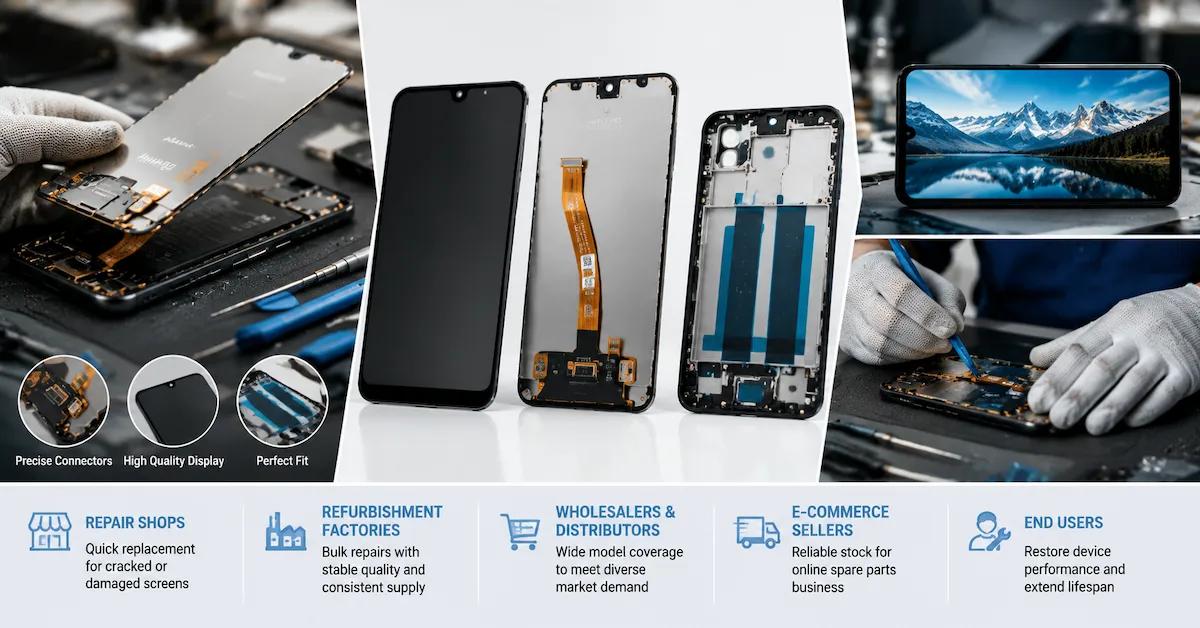
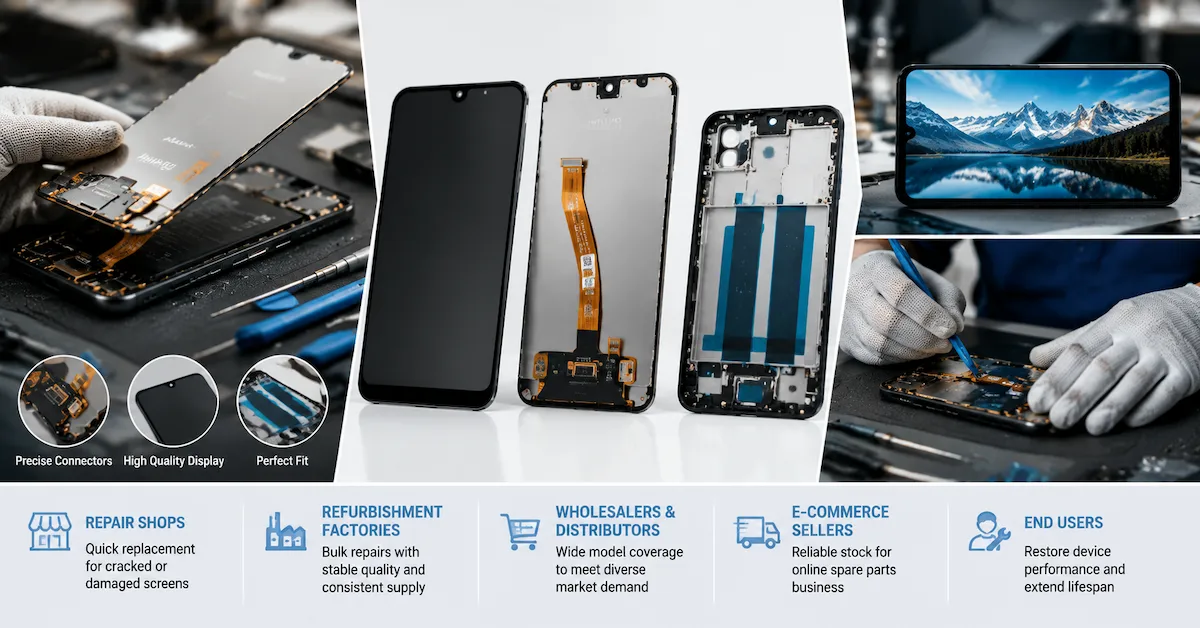
A display assembly normally combines several screen-related components into one replacement module.
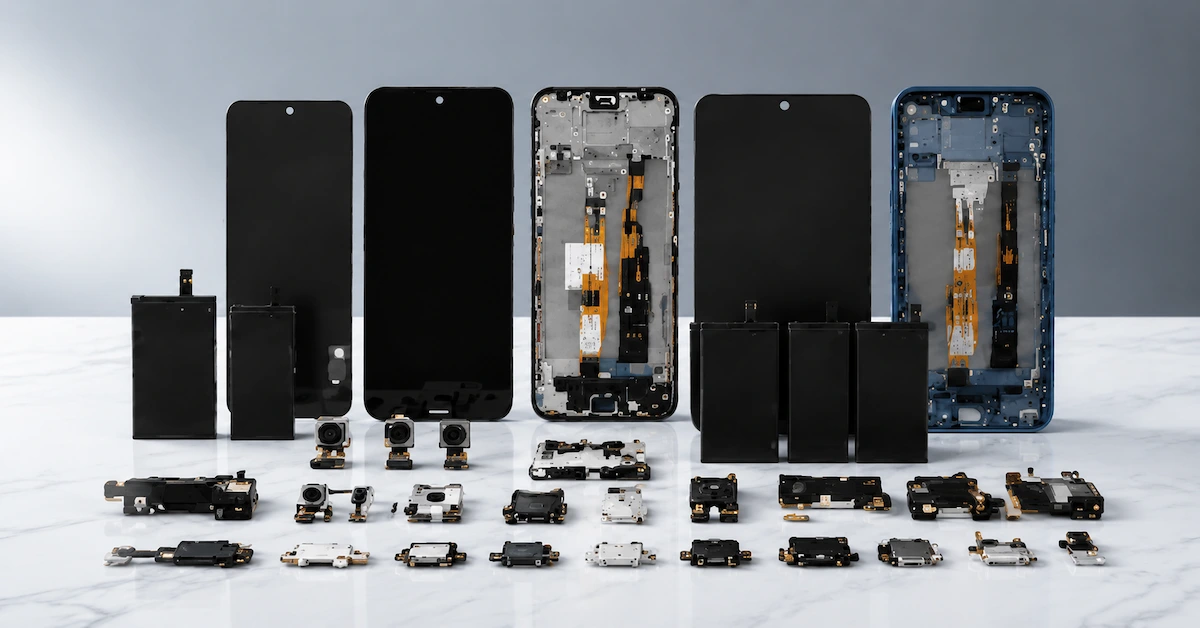
Depending on the model and supplier configuration, the assembly may include:
- display panel
- touch digitizer
- cover glass
- flex cable
- display connector
- touch connector
- driver-related components
- frame or bezel, when sold as a with-frame version
These components operate together.
A display that produces a clear image but has inaccurate touch response is still a failed repair. Likewise, a functional panel with an incorrect flex connector or poor frame alignment may never install correctly.
LCD Assembly Is Different From Glass-Only Repair
Not every cracked Huawei screen requires a complete assembly replacement.
Huawei itself distinguishes between screen-glass damage and display-module damage. On supported models and in participating markets, Huawei states that glass-only replacement may be possible when the cover glass is broken but the underlying display remains functional after inspection.
That distinction matters for independent repair businesses.
If only the outer glass is damaged and a refurbishment facility has suitable separation and OCA lamination equipment, glass refurbishment may be considered.
A complete Huawei LCD assembly for repair becomes more relevant when problems involve the display or touch module itself.
Examples include:
- no image
- broken display panel
- black areas
- horizontal or vertical lines
- severe flickering
- failed touch
- ghost touch
- damaged display flex cable
- damaged connector
- panel separation
- combined glass and display damage
Huawei also maintains official screen-repair and spare-parts support resources, confirming that screens are treated as replaceable service components within its repair ecosystem.
LCD or OLED: Confirm the Display Technology First
The phrase “Huawei LCD” is widely used in the replacement-parts market, but procurement teams should not use it as a technical assumption.
Some Huawei models use LCD panels, while others use OLED displays.
Replacing an OLED-equipped device with a product selected only from a generic “LCD” description can lead to the wrong purchasing decision.
What Buyers Should Confirm
Before ordering, verify:
- exact Huawei model
- device model number
- LCD or OLED technology
- display size
- connector configuration
- flex-cable design
- frame requirement
- regional or board revision where applicable
The product title should be treated as the start of verification, not the end.
Which Huawei Product Families Matter for Repair-Part Buyers?
CPG's current product architecture separates Huawei screen repair parts into major families including:
- Huawei Y Series
- Huawei P Series
- Huawei Mate Series
- Huawei Nova Series
Its current Huawei category also shows tablet replacement assemblies such as MatePad models.
This is useful for distributors because Huawei repair demand is not limited to one generation or one form factor.
Huawei Y Series
Y-series devices commonly enter price-sensitive repair markets.
Buyers serving local phone-repair shops may prioritize:
- affordable replacement cost
- stable touch response
- common-model availability
- mixed-model purchasing
- easy identification
Huawei P Series
For P-series repairs, display quality and fit can become more important because customers may expect a higher visual standard from premium models.
Buyers should pay closer attention to:
- correct display technology
- brightness
- color behavior
- touch response
- edge fit
- frame compatibility
Huawei Mate Series
Mate-series products span different generations and display configurations.
Model verification is therefore especially important.
Do not order simply by family name such as “Huawei Mate screen.” Use the full model designation.
Huawei Nova Series
Nova-series parts can be relevant to repair businesses serving markets where these devices remain common.
As with other series, generation and exact model should determine the replacement assembly.
Huawei MatePad and Tablet Repair
Tablet displays create additional purchasing considerations because larger panels are more vulnerable during storage, handling, installation, and international shipping.
CPG's Huawei category currently lists MatePad LCD display and touch-screen digitizer assemblies, including without-frame configurations.
With Frame vs Without Frame: Which Huawei Screen Should You Buy?
One of the most practical sourcing decisions is whether to purchase a replacement display with a frame or without one.
| Option | Main Advantage | Main Limitation | Best For |
|---|---|---|---|
| With Frame | Simplifies part of the installation process | Usually higher part cost and larger shipping volume | Repair shops prioritizing installation efficiency |
| Without Frame | Lower assembly scope and often more flexible for refurbishment | Requires more removal, cleaning and bonding work | Experienced technicians and refurbishment facilities |
Huawei LCD Assembly With Frame
A with-frame assembly usually reduces the amount of work required to separate the damaged display from the original middle frame.
Potential benefits include:
- easier positioning
- less adhesive removal
- reduced dependence on the condition of the old frame
- more predictable assembly workflow
However, buyers must confirm that the supplied frame matches:
- button openings
- speaker openings
- mounting points
- antenna locations
- internal component positions
- regional variation where relevant
Huawei LCD Assembly Without Frame
A without-frame screen allows the original housing or middle frame to remain in use.
This can make sense when:
- the original frame is undamaged
- technicians have screen-separation experience
- repair cost must be controlled
- a refurbishment line already has bonding equipment
But technician skill becomes more important.
Poor adhesive removal, uneven bonding, incorrect positioning, or damage during separation can turn a good replacement display into a failed repair.
The Components That Most Affect Repair Quality
Bulk buyers should evaluate the assembly as a system rather than judging only the visible glass.
Display Panel
The display panel determines fundamental image performance.
Important buyer concerns include:
- brightness
- color consistency
- viewing angle
- image uniformity
- dead pixels
- flickering
- black spots
- lines
Touch Digitizer
The touch layer should respond consistently across the usable screen area.
Common problems in poor replacements include:
- dead touch zones
- delayed response
- ghost touches
- inaccurate gestures
- edge-touch failure
- intermittent response
Flex Cable
The flex cable connects the display assembly to the device electronics.
For repair buyers, important considerations include:
- correct shape
- connector position
- connector seating
- bending quality
- visible damage
- reinforcement around stress areas
Connector
A display can be technically functional but unusable if the connector does not align correctly with the intended motherboard.
This is why exact model verification is critical.
Frame and Mechanical Fit
Incorrect tolerances may cause:
- raised screen edges
- uneven gaps
- adhesive failure
- pressure on the panel
- difficulty reinstalling surrounding components
Mechanical fit should therefore be part of sample evaluation.
How to Diagnose Whether the Huawei Screen Assembly Is Really the Problem
Replacing the complete assembly before diagnosis can increase repair cost unnecessarily.
Huawei's own troubleshooting resources note that some display abnormalities, including flickering, may occur under particular operating or temperature conditions rather than automatically indicating permanent panel damage.
Repair technicians should therefore distinguish between:
physical display damage
and
software, temperature, connector, power, or board-level symptoms
before replacing parts.
Common Reasons to Suspect Hardware Damage
- visible cracked panel
- black display after impact
- colored lines after physical damage
- large dead image areas
- touch failure after impact
- damaged flex
- damaged connector
- panel deformation
Problems That Need Further Diagnosis
- occasional flickering
- intermittent black screen
- brightness abnormalities
- touch issues without visible damage
- screen problems appearing only under certain operating conditions
A good parts supplier supports repair work, but correct diagnosis remains the technician's responsibility.
QC Checklist for a Huawei LCD Assembly for Repair
For wholesale purchasing, a sample that turns on is not enough.
A structured inspection process should cover both optical and mechanical performance.
| QC Area | What Buyers Should Check | Main Risk Reduced |
| Visual Inspection | Glass, panel, flex, connectors | Cosmetic and handling defects |
| Display Test | Full image and uniformity | Lines, black spots, dead areas |
| Touch Test | Entire touch surface | Dead zones and ghost touch |
| Brightness Check | Usable and even brightness | Dim or uneven display |
| Color Check | Consistent image reproduction | Strong color cast |
| Connector Check | Alignment and secure connection | Installation failure |
| Flex Inspection | Position and physical condition | Intermittent signal faults |
| Frame Fit | Alignment with housing | Raised edges and poor assembly |
| Model Verification | Exact SKU compatibility | Wrong-part returns |
| Batch Sampling | Multiple units from shipment | Inconsistent wholesale quality |
These are useful buyer-side QC criteria. They should not automatically be interpreted as a claim that every supplier performs every test unless the supplier provides a documented QC procedure.
Why Batch Consistency Matters More Than One Good Sample
Repair shops often evaluate only one or two units.
Distributors and refurbishment factories have a different problem.
They may purchase dozens or hundreds of screens across multiple Huawei models.
For them, the real cost is influenced by:
Part Cost + Installation Labor + Rework + Returns + Warranty Handling
A cheaper assembly can become more expensive if technicians repeatedly encounter:
- inconsistent touch
- poor connector fit
- weak bonding
- mismatched frames
- defective pixels
- incorrectly labeled models
This is why professional procurement should evaluate repeatability, not only sample appearance.
Different Buyers Need Different Huawei Screen Solutions
Independent Repair Shops
Most repair shops need:
- relatively small quantities
- popular Huawei models
- straightforward identification
- low installation risk
- quick replenishment
With-frame assemblies may be attractive when reducing technician time is more valuable than minimizing part cost.
Refurbishment Factories
Refurbishers usually focus on:
- batch consistency
- predictable installation
- without-frame options
- repair yield
- multi-model supply
- repeat ordering
They may prefer a lower assembly scope if their production line already supports screen separation and bonding.
Mobile Parts Wholesalers
Wholesalers need:
- wide model coverage
- clear SKU labels
- accurate compatibility
- protective packaging
- stable repeat supply
- mixed-model purchasing
Wrong labeling can be almost as damaging as poor product quality because the downstream repair technician may receive a good part for the wrong device.
Importers and Regional Distributors
These buyers have additional priorities:
- consolidated shipments
- packaging protection
- model planning
- inventory turnover
- after-sales process
- long-term availability
For them, purchasing is a supply-chain decision rather than a single-component decision.
Common Sourcing Risks With Huawei Replacement Screens
Risk 1: Ordering by Marketing Name Only
Similar product names do not guarantee identical connectors or internal revisions.
Better approach: provide the exact model number whenever possible.
Risk 2: Assuming Every “Huawei LCD” Is LCD
Some devices require OLED.
Better approach: verify original display technology.
Risk 3: Buying Only on Lowest Price
Low initial cost can be offset by:
- rework
- customer returns
- technician time
- shipping replacements
- reputation damage
Better approach: compare total repair cost.
Risk 4: Ignoring Frame Configuration
A buyer orders without frame but technicians expect a ready-to-install framed unit.
Better approach: state frame requirements in the purchase specification.
Risk 5: Testing Only One Unit
One working sample cannot prove batch consistency.
Better approach: sample several units, particularly for high-volume SKUs.
Risk 6: Poor Packaging
Screens are fragile parts.
Large tablet assemblies are particularly vulnerable to bending, edge impact, and pressure during transportation.
Better approach: confirm individual protection, separation, cushioning, and outer-carton protection before bulk shipment.
How Buyers Should Send a Huawei LCD RFQ
A precise RFQ can prevent days of clarification.
Instead of writing:
“Need Huawei LCD price.”
send:
Product Information
- Huawei model
- model number
- LCD or OLED if known
- with frame / without frame
- quantity per model
Quality Requirements
- target market
- expected quality level
- required functional testing
- packaging needs
Commercial Information
- sample quantity
- bulk quantity
- destination country
- mixed-model requirement
- expected purchasing frequency
For buyers handling multiple Huawei models, a spreadsheet with one model per row is usually more reliable than sending screenshots through separate messages.
Why CPG Is Relevant to Huawei Repair-Part Buyers
CPG's current catalog includes a dedicated Huawei LCD repair parts category, alongside broader mobile phone repair parts covering display assemblies, batteries, charging parts, and other repair components.
That product breadth is particularly useful for wholesalers and repair businesses that want to consolidate several repair categories rather than source screens, batteries, and small parts independently.
CPG's existing screen-related content also covers areas such as cracked screen repair parts, replacement displays, brightness, flex cables, and refurbishment topics. Its public content shows a clear focus on compatibility, touch/display performance, and repair applications, although highly specific performance claims from older articles should be verified against current product documentation before being used as purchasing specifications.
Buyers requiring specific Huawei models can send an RFQ through the CPG contact page with model numbers, frame preferences, and expected quantities.
A Practical Huawei LCD Assembly Buying Checklist
Before approving a bulk order, confirm:
- exact Huawei model
- model number
- LCD or OLED
- with frame or without frame
- touch functionality
- connector alignment
- flex-cable configuration
- visual quality
- physical fit
- sample performance
- batch consistency
- SKU labeling
- protective packaging
- defective-part procedure
- repeat-order availability
A supplier that cannot clearly answer compatibility questions should not be evaluated on price alone.
FAQ About Huawei LCD Assembly for Repair
1. What does a Huawei LCD assembly include?
It commonly combines the display panel and touch digitizer, with related flex cables and connectors. Some products also include the frame. Exact construction varies by Huawei model.
2. Does every Huawei phone use an LCD screen?
No. Huawei devices use different display technologies across models and generations, so buyers should confirm whether the specific device requires LCD or OLED before purchasing.
3. Should I replace the full assembly if only the glass is cracked?
Not always. Huawei itself offers glass-only replacement for certain supported devices when the display underneath still functions properly after inspection. Full assembly replacement is generally more relevant when the display, touch layer, flex, or related module is damaged.
4. Is a Huawei screen with frame easier to install?
In many repair workflows, yes. A with-frame assembly can reduce separation and bonding work. However, the frame must match the exact model and internal configuration.
5. Is a without-frame display cheaper?
It often involves a smaller replacement assembly, but total repair cost depends on technician labor, adhesive work, equipment, and rework risk. Compare total repair economics rather than component price alone.
6. What are the most important QC checks?
Check image output, touch across the full screen, brightness uniformity, connectors, flex condition, fit, model compatibility, and consistency across multiple samples.
7. Why can a replacement screen flicker?
Possible causes include the screen assembly, flex or connector issues, installation problems, power-related faults, software conditions, or device operating conditions. Huawei's support documentation also notes that flickering can occur under certain temperature or system conditions, so diagnosis should come before part replacement.
8. Can repair shops order multiple Huawei models together?
Mixed-model purchasing depends on the supplier and available stock. For B2B sourcing, send a complete SKU and quantity list so availability and purchasing terms can be evaluated together.
9. What information should I send when asking for a Huawei screen quotation?
Provide the Huawei model, exact model number, quantity, display technology if known, with-frame or without-frame preference, destination market, and any packaging or quality requirements.
10. Where can I find Huawei LCD repair parts from CPG?
Browse the CPG Huawei LCD Repair Parts category or review the full CPG product catalog. For bulk model matching and quotations, submit your requirement through Contact Us.
Conclusion
Choosing the right Huawei LCD assembly for repair is primarily a compatibility and risk-control decision.
Buyers should verify the exact device model, determine whether the original display is LCD or OLED, select the appropriate frame configuration, and evaluate the touch layer, flex cable, connectors, visual performance, fit, packaging, and batch consistency before committing to volume purchasing.
Repair shops may prioritize installation convenience. Refurbishment factories may prioritize repeatability and cost per successful repair. Distributors need model coverage, reliable labeling, packaging, and repeat supply.
For multi-model Huawei repair requirements, review CPG's Huawei LCD repair parts and send your model list, frame requirements, and quantities through the CPG contact page before bulk ordering.