
Choosing a Charging port flex cable distributor is important for repair shops, refurbishment factories, online repair parts sellers, and phone parts wholesalers that need stable replacement parts for daily phone repair demand. A charging port flex cable may look like a small component, but it directly affects charging performance, data transfer, microphone function, signal connection, and customer satisfaction after repair.
When a phone cannot charge properly, the issue may come from the charging socket, charging connector, dock connector board, or charging port flex cable. If the replacement part is poorly matched or not tested properly, the phone may still charge slowly, disconnect during use, or return to the repair shop with the same problem.
For B2B buyers, a reliable distributor should provide more than a product list. The distributor should support accurate model matching, tested product quality, organized packaging, mixed-model bulk orders, and clear after-sales communication.
For more mobile phone parts sourcing support, buyers can visit CPG mobile phone parts supplier.
Why Charging Port Flex Cables Are Important in Phone Repair
Charging port flex cables are high-frequency repair parts because the charging area is used every day. Users plug and unplug cables repeatedly, use different chargers, carry phones in dusty environments, and sometimes damage the port through impact, moisture, or improper cable insertion.
Repair shops often need charging port flex cable replacement when customers report:
- phone not charging
- slow charging
- unstable charging connection
- loose cable fit
- charging only at a certain angle
- damaged Type-C port
- Micro USB or Lightning connector failure
- data transfer interruption
- microphone or signal issue related to the dock area
- overheating near the charging port
Because these problems are common, a stable Charging port flex cable distributor can help repair businesses maintain inventory and reduce customer waiting time.
Who Needs a Charging Port Flex Cable Distributor?
Charging port flex cables are mainly purchased by B2B buyers in the mobile phone repair parts market.
Repair Shops
Independent repair shops need fast-moving charging port flex cables for popular phone models. Their main concerns are model accuracy, small-batch availability, product stability, and lower after-sales risk.
Repair Chain Stores
Repair chains need consistent parts quality across multiple branches. A stable distributor helps standardize repair results and reduce customer complaints.
Refurbishment Factories
Refurbishment factories repair used phones in larger volumes. They need bulk charging port flex cables with clear model labels, organized packaging, and stable batch quality.
Phone Parts Wholesalers
Wholesalers need wide product coverage and repeatable supply so they can serve local repair shops, resellers, and online spare parts sellers.
Online Repair Parts Sellers
E-commerce sellers need clean packaging, accurate product names, and reliable product performance to reduce returns and negative reviews.
What Is a Charging Port Flex Cable?
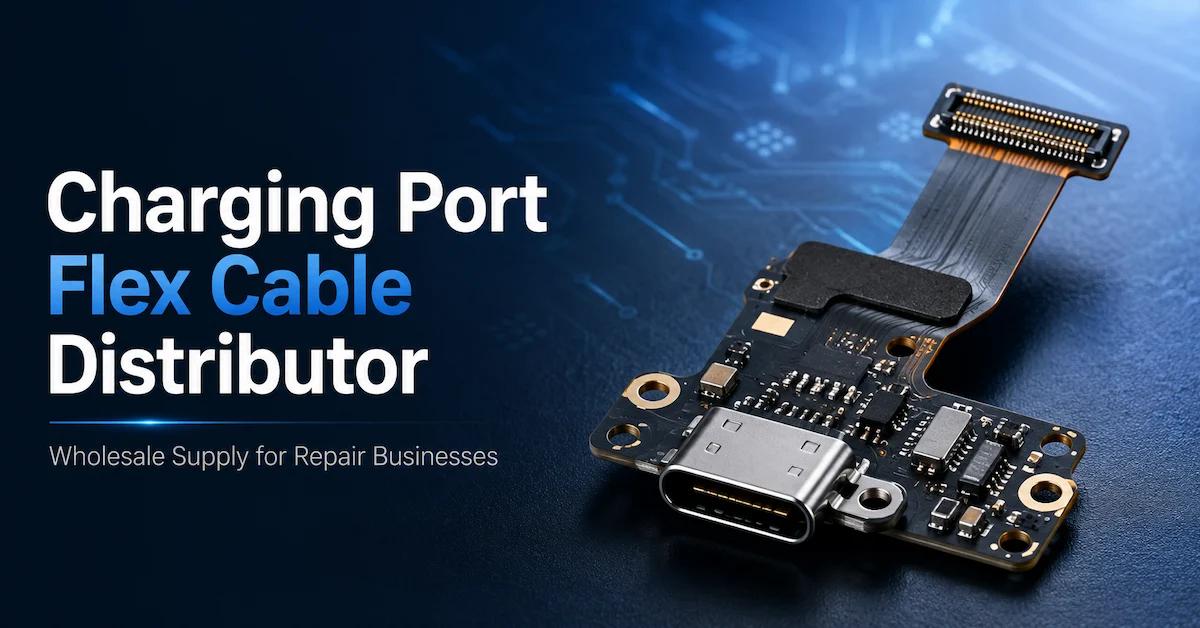
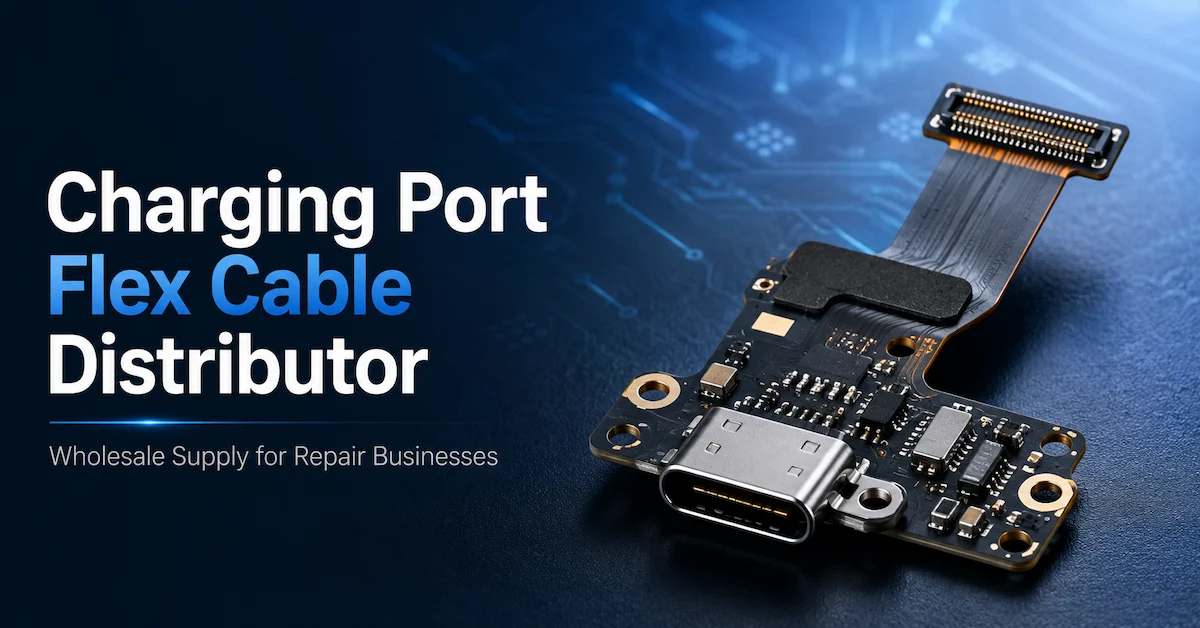
A charging port flex cable is a flexible circuit component that usually connects the charging socket to the internal phone board or related circuit system. Depending on the model, it may include the charging connector, microphone connection, antenna contact, signal contacts, vibration motor connection, or other small components.
Common product names include:
- charging port flex cable
- phone charging flex cable
- dock connector flex cable
- USB charging port flex
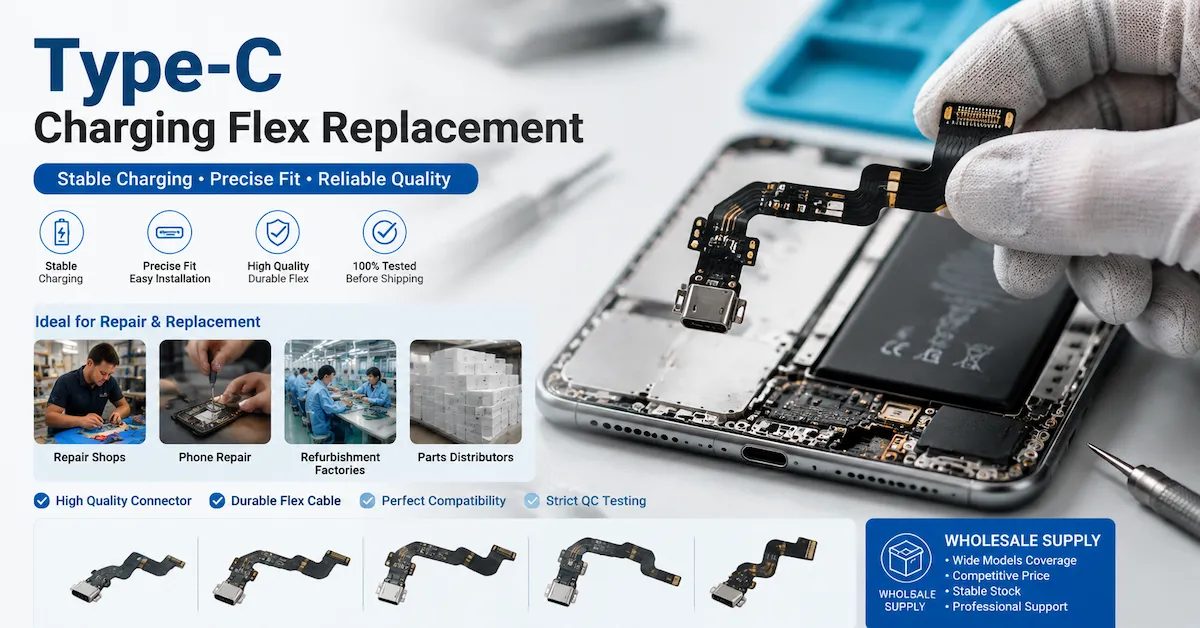
- Type-C charging flex cable
- charging interface flex cable
- phone charging connector flex
- replacement charging port assembly
In the wholesale market, these terms are sometimes used together. That is why buyers should always confirm the exact phone model, connector type, layout, and compatible version before placing an order.
Main Product Types a Distributor Should Offer
A professional charging port flex cable distributor should provide multiple connector types, model ranges, and repair solutions.
| Product Type | Main Feature | Best For |
|---|---|---|
| Type-C Charging Port Flex Cable | Common in modern Android phones | Repair shops and distributors |
| Micro USB Charging Flex Cable | Used in older or entry-level models | Budget repair markets |
| Lightning Charging Port Flex | Used for selected iPhone repairs | Apple repair parts sellers |
| Dock Connector Flex Cable | Supports charging and signal functions | Refurbishment factories |
| Charging Port Board Assembly | Includes connector and small board | Complex repair needs |
| Fast-Charging Flex Cable | Supports stable current transmission | High-demand repair markets |
| OEM-Compatible Flex Cable | Model-specific layout and fit | Bulk repair programs |
For buyers, the most important point is exact compatibility. Similar-looking flex cables may have different connector positions, board layouts, screw holes, or flex lengths.
Charging Port Flex Cable vs Charging Socket
Many buyers confuse charging port flex cables with charging sockets. They are related, but not always the same product.
| Item | Description | Suitable Buyer |
| Charging Socket | The physical connector where the cable plugs in | Skilled technicians doing socket-level repair |
| Charging Port Flex Cable | Flexible circuit with charging socket and related connections | Repair shops needing easier replacement |
| Dock Connector Board | Board assembly with charging and signal components | Refurbishment factories |
| Full Charging Assembly | Complete solution including socket, flex, board, and contacts | High-volume repair businesses |
For most repair shops, replacing the full charging port flex cable is easier than replacing only the socket. For experienced technicians, socket-only repair may reduce cost but requires better soldering skill.
Key Quality Points Buyers Should Check
When choosing a Charging port flex cable distributor, buyers should evaluate product performance, not only unit price.
1. Connector Fit
The charging connector should hold the charging cable firmly without being too loose or too tight. Poor fit can cause unstable charging after repair.
2. Circuit Stability
The flex cable should support stable current and signal transmission. Weak circuit design can lead to slow charging, data transfer failure, or repeated charging interruption.
3. Flex Durability
The flexible cable should resist bending and cracking during installation. Low-quality flex material may break after installation or during repair handling.
4. Soldering and Component Quality
If the flex cable includes small components, soldering consistency matters. Weak soldering can cause loose contact, short circuits, or early failure.
5. Model Compatibility
Phone models can have regional versions or small internal structure differences. A reliable distributor should help confirm exact compatibility before shipment.
6. Board Layout Accuracy
The screw holes, connector position, microphone hole, and contact points should match the phone structure accurately.
7. Batch Consistency
Bulk buyers need stable quality across repeat orders. One good sample does not guarantee reliable long-term supply.
Technical Specifications to Confirm Before Ordering
Before buying charging port flex cables in bulk, prepare a clear specification list.
| Item | What to Confirm |
| Phone Brand | Apple, Samsung, Xiaomi, OPPO, Huawei, Vivo, or others |
| Exact Model | Model number, version, and market variant |
| Connector Type | Type-C, Micro USB, Lightning, or special connector |
| Product Form | Flex cable, board assembly, socket, or full charging assembly |
| Function | Charging, data transfer, microphone, antenna, or signal |
| Flex Material | Flexible PCB structure and bending durability |
| Connector Position | Port alignment, screw holes, and board contact points |
| Testing Requirement | Charging test, plug test, data transfer test |
| Packaging | Anti-static bag, tray, foam box, or carton |
| Order Type | Sample, mixed-model order, or bulk wholesale order |
Clear specifications help reduce misunderstandings and improve order accuracy.
QC Testing a Distributor Should Provide
Quality control is critical for repair businesses. A charging port flex cable may look correct but still fail after installation if the circuit, connector, or flex structure is unstable.
Recommended QC checks include:
| QC Item | Why It Matters |
| Appearance Inspection | Checks deformation, stains, oxidation, and damaged contacts |
| Plug-In Test | Confirms connector tightness and smooth cable insertion |
| Charging Function Test | Verifies stable charging performance |
| Data Transfer Test | Important when USB data function is required |
| Flex Bending Test | Reduces risk of flex cable cracking during installation |
| Contact Stability Test | Helps prevent intermittent charging issues |
| Model Fit Check | Confirms structure, hole position, and connector alignment |
| Soldering Inspection | Helps prevent loose contact and early failure |
| Batch Sampling | Maintains consistency for wholesale orders |
| Packaging Inspection | Reduces damage during shipping |
Instead of only asking “What is your lowest price?”, buyers should ask: “How do you test charging port flex cables before shipment?”
This question helps identify whether the distributor understands real repair-market quality requirements.
Why Distributor Capability Matters
A distributor is not only a product seller. For repair businesses, a good distributor helps reduce sourcing complexity.
A reliable Charging port flex cable distributor should provide:
- wide phone model coverage
- stable fast-moving inventory
- mixed-model order support
- model confirmation before shipment
- practical MOQ options
- protective packaging
- repeat order consistency
- clear after-sales handling
- knowledge of repair shop needs
This is especially important for buyers who manage many phone models. Without a stable distributor, repair shops may waste time switching suppliers, correcting wrong models, or handling defective parts.
Common Purchasing Risks
Charging port flex cable sourcing can create hidden costs if the distributor is not reliable.
Wrong Model Shipment
Many charging port flex cables look similar but are not interchangeable. Wrong models can delay repairs and create inventory waste.
Poor Connector Tightness
A weak connector may charge only when the cable is held at a certain angle, causing customer returns.
Weak Flex Material
Poor flex material may crack during installation or fail after repeated device use.
Unstable Charging Performance
Low-quality circuit or contact design may cause slow charging, no charging, or unstable charging.
Mixed Packaging Errors
If product labels are unclear, repair shops and wholesalers may waste time sorting similar parts.
No Clear After-Sales Process
If the distributor does not provide clear support for defective goods, the buyer may carry all losses.
How to Compare Charging Port Flex Cable Distributors
Use the table below before choosing a supplier.
| Comparison Factor | Reliable Distributor | High-Risk Supplier |
| Product Range | Covers multiple brands and connector types | Limited or unclear models |
| Model Confirmation | Helps confirm exact compatibility | Uses vague product names |
| QC Testing | Tests charging, plug fit, flex, and appearance | Only checks basic appearance |
| Packaging | Anti-static, labeled, and protective packaging | Weak or mixed packaging |
| Bulk Order Support | Supports mixed models and repeat orders | Unclear MOQ or stock |
| Communication | Provides clear product specifications | Slow or vague replies |
| After-Sales | Has clear handling process | No clear responsibility |
| Repair Market Knowledge | Understands repair shop requirements | Only sells generic parts |
A reliable distributor should help buyers reduce risk, simplify purchasing, and build stable repair parts inventory.
How CPG Supports Charging Port Flex Cable Buyers
CPG focuses on mobile phone parts and accessories wholesale for B2B customers. Its product range covers LCD repair parts, small phone parts, charging components, batteries, charger adapters, data cables, wireless chargers, screen protectors, phone cases, repair tools, and related mobile phone accessories.
Buyers can explore available product categories here: CPG products page.
For charging port flex cable buyers, CPG can support repair shops, refurbishment factories, distributors, and online sellers with product selection, model matching, bulk order planning, and related phone repair parts sourcing.
A buyer sourcing charging port flex cables may also need:
- replacement charging sockets
- charging port spare parts
- aftermarket charging connectors
- LCD display replacement parts
- phone batteries
- repair tools
- data cables
- charger adapters
- screen protectors
- phone cases
Working with one supplier for multiple categories can help reduce communication time and improve purchasing efficiency.
Sample Order vs Bulk Distributor Order
For new buyers, sample testing is important before placing a larger distributor order.
| Stage | What to Check | Buyer Goal |
| Sample Order | Connector fit, charging, flex quality, appearance | Confirm basic quality |
| Small Batch Order | Model accuracy, defect rate, packaging | Test real repair performance |
| Bulk Order | Batch consistency, lead time, carton packing | Build stable inventory |
| Repeat Order | Quality stability and supplier response | Maintain long-term cooperation |
A practical distributor should help buyers test key models first, then expand to mixed-model bulk orders.
Packaging Requirements for Flex Cable Distribution
Charging port flex cables are small, delicate, and easy to mix. Good packaging protects the product and improves warehouse workflow.
Recommended packaging may include:
- anti-static bags
- separated trays
- foam protection
- clear model labels
- sealed inner packaging
- organized cartons
- mixed-model packing list
- SKU or barcode labels if required
- batch separation by model
For wholesalers and online sellers, clear packaging reduces picking mistakes. For repair factories, organized packaging improves repair-line efficiency.
Practical Buying Checklist
Before choosing a Charging port flex cable distributor, use this checklist:
- Confirm exact phone models and connector types.
- Decide whether you need flex cables, boards, sockets, or full assemblies.
- Ask about plug-in, charging, and data transfer testing.
- Check flex durability and connector tightness.
- Confirm packaging method and model labels.
- Ask whether mixed-model orders are supported.
- Test samples or small-batch orders first.
- Confirm MOQ, lead time, and repeat supply ability.
- Clarify after-sales handling for defective parts.
- Choose a distributor with mobile phone repair parts experience.
For more repair-part sourcing guides and FAQ-style buying tips, buyers can visit the CPG blog.
FAQ: Charging Port Flex Cable Distributor
1. What is a charging port flex cable distributor?
A charging port flex cable distributor supplies charging port flex cables, dock connector flex cables, charging sockets, and related phone repair parts to repair shops, wholesalers, and refurbishment businesses.
2. Who needs charging port flex cables?
Repair shops, repair chains, refurbishment factories, phone parts wholesalers, distributors, and online repair parts sellers often need charging port flex cables.
3. What should I check before buying from a distributor?
You should check model compatibility, connector type, flex cable durability, charging stability, QC testing, packaging, MOQ, and after-sales support.
4. Is a charging port flex cable the same as a charging socket?
Not always. A charging socket is the connector itself, while a charging port flex cable may include the socket, flexible circuit, board, microphone contacts, and other related components.
5. What connector types are common?
Type-C, Micro USB, and Lightning are common connector types in the phone repair parts market.
6. Can I order mixed models from a distributor?
Many B2B buyers prefer mixed-model orders because repair markets need different phone models. Buyers should confirm MOQ, model list, and packaging details.
7. Why is QC testing important for charging port flex cables?
QC testing helps reduce unstable charging, loose cable fit, poor contact, data transfer failure, flex cracking, and customer return problems.
8. What packaging is suitable for charging port flex cables?
Anti-static bags, model labels, separated trays, foam protection, organized cartons, and packing lists are useful for wholesale charging port flex cable shipments.
9. How can repair shops reduce defective part risk?
Start with samples, confirm exact model compatibility, ask about QC standards, inspect packaging details, and choose a distributor with clear after-sales support.
10. How can I request a quote for charging port flex cables?
Prepare your model list, connector types, quantity, packaging needs, and destination market. Then contact the distributor for MOQ, sample availability, lead time, and wholesale pricing.
Conclusion
Choosing a reliable Charging port flex cable distributor can help repair shops, refurbishment factories, wholesalers, and online sellers reduce repair failures, control inventory risk, and improve customer satisfaction. The best distributor is not simply the cheapest option. It is the supplier that can provide accurate model matching, durable flex cable quality, QC testing, protective packaging, mixed-model supply, and responsive support.
If you are sourcing charging port flex cables, replacement charging sockets, charging port spare parts, or related phone repair parts in bulk, CPG can help you compare suitable options and prepare a wholesale supply solution for your market.
To discuss model lists, bulk orders, or repair parts sourcing needs, contact CPG here: Contact CPG.