
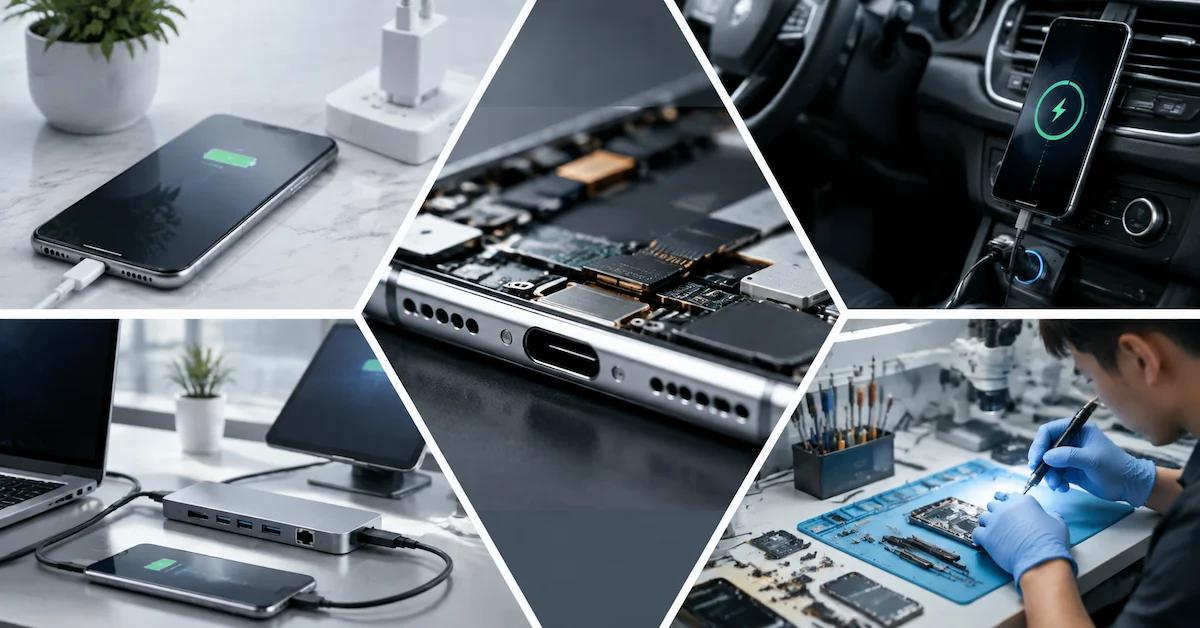
A charging port for fast-charging devices may look like a small replacement component, but for repair businesses it can determine whether a device charges normally, negotiates fast charging correctly, maintains stable data communication, or returns to the shop with another charging complaint.
This is why repair shops, refurbishment factories, electronics service centers, and mobile phone parts distributors should not evaluate charging ports by connector appearance and unit price alone.
The replacement has to match the exact device architecture, connector layout, flex or PCB configuration, power path, and relevant communication contacts.
For buyers sourcing in volume, the practical question is therefore not simply:
“Does this USB-C connector fit?”
The better question is:
“Will this charging-port assembly restore the functions the device is designed to support, consistently across a batch?”
CPG's current mobile phone accessories range includes charging flex cable replacements alongside other phone repair components, while its Type-C repair content distinguishes between charging sockets, dock connectors, flex cables, charging boards, USB-C sub-boards, and complete interface assemblies.
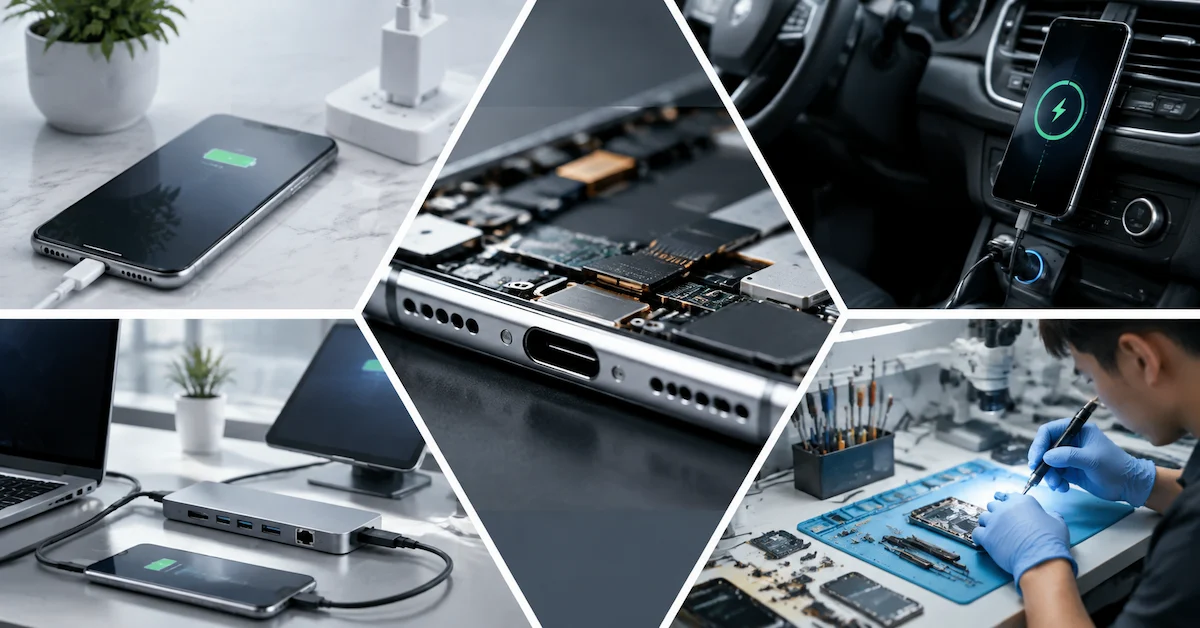
What Is a Charging Port for Fast-Charging Devices?
A charging port for fast-charging devices is the physical charging-interface component—or the larger flex, board, or dock assembly containing that interface—used in a device designed to support higher-power charging modes.
Depending on the device, the replacement part may include:
- USB-C / Type-C receptacle
- charging socket
- dock connector
- charging flex cable
- charging sub-board
- PCB assembly
- microphone contacts
- antenna contacts
- data contacts
- board-to-board connector
- mounting brackets or shielding
The construction varies significantly between phone models.
Some devices use a small replaceable charging sub-board. Others integrate the port into a flex assembly. Some repairs require replacing only the connector through microsoldering.
That difference directly affects part selection, repair skill, labor time, and failure risk.
USB-C Does Not Automatically Mean Fast Charging
One of the most important technical distinctions for buyers is that USB Type-C and USB Power Delivery are not the same thing.
USB-IF specifically distinguishes the physical USB Type-C interface from USB Power Delivery. USB PD is the protocol/hardware solution used to extend power capabilities, while Type-C describes the connector and related interface architecture.
The official USB-IF USB Power Delivery information states that USB PD Revision 3.1 can support power delivery up to 240W over appropriately designed USB Type-C cable and connector systems. This does not mean a smartphone charging port should be expected to handle 240W; actual device power remains limited by the device, charger, cable, battery-management system, and overall hardware design.
For repair buyers, the practical lesson is simple:
Never select a replacement port only because it physically looks like USB-C.
How the Charging Port Fits Into the Fast-Charging Power Path
Fast charging depends on several components working together.
A simplified charging path is:
Charger → Cable → Charging Port → Flex/Sub-Board → Power Management Circuit → Battery
A fault at any stage can reduce charging speed or prevent charging completely.
The Charging Port
The receptacle provides the physical connection and electrical contacts.
Poor contacts, worn terminals, corrosion, mechanical deformation, or weak solder joints may produce intermittent charging or unstable connection.
The Flex Cable or Charging Board
In many smartphones, the port is part of a charging flex cable or sub-board.
Depending on the model, that assembly may also carry:
- data signals
- microphone connections
- antenna contacts
- grounding
- other peripheral connections
This is one reason that replacing a charging assembly with an incorrect revision can sometimes create symptoms beyond charging.
Fast-Charging Communication
Compatible equipment must communicate correctly before higher-power charging modes are used.
USB-IF's fast-charger documentation also identifies Programmable Power Supply, or PPS, as a feature associated with USB Power Delivery fast charging, with compatible charger, host/device, and related components needed to make use of it.
A replacement port therefore needs intact signal and configuration paths where the device design requires them.
Charger, Cable and Device Electronics
Even a perfectly functioning port cannot make an incompatible charger or cable deliver a charging mode that the device does not support.
Likewise, replacing the port will not repair a failed charging IC, damaged battery, or board-level power problem.
This distinction matters because unnecessary charging-port replacement increases both repair cost and diagnostic time.
Who Buys Charging Ports for Fast-Charging Devices?
Different buyers evaluate the same component differently.
Independent Phone Repair Shops
Repair stores usually need relatively small quantities across many popular models.
Their priorities typically include:
- accurate compatibility
- easy installation
- reliable charging after repair
- low comeback risk
- fast replenishment
- support for mixed-model purchasing
For these buyers, complete charging flex or sub-board assemblies can sometimes reduce repair complexity compared with socket-only microsoldering.
Refurbishment Factories
Refurbishment operations care more about repeatability.
A low component price offers little benefit if the batch produces inconsistent charging behavior or increases rework.
Their priorities often include:
- batch consistency
- installation efficiency
- repeatable fit
- functional testing
- stable supply
- SKU management
- predictable rework rates
Mobile Phone Parts Wholesalers and Distributors
Wholesalers need broad model coverage and stock that downstream repair technicians can identify correctly.
The purchasing challenge is therefore not only quality but also:
- model labeling
- revision identification
- packaging
- mixed-model supply
- stable replenishment
- after-sales handling
Electronics Repair Centers
Repair centers working across phones, tablets, and other electronics may need multiple charging-interface formats.
They are more likely to compare socket-only components, flex assemblies, dock connectors, sub-boards, and board-level components according to technician capability.
Common Symptoms Before Replacing a Charging Port
A charging port may be suspected when the device shows symptoms such as:
- no charging
- intermittent charging
- charging only when the cable is held at an angle
- loose cable connection
- repeated connection and disconnection
- unstable data connection
- visibly damaged connector
- corrosion around the interface
- bent or contaminated contacts
- abnormal heat near the charging area
However, these symptoms do not prove the port is the only faulty component.
Before replacement, professional repair diagnosis should also consider:
- charger condition
- cable condition
- debris inside the connector
- battery condition
- charging IC or power-management failure
- damaged flex cable
- liquid damage
- PCB damage
For related component-selection issues, CPG's Type-C charging flex replacement guide discusses compatibility, flex construction, charging performance, QC, and wholesale sourcing from a repair-business perspective.
Socket, Flex Cable, Sub-Board or Dock Assembly: Which Should Buyers Order?
The term “charging port” can describe several different replacement formats.
| Replacement Format | What Is Replaced | Repair Skill | Main Advantage | Main Purchasing Risk | Typical Buyer |
|---|---|---|---|---|---|
| Socket Only | Physical connector | High / microsoldering | Lower component replacement scope | Wrong footprint or soldering difficulty | Board-level repair center |
| Charging Flex Cable | Port + flexible circuit assembly | Medium | Faster module replacement | Flex shape/revision mismatch | Phone repair shop |
| Charging Sub-Board | Port + PCB/sub-board | Medium | Replaces several related interface components | Incorrect board revision | Repair shop/refurbisher |
| Dock Assembly | Port + integrated interface assembly | Medium | More complete repair solution | Higher part cost and model specificity | Professional repair business |
There is no single “best” format.
A socket-only component may reduce part cost but increase technician labor and soldering risk.
A complete sub-board may cost more per unit but reduce board-level work.
The correct decision should therefore be based on total repair economics, not only component price.
8 Factors to Check Before Buying a Charging Port for Fast-Charging Devices
1. Exact Device Compatibility
Model compatibility should be the first filter.
Buyers should verify:
- brand
- model
- regional version where relevant
- model number
- board revision
- connector orientation
- flex shape
- mounting points
- board-to-board connector position
Two ports can look almost identical while being electrically or mechanically incompatible.
For bulk orders, provide the supplier with a clear model list rather than requesting only “USB-C charging ports.”
2. Charging Interface Type
Confirm whether the original device uses:
- USB-C
- Lightning
- Micro USB
- another dedicated connector
For USB-C repairs, do not assume every Type-C interface supports the same power or data capabilities.
USB-IF describes USB Type-C as a scalable interface but separately defines testing and compliance requirements for Type-C and USB Power Delivery products.
3. Power and Communication Path Integrity
A fast-charging replacement should preserve the electrical and communication paths required by the original device design.
For procurement teams, the key issue is not to assign an arbitrary wattage to every replacement port.
Instead, ask whether the component is designed for the specific original device application and its expected charging behavior.
This avoids misleading specifications such as advertising every USB-C replacement socket as a generic “100W” or “240W charging port.”
4. Connector Contact and Soldering Quality
Inspect the physical connector carefully.
Important areas include:
- terminal alignment
- housing shape
- solder pads
- mounting tabs
- connector seating
- visible contamination
- deformation
- inconsistent finishing
A low-cost connector that creates unreliable physical contact can make an otherwise successful repair fail in daily use.
5. Flex Cable or PCB Construction
When the charging port is integrated into a flex cable or board, inspect the entire assembly—not just the socket.
Check:
- flex routing
- connector alignment
- component placement
- board dimensions
- solder joints
- reinforcement
- mounting-hole positions
- interface contacts
CPG also maintains a dedicated charging port board wholesale guide discussing connector compatibility, charging stability, board quality, QC, packaging, and bulk sourcing.
6. Integrated Functions
A charging assembly may support more than charging.
Depending on device design, related functions may include:
- USB data transfer
- microphone
- antenna contacts
- audio-related contacts
- grounding
- other lower-board functions
Ask the supplier exactly what is integrated into the replacement assembly.
This helps technicians avoid diagnosing a post-repair microphone or data problem as a completely separate failure.
7. Mechanical Fit and Connector Retention
Fast charging is irrelevant if the cable cannot maintain reliable mechanical contact.
Buyers should evaluate:
- cable insertion
- connector retention
- alignment with device housing
- port opening position
- movement after installation
- interference with screws or brackets
This is especially important for refurbishment operations where small fit differences can multiply across hundreds of repairs.
8. Batch Consistency
A good sample is only the beginning.
For wholesalers and refurbishment factories, the real question is whether subsequent batches remain consistent.
Ask suppliers how they control:
- incoming components
- model identification
- batch inspection
- packing labels
- mixed-model orders
- defective-part handling
The purpose of QC is not simply to produce a “tested” label. It is to reduce uncertainty for the buyer.
A Practical QC Checklist for Charging-Port Buyers
Before a large order, buyers can build a sample-validation process around real repair conditions.
| QC Item | What to Check | Why It Matters |
|---|---|---|
| Visual Inspection | Connector, flex, PCB, solder area | Detect obvious defects |
| Model Fit | Mounting and connector position | Prevent installation mismatch |
| Standard Charging | Device accepts normal charging | Basic functional verification |
| Supported Fast Charging | Device behaves as designed with known compatible equipment | Confirms practical application |
| Cable Orientation | USB-C connection where applicable | Detect contact problems |
| Data Test | USB connection/data function if supported | Verify signal path |
| Microphone Test | When microphone is integrated | Avoid post-repair functional loss |
| Mechanical Test | Stable cable fit | Reduce intermittent connections |
| Temperature Observation | Check for abnormal heating during validation | Detect potential connection problems |
| Batch Sampling | Repeat tests across multiple pieces | Evaluate consistency |
USB-IF maintains formal compliance programs and test specifications for USB products. Repair-part distributors are not automatically USB-certified simply because they sell a Type-C component, so buyers should avoid assuming certification unless the specific product documentation proves it.
Fast-Charging Compatibility: What Procurement Teams Should Ask
When evaluating a charging port for fast-charging devices, avoid asking only:
“Does it support fast charging?”
That question is too broad.
Ask instead:
What exact device models is the component intended for?
Compatibility should come before theoretical power.
Is it a socket, flex cable, sub-board or complete assembly?
This determines installation method and technician requirements.
Has it been tested in the intended device?
Component-level appearance does not confirm full-device functionality.
Which functions are integrated into the assembly?
Charging, data, microphone, and antenna functions may share the same lower-board assembly.
Does the supplier distinguish USB-C from USB PD?
A technically credible supplier should understand that connector type and charging protocol are different concepts.
The official USB Type-C specification resources and USB Power Delivery resources are useful references when buyers need to separate interface terminology from actual power-delivery capability.
Why the Cheapest Charging Port Can Become the Most Expensive Repair
For professional repair businesses, component price is only one part of cost.
A more realistic cost model is:
Part Cost + Technician Time + Rework + Return Handling + Customer Downtime
Suppose one port is slightly cheaper but requires more alignment work or generates inconsistent charging complaints.
The apparent purchasing saving can disappear once technicians reopen repaired devices.
This is why refurbishment factories often evaluate a component differently from a small retail repair shop.
Repair Shop Priority
Usually:
Compatibility + reliability + easy installation
Refurbishment Factory Priority
Usually:
Batch consistency + labor efficiency + repeatability
Distributor Priority
Usually:
Model coverage + stock stability + labeling + after-sales support
The “best charging port” therefore depends on the buyer's operating model.
How to Reduce Risk Before a Bulk Order
A practical sourcing process can follow six steps.
Step 1: Prepare a Model List
Include exact model numbers and quantities.
Step 2: Confirm Replacement Format
Specify:
- socket
- charging flex
- charging board
- sub-board
- dock assembly
Step 3: Request Samples for Important SKUs
Prioritize high-volume models.
Step 4: Test Under Real Repair Conditions
Use a known-good charger and cable appropriate for the device.
Do not judge performance only from appearance or continuity testing.
Step 5: Check Packaging and Labeling
Similar-looking charging parts are easy to mix.
Clear SKU identification reduces warehouse and technician mistakes.
Step 6: Define After-Sales Handling Before Ordering
Ask:
- How are defective parts reported?
- What evidence is required?
- How are incorrect-model issues handled?
- Can mixed-model orders be supported?
- How are repeat orders matched to previous SKUs?
These questions often reveal more about supplier reliability than promotional claims.
Building a Better Charging-Port Inventory for Repair Businesses
A repair business does not necessarily need every charging port available.
Inventory should be based on actual repair demand.
A practical classification can include:
A-Class: High-Turnover Models
Keep regular inventory.
These are frequently repaired models where delayed parts directly slow workshop throughput.
B-Class: Moderate-Turnover Models
Keep smaller quantities or consolidate replenishment orders.
C-Class: Low-Turnover Models
Order when required or maintain minimal safety stock.
Wholesalers can apply the same idea at a larger scale, using customer order history to determine which charging-port flex cables, sockets, and sub-boards deserve deeper stock.
This reduces two opposite risks:
stockouts of fast-moving models and dead inventory of obsolete models.
What Should You Expect From a Charging-Port Supplier?
For B2B sourcing, a supplier should contribute more than a product image and price.
Useful capabilities include:
- clear model identification
- multiple replacement formats
- stable SKU management
- sample support
- product inspection
- protective packaging
- mixed-model supply
- responsive after-sales communication
CPG's existing content cluster already covers Type-C dock repair parts, charging-port flex cable sourcing, charging boards, charging IC components, and related mobile phone repair parts, reflecting the fact that charging problems can involve several different component levels.
Buyers can also browse CPG's broader mobile phone repair parts and accessories when consolidating screens, batteries, charging components, and other repair parts into the same sourcing workflow.
Questions to Ask Before Choosing a Charging Port Supplier
Before placing a wholesale order, send the supplier a structured requirement list.
Ask:
- Which exact models does this charging port fit?
- Is it a socket-only part or a complete flex/board assembly?
- Are multiple board revisions available?
- Which functions are integrated into the assembly?
- How are compatibility and charging functions checked?
- Can samples be supplied before a bulk order?
- Can different models be consolidated in one purchase?
- How are SKUs labeled and packed?
- What happens if a batch has compatibility problems?
- How stable is repeat supply for the same model?
These questions turn sourcing from a price comparison into a risk-management process.
FAQ About Charging Port for Fast-Charging Devices
1. Does every USB-C charging port support fast charging?
No. USB-C describes the connector/interface architecture, while fast-charging capability depends on the complete device, charger, cable, communication protocol, power-management hardware, and other design factors. USB-IF explicitly distinguishes USB Type-C from USB Power Delivery.
2. Can replacing the charging port restore fast charging?
Yes, if the damaged port or its related flex/sub-board is the cause of the fault and the replacement is correctly matched. If the problem is caused by the charger, cable, battery, charging IC, or main board, port replacement alone may not solve it.
3. Is a charging flex cable better than replacing only the USB-C socket?
Neither is universally better. A flex assembly can simplify some repairs, while socket-only replacement may suit technicians with microsoldering capability. The right choice depends on the device design and repair workflow.
4. What is the difference between a charging port board and charging flex cable?
A charging port board uses a rigid PCB or sub-board, while a charging flex cable uses a flexible circuit structure. Some devices combine both structures within a larger assembly.
5. Why does a phone charge normally but not enter fast charging after repair?
Possible causes include an incompatible replacement component, signal-path problems, connector contact issues, cable or charger incompatibility, power-management faults, or other device-level issues. Diagnosis should check the complete charging path.
6. Should wholesalers advertise a USB-C replacement port by wattage?
Only when the specific component and intended application support a verified specification. A generic connector appearance does not justify assigning a high-power rating to every replacement part.
7. What should refurbishment factories test before bulk purchasing?
They should evaluate model fit, normal charging, supported charging behavior, mechanical connection, data or microphone functions where applicable, and consistency across multiple samples.
8. Can one charging port fit several phone models?
Sometimes related models share an assembly, but buyers should never assume cross-model compatibility from appearance alone. Exact model and board-revision verification is safer.
9. What information should I send when requesting a quotation?
Send the brand, exact model, part type, quantity, required replacement format, target market, and any important quality or packaging requirements.
10. Where can I source charging ports and related phone repair parts?
Repair shops, refurbishment factories, and parts distributors can review CPG's mobile phone accessories and related repair-parts range. For model matching, quantities, and sourcing requirements, send your list through the CPG contact page.
Conclusion
Choosing a charging port for fast-charging devices requires more than finding a connector that physically fits.
Professional buyers need to evaluate exact model compatibility, replacement format, connector and flex construction, charging and communication paths, integrated functions, mechanical fit, QC, and batch consistency.
The most important technical principle is equally straightforward: USB-C is the interface, not a guarantee of a specific fast-charging capability. Fast charging depends on the complete charging system.
For repair shops, the goal is a successful repair with minimal comeback risk. For refurbishment factories, it is repeatable performance and lower rework. For distributors, it is stable model coverage, identification, and supply.
If you are purchasing multiple charging sockets, Type-C flex cables, charging boards, or dock assemblies, send CPG your model list and expected quantities through Contact Us so the required replacement formats can be checked before bulk sourcing.