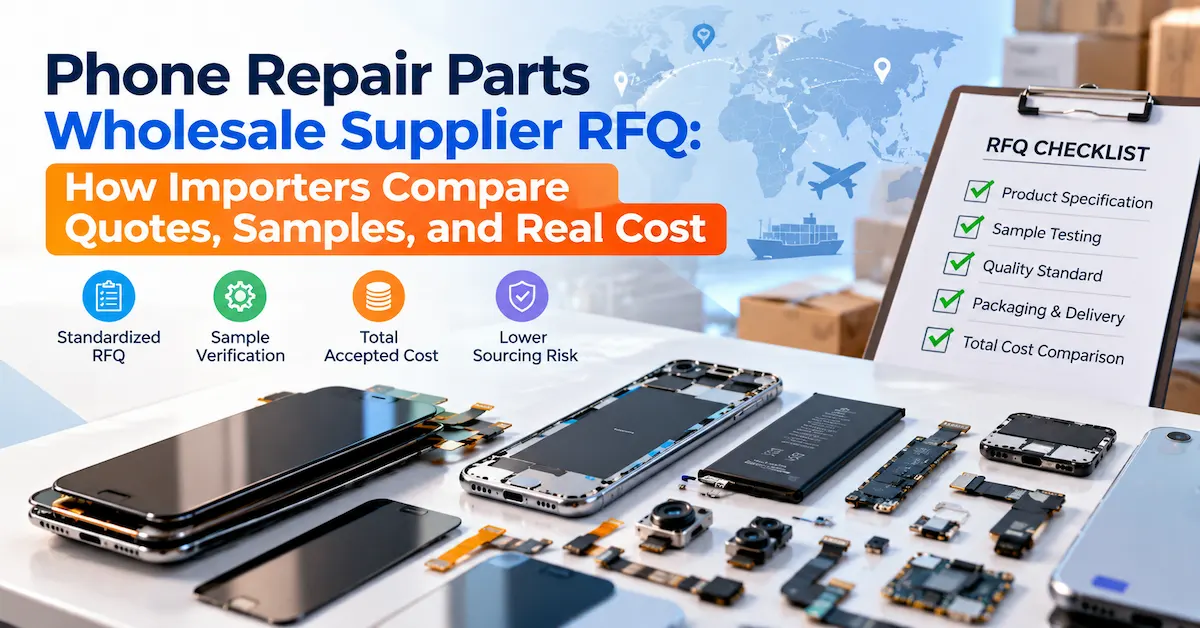

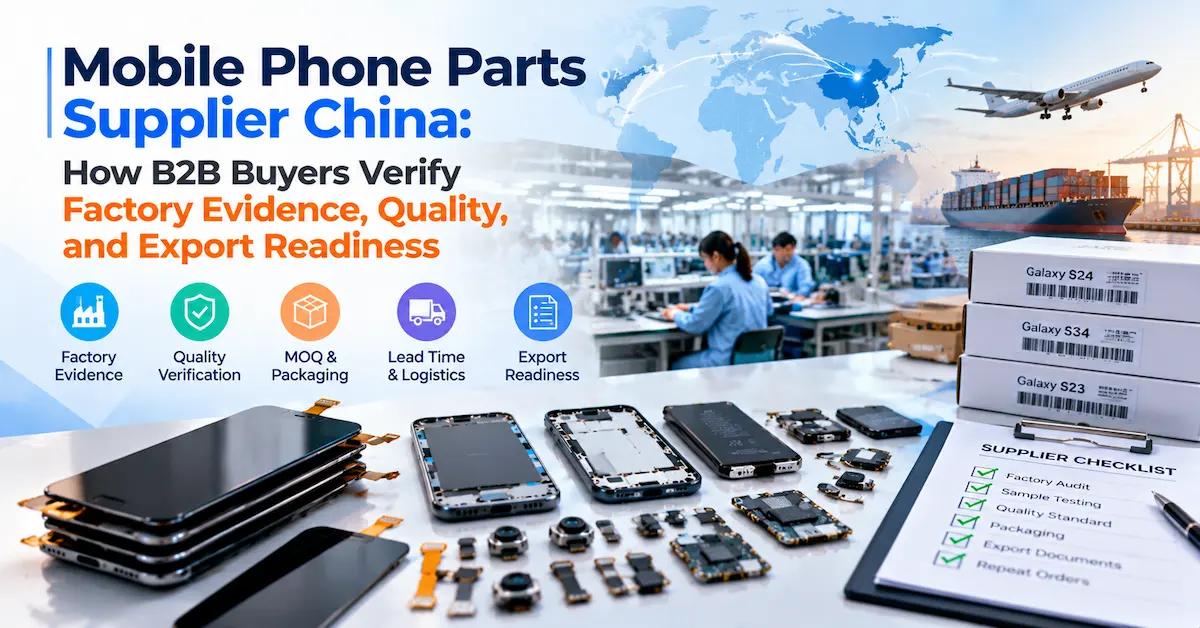
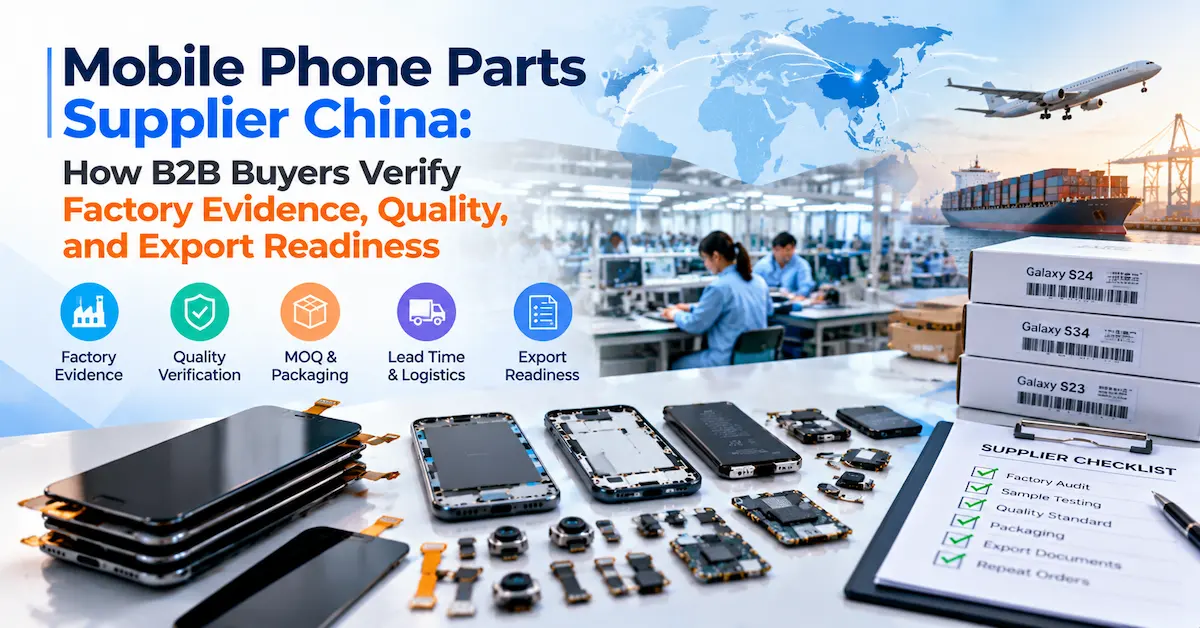
Quick Answer: How Should You Evaluate a Mobile Phone Parts Supplier in China?
A dependable mobile phone parts supplier China buyer can use should be qualified through evidence, not through a catalog size or a low first quotation. Verify five things before placing a mixed-SKU order: who the supplier is, what role it performs for each product, which parts and models it can support, how quality is tested and recorded, and whether its MOQ, packaging, documents, logistics, and after-sales process fit your market.
The practical sequence is simple: define your model and component list, check the supplier's public company evidence, request a SKU-level quotation, approve representative samples, record acceptance results, confirm commercial and export terms, and use a controlled repeat-order record. A supplier may manufacture some products, source others, or coordinate a wider supply chain. That role must be confirmed for the actual SKU instead of assumed from the word factory.
The phrase mobile phone parts supplier China usually signals commercial investigation. The buyer may be comparing Chinese suppliers for repair shops, distribution, e-commerce fulfillment, refurbishment, or after-sales service. The right question is who can provide the required parts with traceable specifications, practical purchasing terms, and repeatable execution.
What Buyers Are Actually Qualifying
A supplier name, a factory image, and a product page are three different types of information. A company may operate production facilities, manage brands, source selected components, or combine these activities across different product families. The qualification process should therefore separate the company entity, the supply role, the product, and the evidence attached to that product.
Supplier, Manufacturer, and Supply-Chain Partner Are Not Interchangeable
Many purchasing mistakes begin when a buyer treats every supplier as the manufacturer of every listed item. The word manufacturer can refer to the legal entity, the facility, the assembly process, the original brand owner, or a marketing description. For a mixed order containing displays, batteries, small parts, tools, and accessories, the answer may differ by category.
CPG presents itself publicly as China Premium Goods, a Guangzhou-based global supply-chain company founded in 2005 and focused on mobile phone parts and screen solutions for B2B customers. Its About page describes production facilities, smart management systems, three group brands, and selected brand authorizations. These are company-level facts, not proof that CPG manufactures every catalog item, so confirm the role per SKU.
| Entity or role | Question for the buyer | Evidence to request |
|---|---|---|
| Legal supplier entity | Who issues the quotation, invoice, and after-sales response? | Company name, address, contact route, quotation header, and payment details |
| Manufacturer or assembler | Who makes or assembles the quoted SKU? | SKU-specific role statement, production or assembly information, and change-notification process |
| Sourcing or distribution partner | Who selects, stocks, and ships the product if it is not made in-house? | Source-control explanation, inspection record, stock status, and approved specification |
| Product | What exact part is being purchased? | Model, component type, configuration, materials or construction, photo, and supplier SKU |
| Market and application | Where will the part be sold or installed? | Destination country, repair workflow, labeling needs, documents, and service requirements |
Use One Qualification Record Per Product Family
Do not create one broad approval called "CPG phone parts" or "China repair parts." Use separate records for LCD assemblies, batteries, small parts, adapters, cables, accessories, and repair tools. Each family has different technical risks, shipping constraints, and acceptance criteria. A buyer can still work with one commercial contact while keeping product evidence organized at the family and SKU levels.
First Check: Company Identity and Location
Before a buyer spends time comparing unit prices, confirm whether the supplier presents a consistent identity across its website, catalog, quotation, email domain, packaging, and payment documents. A mismatch does not automatically indicate a problem, but it must be explained before the first order.
A useful company check includes:
- Legal or trading name used in the quotation and invoice.
- Operating location and sales contact, including the city or region.
- Public website with a clear product scope and contact route.
- Named person or team responsible for product and technical questions.
- Documented process for samples, claims, replacements, and changes.
- Consistency between the company story and the products actually offered.
CPG's public About page identifies Guangzhou as its headquarters and describes a company history beginning in 2005. It also presents the business as a global supply-chain partner rather than only a single-product factory. A buyer can use this information to understand the commercial entity, then ask the sales team which role applies to each requested SKU.
What a Website Can Prove and What It Cannot Prove
| Public evidence | Reasonable conclusion | Conclusion that still requires confirmation |
|---|---|---|
| Company About page | The company has publicly stated its identity, location, history, and business positioning | That every catalog product is manufactured in the stated location |
| Production-facility image | The company publishes a visual representation of production or operating capacity | Capacity, process ownership, equipment list, or production output for a specific SKU |
| Product listing | A model and product description are publicly presented | Current stock, exact batch, material source, test report, or universal lead time |
| Authorization certificate | A first-party authorization document is displayed for the named brand or scope | Authorization for every phone part, model, or market |
| Fast response statement | The company states a target for responding to requests | Production completion, dispatch date, or delivery guarantee |
Second Check: Product Scope and SKU Coverage
A mobile phone parts supplier China buyer can trust should be able to translate a broad product catalog into a usable SKU response. Catalog breadth is helpful only when the supplier can identify the exact product, configuration, and availability for the buyer's market.
Start with a demand list containing:
- Brand, commercial model, exact model number, and regional variant where relevant.
- Part type: display assembly, battery, charging flex, small part, adapter, cable, tool, or accessory.
- Required configuration such as with frame, without frame, touch included, connector type, or capacity.
- Sample quantity, first order quantity, estimated monthly demand, and reorder frequency.
- Destination country, sales channel, label language, and packaging requirements.
- Critical acceptance criteria and documents required before shipment.
CPG's catalog separates major product groups, including Samsung LCD repair parts, Apple and Xiaomi display parts, mobile phone batteries, accessories, adapters and cables, and repair tools. This structure can help an importer build a candidate list. It should not replace a SKU-specific confirmation of model, configuration, stock, source, or technical documentation.
Do Not Approve a Brand Name as a Product Specification
"Samsung screen," "iPhone battery," or "mobile phone connector" is not enough for purchasing control. Similar commercial names may hide different display technologies, connector layouts, frame options, flex designs, battery capacities, or accessory versions. A good mobile phone parts supplier China inquiry keeps the buyer's SKU and the supplier's SKU visible in every quotation and sample label.
A display request should state the model, assembly type, frame status, touch requirement, color, connector or flex requirement, and sample standard. A battery request may need model, chemistry, capacity, voltage, connector, protection information, transport documents, and packaging. Fields depend on the product family.
Third Check: Materials, Construction, and Process Evidence
Materials are often used as a sales adjective instead of a purchasing field. In a display assembly, material questions can refer to the panel, cover glass, polarizer, touch layer, adhesive, flex, backlight, frame, or packaging. In a battery, the relevant information may include cell construction, protection circuit, flex, label, capacity, and required safety documents. In a tool or accessory, housing material, cable construction, connector, and electrical ratings may matter.
Ask the supplier to state which material or construction fields are verified for the quoted SKU. If a field is not published, mark it as pending confirmation. Do not infer glass type, cell source, frame alloy, adhesive, or internal process from a product photograph.
Separate the Three Evidence Levels
| Evidence level | Example wording | How it should affect the decision |
|---|---|---|
| Verified product field | Model, listed size, listed resolution, capacity, voltage, or visible configuration on the current product page | Use it in the candidate specification and verify it against the quotation or sample |
| First-party site claim | QC tested, production facility, authorization, or company capability statement | Attribute it to the supplier and ask for the relevant document or process detail |
| Open technical field | Exact material source, batch yield, defect rate, universal warranty, or all-SKU lead time | Keep it open in the RFQ; do not award full points based on an assumption |
A professional mobile phone parts supplier China comparison does not punish a supplier for having an unpublished field. It does require the supplier to identify the field, answer it clearly when relevant, and connect the answer to the correct SKU or batch.
Original CPG Evidence: Company, Products, and Operating Context
CPG publishes first-party evidence that can support the beginning of a supplier qualification file. Its public company materials describe China Premium Goods as a Guangzhou-based global supply-chain company founded in 2005, with nearly 20 years in the electronics aftermarket and a focus on mobile phone parts and screen solutions for B2B customers. The About page also describes advanced production facilities and smart management systems, and shows selected authorization certificates for named brands.

What CPG's Public Product Records Actually Show
The public catalog adds SKU-level evidence to the company and factory context. The examples below are quoted as published product records, not as independent laboratory results or universal specifications. They show the level of detail a buyer can request for every line in a mixed order.
| CPG public SKU example | Published product evidence | Still confirm in the RFQ |
|---|---|---|
| Samsung Galaxy A02S LCD assembly | 6.5-inch display, 1600 x 720 resolution, LCD and touch digitizer, black, listed compatibility for SM-A025 variants, professional QC team, tested before shipment, and bubble bag + paper box + foam box packaging. | Panel or cell source, frame configuration for the quoted batch, test record, MOQ, lead time, warranty, and manufacturing or sourcing role. |
| Alcatel 6056 LCD digitizer assembly | 6.5-inch display, 720 x 1600 resolution, LCD and touch digitizer, and a catalog statement of 100% tested one by one before shipping with bubble bag + paper box + foam box packaging. | Test method, acceptance limits, batch evidence, source or assembly responsibility, MOQ, and delivery date. |
| Eight-piece mobile repair tool kit | Plastic + metal construction, 0.8 mm, 1.5 mm, and 2.0 mm screwdriver sizes, universal compatibility, and foam box + carton packaging. | Material grade, carton quantity, available stock, MOQ, and destination-specific shipping terms. |
These records demonstrate original evidence without overstating it. CPG's About page states that product packaging carries the CPG brand and that its 2020-2024 program strengthened quality control. Public pages do not provide a named customer case, engineer profile, numeric defect rate, or universal delivery calendar; keep those fields open until CPG supplies them for the requested SKU and destination.
How to Read CPG's Public MOQ and Response Information
CPG's public FAQ states that many LCD screens and batteries commonly have an MOQ of about 10-50 pieces, while accessories such as cases and cables are usually higher, often around 100-500 pieces. The same FAQ indicates that first orders and samples may have more flexible arrangements. This is useful general guidance for planning an inquiry, but it is not a fixed MOQ for every product or model.
CPG's public contact information also states that the team responds within 24 hours with tailored recommendations and partnership solutions. Treat this as a communication response statement. It should not be rewritten as a universal production lead time, dispatch commitment, or delivery guarantee.
Do not publish one universal MOQ, material standard, test result, lead time, packaging format, warranty, or manufacturer claim for all CPG products. Confirm each value against the selected SKU, quantity, stock or production status, destination, and commercial terms.
Fourth Check: Quality Control and Sample Approval
Quality claims become useful when connected to a product, test method, acceptance rule, and responsible record. "QC tested" is a starting point, not a complete approval standard.
Define the Acceptance Standard Before the Sample Arrives
Write down what a successful sample must do. For display parts, the list may include model identity, image output, touch response, visible defects, connector and flex condition, frame fit, cosmetic condition, and package protection. For batteries, it may include model, voltage, capacity information, connector, protection behavior, physical condition, label, and transport documents. For charging parts, it may include connector fit, charging behavior, flex condition, and device-specific functions.
The acceptance list should match the intended application. A walk-in repair shop may prioritize fit and first-time installation speed. A refurbishment operation may prioritize repeatable assembly, process compatibility, and batch consistency. A distributor may prioritize labeling, carton control, documentation, and a repeatable return process.
Use a Controlled Five-Stage Sample Flow
- Identify: Record buyer SKU, supplier SKU, model, configuration, date, sample quantity, and package label.
- Inspect: Photograph the visible part, connector, flex, frame, label, and package before installation.
- Test: Perform the agreed electrical, functional, mechanical, and cosmetic checks before permanent assembly where possible.
- Decide: Approve, reject, or approve with conditions against written criteria. Do not approve a whole brand family from one sample.
- Control: Keep the approved record and compare future quotations, packaging, and samples against it.
When a product page states that a part is tested before shipment, ask what is tested, at which stage, whether the test is recorded, and how the record is linked to the shipment. If the supplier proposes a different panel, frame, cell, flex, package, or source, treat the change as a new approval event.
Fifth Check: MOQ, Lead Time, Packaging, and Export Readiness
A technically suitable part can still be a poor supplier choice if its commercial and export process does not match the buyer's operation. A mobile phone parts supplier China buyer should qualify the full order path, from sample to shipment and claim handling.
MOQ and Mixed-SKU Rules
Ask whether MOQ applies per model, per configuration, per quality option, per packaging format, or to the combined order. A total order of 100 pieces may not satisfy ten separate SKUs if the minimum is applied to each row. Ask whether samples count toward the first order, whether slow-moving models can be mixed, and whether a private label or custom carton changes the minimum.
Lead Time With a Defined Starting Point
Lead time should identify what starts the clock. Possible starting points include sample confirmation, order confirmation, deposit receipt, artwork approval, material approval, or production release. Ask the supplier to separate sample preparation, stock allocation, production, inspection, packaging, and dispatch. If one item in a mixed order is delayed, confirm whether the shipment can be split and how additional logistics costs are handled.
Packaging and Warehouse Identification
Packaging is part of product control, especially for fragile displays, batteries, and mixed model shipments. Request unit protection, inner packing, master carton information, carton quantity, dimensions, gross weight, model marking, buyer SKU, barcode, and handling instructions where relevant. A package that protects a screen but does not identify the model can still create warehouse errors.
Export Documents and Destination Requirements
Tell the supplier the destination country and product category before the quotation is finalized. Batteries may require different shipping and safety documentation from display assemblies or accessories. Labels, cartons, invoices, packing lists, transport restrictions, and import requirements can vary by market. Do not assume that a supplier's ability to ship one category means every category follows the same route or document set.
For product-specific questions, buyers can use the CPGLCD contact page to send a model list, destination, quantity, packaging request, and required documents. A specific inquiry gives the sales and sourcing team enough context to answer the actual order rather than returning a generic catalog.
Compare Total Usable Cost, Not Only Unit Price
The cheapest quotation can become the most expensive source when the buyer pays for wrong models, failed samples, rework, returns, freight damage, relabeling, or excess stock. This is why supplier qualification should include a simple total usable cost model.
Total usable cost per accepted part = product price + packaging + freight + duties and fees + inspection cost + expected rework and return cost + inventory carrying cost, divided by the number of accepted and usable parts.
The formula does not need perfect data at the first comparison stage. It is a discipline for showing which assumptions remain open. If one supplier cannot provide the packaging weight, test basis, defect process, or lead-time condition, record the missing input instead of treating it as zero.
For a mobile phone parts supplier China comparison, the most important cost variables may differ by buyer:
- Repair shops often care about installation time, fit, technician rework, and customer return risk.
- Distributors care about SKU accuracy, packaging, labels, carton counts, claims, and replenishment.
- Refurbishment operations care about process yield, batch consistency, and controlled changes.
- E-commerce sellers care about listing accuracy, fulfillment packaging, documentation, and return rates.
Use a 100-Point China Supplier Scorecard
Use the same scorecard for each candidate. A score is meaningful only when it has an evidence reference beside it. If a supplier has not answered an important question, mark it as pending rather than awarding a pass.
| Evaluation area | Weight | Evidence to request | Pass question |
|---|---|---|---|
| Company identity and supplier role | 15 | Company details, quotation entity, and SKU-level role statement | Can the buyer identify who sells, makes, assembles, or sources the product? |
| Product and model coverage | 15 | Completed model matrix and supplier SKU mapping | Can the supplier answer the actual demand list instead of only presenting a catalog? |
| Technical specification | 15 | Configuration, material or construction fields, compatibility, and photos | Are the important product fields clear enough for approval? |
| Sample and testing | 15 | Tagged samples, acceptance criteria, test method, and records | Can the buyer approve the product using repeatable checks? |
| Batch and change control | 10 | Reorder record, revision notice, and source or process change policy | Can the approved specification survive replenishment? |
| MOQ and inventory fit | 8 | MOQ per SKU, mixed-order policy, and price breaks | Can the buyer stock the right quantity without avoidable overstock? |
| Packaging and warehouse control | 7 | Packaging photos, labels, carton data, and damage process | Can parts arrive protected and remain identifiable? |
| Export and logistics readiness | 8 | Destination-specific documents, shipping basis, and dispatch conditions | Can the order move through the intended route without undefined requirements? |
| Communication and after-sales | 7 | Named contacts, claim process, response route, and replacement terms | Can issues be resolved using a clear evidence trail? |
Score each category from 0 to 5, multiply by the weight, and divide by 5. Do not allow a strong company presentation to compensate automatically for an unresolved model mismatch or absent sample evidence. For high-risk products, technical and export evidence should be treated as a minimum gate, not only as points in a total score.
How to Move From Sample to Repeat Order
Supplier qualification is incomplete when the first sample works but the second or third order is uncontrolled. A buyer should define what is fixed, what can change, and how a change is communicated.
Stage 1: Create the Approved Product Record
Keep the model, supplier SKU, buyer SKU, configuration, visible markings, material or construction fields, packaging, test criteria, sample photos, commercial terms, and approval date together. The record should be understandable to purchasing, technical, warehouse, and finance teams.
Stage 2: Link the Record to the Purchase Order
Reference the approved SKU and configuration in the quotation, purchase order, carton label, invoice, and packing list. If the supplier uses a different internal code, keep the mapping visible. A catalog title is not enough to control a repeat order.
Stage 3: Define Change Notification
Ask the supplier to notify the buyer before a change to source, material, panel, cell, flex, frame, assembly process, package, label, or test method that could affect compatibility or performance. The appropriate response may be a new sample, a document review, or a conditional approval depending on risk.
Stage 4: Review the First Replenishment
Compare the replenishment quotation and packaging with the approved record. Inspect representative units when the product or supplier is new. Record damage, defects, missing documents, model mix-ups, and response time. The result becomes evidence for the next order, not only a complaint after the fact.
Common Mistakes When Choosing a China Phone Parts Supplier
Mistake 1: Treating Factory Photos as a Technical Audit
A production image can support company context, but it cannot establish the process, output, material, or test result of a specific product. Use the image to start a conversation, then request product evidence.
Mistake 2: Assuming One Company Role Applies to Every SKU
A supplier may manufacture, assemble, stock, or source different categories. Ask the role question per product family and, when material, per SKU. Transparent role information is more useful than an unsupported manufacturer label.
Mistake 3: Comparing Prices Before Normalizing the Specification
Two low prices may represent different frame status, components, packaging, quality options, shipping terms, or test scope. Normalize the product first and compare total usable cost second.
Mistake 4: Turning General MOQ Guidance Into a Contract Term
Public MOQ information is helpful for planning, but the final minimum can vary by model, quantity, stock status, packaging, destination, and order arrangement. Put the confirmed value in the quotation.
Mistake 5: Ignoring Export Constraints Until After the Order
Destination, battery restrictions, labels, documents, and shipping terms should be discussed before payment and packing. Late discovery can change cost, timing, or whether a shipment is practical.
Mistake 6: Approving a Brand Family Instead of a SKU
Approval should name the exact model and configuration. "Samsung approved" or "iPhone battery approved" is too broad for a repeat-order record.
Prepare a Qualification-Ready Inquiry
A concise but complete inquiry helps a mobile phone parts supplier China sales or sourcing team return a response that purchasing can actually compare. Send one spreadsheet with one row per requested product and include:
- Buyer company, country, application, and destination warehouse.
- Product category, device brand, model, exact variant, and buyer SKU.
- Component type and required configuration.
- Known materials, capacity, voltage, display data, or construction requirements.
- Sample quantity, first-order quantity, expected monthly demand, and reorder plan.
- Acceptance tests, defect limits, photos, reports, and certificates required.
- Packaging, labels, barcodes, carton marks, and language requirements.
- MOQ per SKU, stock status, sample timing, production timing, dispatch terms, and shipping basis.
- After-sales process, warranty scope, claim evidence, and change notification.
For category exploration, buyers can review mobile phone accessories, mobile phone batteries, and repair tools and machines. For a supplier response, send the exact list through the CPGLCD contact page instead of asking for a broad price list without model and quantity information.
Frequently Asked Questions
What does mobile phone parts supplier China mean for a B2B buyer?
It generally refers to a China-based supplier or supply-chain partner that provides replacement parts, accessories, tools, or related products for overseas business buyers. The phrase does not by itself prove that the supplier manufactures every listed product. The buyer should confirm the company, product, role, and terms for the actual order.
How can I tell whether a China supplier is a manufacturer or a sourcing partner?
Ask who makes, assembles, stocks, inspects, and ships each product family or SKU. Request a written role statement, product specification, sample evidence, and change-control process. A supplier that clearly explains the role may be more useful than one that uses a broad manufacturer claim without product detail.
Is a factory photo enough to qualify a mobile phone parts supplier China?
No. A factory photo is first-party visual evidence of the environment presented by the company. It does not establish materials, production capacity, batch performance, test data, or manufacturing responsibility for every part. Use it as context and require SKU-level evidence.
What should I include in a phone parts supplier RFQ?
Include the exact model and variant, component type, configuration, quantity, sample requirement, application, destination, packaging, labels, tests, documents, MOQ, lead-time starting point, shipping basis, and after-sales requirements. One row per SKU makes the supplier response easier to compare.
What MOQ can I expect from a China phone parts supplier?
CPG's public FAQ gives general guidance of about 10-50 pieces for many LCD screens and batteries, while accessories may be higher, often around 100-500 pieces. These values are not universal. Confirm the MOQ per SKU, configuration, packaging, quantity, and order arrangement.
How should I compare samples from two suppliers?
Use the same model, configuration, test method, sample quantity, installation process, cosmetic criteria, and acceptance rule for both suppliers. Record supplier SKU, date, package, test result, failures, rework, and technician feedback. Compare accepted and usable parts rather than first impressions.
What materials should be confirmed for mobile phone parts?
The answer depends on the product. Display buyers may need panel, cover glass, touch layer, adhesive, flex, backlight, and frame information. Battery buyers may need cell, protection circuit, flex, capacity, label, and documents. Ask for the fields that affect your application and keep unverified fields open.
How do I verify lead time?
Ask the supplier to separate sample preparation, stock allocation, production, inspection, packaging, and dispatch. Define the event that starts the lead-time clock, such as deposit receipt or sample approval. A response-time promise is not the same as a production or delivery commitment.
Should packaging be part of the supplier qualification?
Yes. Packaging affects damage, warehouse identification, mixed-SKU control, shipping cost, and customer presentation. Confirm unit protection, labels, carton quantity, dimensions, weight, carton marks, and any private packaging requirements before the order is released.
Where can I request a product-specific response from CPG?
Review the relevant CPG product category first, then use the contact page to submit the model list, quantities, destination, technical requirements, packaging, and document questions. This gives the team the information needed for a SKU-specific quotation.
Conclusion
The best mobile phone parts supplier China is not selected by a factory photo, the largest catalog, or the lowest unit price alone. Overseas buyers should qualify the supplier as a complete operating system: company identity, role by SKU, product coverage, material and construction evidence, sample testing, batch control, MOQ, packaging, export documents, logistics, and after-sales response.
When the qualification record is tied to the model, configuration, test result, packaging, and reorder process, a China sourcing decision becomes easier to audit and scale. Start with the products relevant to your market, ask the unanswered SKU-level questions, approve representative samples, and keep the accepted specification visible through every repeat order.