

Why Mobile Phone Battery Supplier Selection Requires More Than a Price Comparison
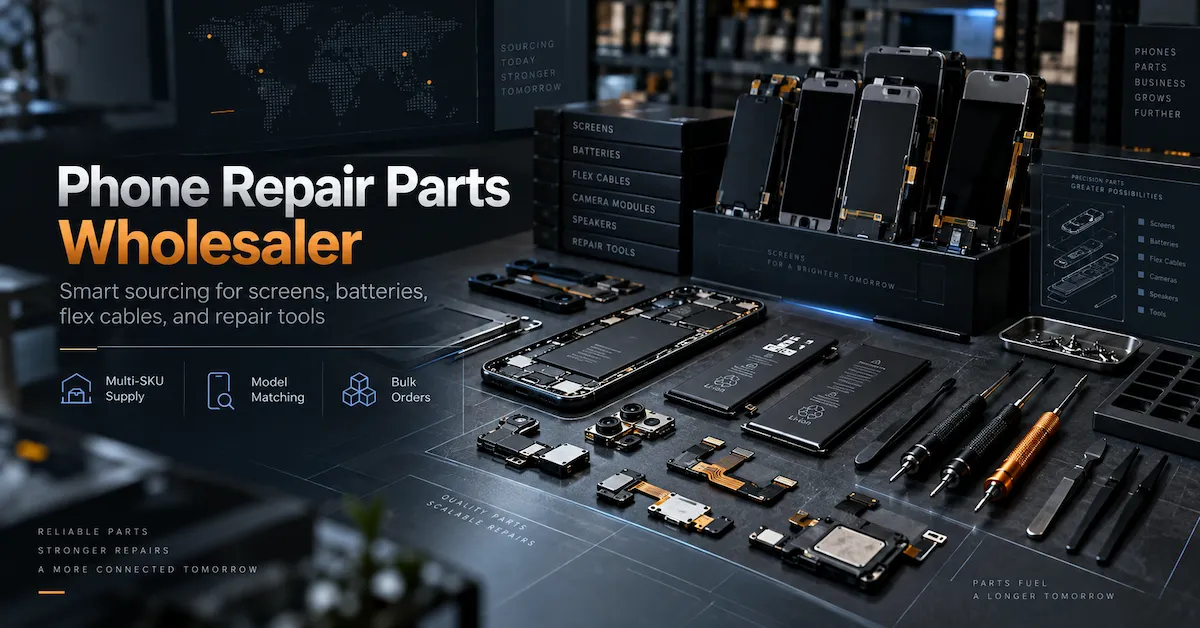
A professional buyer should select a mobile phone battery supplier by first confirming the exact battery required, then evaluating the proposed product, sample approval process, order identification, packaging, commercial terms, and repeat-order consistency. A low quotation does not show whether the battery matches the intended phone, whether the connector and dimensions correspond to the required configuration, or whether the next shipment will be supplied under the same specification. Repair businesses also have different priorities: a local repair shop may concentrate on frequently serviced models, a distributor may need many SKUs in one shipment, while a refurbishment operation may care more about repeatable batch specifications. CPG lists mobile phone batteries as one of its repair-parts categories within a wider mobile phone parts catalog, alongside displays, internal repair parts, charging components, accessories, and tools, allowing professional buyers to discuss batteries as part of a broader repair-parts order.

Which Buyers Need a Mobile Phone Battery Supplier—and Which Requirements Need Separate Verification
A mobile phone battery supplier is most relevant to independent repair stores, repair chains, parts wholesalers, regional distributors, importers, online parts sellers, and smartphone refurbishment businesses purchasing batteries for repeated professional use. Each buyer should define the purchasing objective differently: repair shops may need smaller quantities of popular models, distributors need a manageable SKU structure and replenishment process, and refurbishers may need approved configurations that can be repeated across a device batch. This guide is not intended to tell consumers how to open a phone or install a lithium battery, and it should not be used as proof that a battery is officially authorized by a phone brand. If your procurement specification requires original-brand authorization, a particular certification, a particular cell source, or a defined compliance document, request documentation for the exact offered SKU rather than relying on general catalog wording. CPG describes itself as a multi-brand, one-stop supply-chain business and states that it has developed relationships with core factories, so battery sourcing should be evaluated at the specific product and order level rather than assuming every item has the same manufacturing origin or specification.
Start Every Battery RFQ With the Exact Phone Model
The first purchasing error to prevent is an incomplete model request. “iPhone battery,” “Samsung battery,” or “Android battery” is not enough for a bulk quotation because phone families can contain multiple generations and variants. Your RFQ should identify the brand, complete commercial model, model code where available, and any relevant regional or hardware version, then connect that device information to the supplier’s specific battery reference. The same discipline should continue after the first order: retain the approved supplier SKU, sample reference, photos, labels, and specifications so purchasing staff do not approve a later shipment based only on a familiar product name. CPG’s own repair-parts guidance emphasizes battery model compatibility and connector matching as important purchasing considerations, reinforcing the value of model-specific sourcing rather than broad category ordering.
Build a Technical Specification Sheet Before Comparing Mobile Phone Battery Suppliers
A useful battery specification sheet separates information already confirmed from information still requiring supplier confirmation. Capacity is one field, but professional procurement may also need nominal electrical values, battery dimensions, connector or flex-cable configuration, label information, compatible models, packaging, and any device- or software-dependent behavior. Do not fill missing fields by copying specifications from another seller because visually similar batteries or batteries intended for the same phone family may not necessarily represent the same commercial configuration. Ask the mobile phone battery supplier to confirm which specifications apply to its actual product and record those details alongside the quotation.
| Specification Field | What the Buyer Should Confirm | Why It Matters |
|---|---|---|
| Device identification | Brand, full phone model, model code or relevant version | Reduces wrong-model purchasing |
| Supplier product reference | SKU or exact product title | Creates a traceable reorder reference |
| Battery capacity | Rated or stated capacity and the supplier’s measurement basis where available | Prevents comparisons based on unclear capacity claims |
| Electrical specification | Nominal voltage and other stated electrical values | Helps confirm the proposed battery specification |
| Physical dimensions | Length, width, thickness, shape | Supports mechanical fit verification |
| Connector/flex | Connector location, flex layout and contact configuration | Helps identify incompatible assemblies |
| Included components | Battery pack and any parts supplied with it | Prevents misunderstanding of delivery scope |
| Label/marking | Model label, batch or production identification where provided | Supports receiving and repeat orders |
| Compatibility | Exact supported device variants | Prevents family-name assumptions |
| Packaging | Individual protection, inner packaging and outer carton | Important for handling and shipment planning |
| Special behavior | Any model- or software-dependent function described by the supplier | Requires sample verification before scale-up |
Do Not Evaluate Replacement Batteries by Capacity Alone
Capacity is easy to compare because it is usually presented as a number, but it is not enough to qualify a replacement battery. A buyer should review whether the offered pack is intended for the correct device, whether its physical form and connector layout match the required configuration, how the battery is labeled, what functional information is provided, and what evidence supports any capacity or performance claim. If two suppliers quote apparently identical capacities but one quotation identifies the product and testing conditions clearly while another provides only a generic capacity figure, the quotations are not yet technically equivalent. The same applies to descriptions such as “high capacity,” “premium,” “original quality,” or similar commercial wording: convert each claim into a question that can be checked through specifications, documents, a sample, or an agreed inspection record. CPG’s existing B2B sourcing content likewise advises buyers to consider model compatibility, connector design, battery condition, packaging, and supply continuity instead of focusing only on a capacity number.
Use Sample Approval to Define What You Are Actually Buying
Before scaling an unfamiliar battery to a larger order, establish a sample approval record that can later be compared with production shipments. The purpose is not simply to see whether a phone powers on. A buyer-defined evaluation can include model and connector verification, physical condition, fit, charging behavior, device recognition where relevant, and other functions important to the intended repair workflow. Record the test device, software conditions where they could affect behavior, sample SKU, label photos, test date, and acceptance result. If the supplier provides a capacity report, inspection record, or other measurement, retain it with the sample file rather than reducing the result to “sample passed.” A sample is useful only when the bulk order refers back to the approved configuration; otherwise, a successful sample cannot protect the buyer from an undocumented product change later.
Define QC Evidence Instead of Accepting “Tested” as a Complete Answer
When evaluating a mobile phone battery supplier, ask what “tested” means for the battery being quoted. An appearance inspection, connector check, charging test, capacity measurement, device installation test, and full electrical evaluation are different activities, and they should not be treated as interchangeable. Ask whether the claimed inspection applies to every unit or to a sample from the batch, what equipment or method is used where relevant, which acceptance limits are applied, and whether a batch or date reference can be linked to the result. CPG states on its company page that quality-control activities were strengthened during its operational development, while its broader repair-parts content identifies appearance, model verification, connector condition, and charging performance as battery inspection considerations. These statements provide useful topics for buyer discussion, but the actual inspection scope should still be confirmed for the battery SKU being purchased.
Treat Software-Dependent Battery Features as a Separate Qualification Project
Some replacement batteries require more careful evaluation because the purchasing decision involves device recognition or software-dependent behavior in addition to basic battery replacement. CPG currently lists a No Pop-Up Warning battery range for iPhone 11 through iPhone 15 series. The product page describes no-pop-up functionality and states that no additional JCID flex or welding is required, but it also contains specific conditions related to software versions around iOS 17.4 and health-status display. Those conditions make it especially important for professional buyers to validate the exact phone model, battery version, current software environment, installation process, and resulting device behavior before approving a bulk order. The page also uses commercial wording such as “Ori”; professional buyers should clarify what such terminology means commercially and request any documentation required by their own sourcing policy rather than treating a product-page label as proof of original-brand authorization.
Compare Battery Options by Application, Not by One Universal “Best” Grade
Different buying situations require different approval standards, so a mobile phone battery supplier should be evaluated against the application rather than a vague “best quality” request. The table below is a procurement comparison framework, not a claim that every CPG battery is available in each configuration.
| Sourcing Scenario | Typical Buyer Priority | Key Verification | Main Purchasing Risk |
|---|---|---|---|
| Standard model-specific replacement | Repair shops and service centers | Model, dimensions, connector, capacity information, functional sample | Wrong model or inconsistent specification |
| Software-sensitive replacement | Buyers handling models with device-recognition behavior | Model, battery version, software conditions, installation result | Assuming one result applies to every software version |
| Mixed-model wholesale order | Distributors and importers | SKU list, quantity per model, labels, carton separation | Warehouse confusion or model mix-ups |
| Repeat refurbishment order | Refurbishment operations | Approved sample, batch reference, repeat specification | Undocumented changes between orders |
| Private-label retail program | Distributors or branded resellers | Product approval plus packaging artwork and labeling | Confusing packaging customization with battery redesign |
Packaging and Identification Should Be Part of Battery Quality Management
Battery purchasing does not finish when the product passes a functional sample. Individual packaging, model identification, carton organization, and handling protection also affect whether a wholesale order arrives in a form that a distributor or repair operation can control. CPG’s specific No Pop-Up battery page describes blister box, paper box, shockproof foam box, and carton packaging for that product. That packaging description should not automatically be applied to every battery in the catalog; instead, confirm the quoted packaging for each order and ask how different models will be separated and labeled. For mixed-model purchases, require an itemized packing list and a clear relationship between the supplier SKU, model label, quantity, and carton contents. This is especially useful for wholesalers managing many similar battery packs where a warehouse error can later appear to be a compatibility problem.
Evaluate MOQ, Availability, and Lead Time Separately
CPG’s FAQ states that the typical MOQ for many mobile phone parts such as LCD screens and batteries is 10–50 pieces, while first-time customers and sample orders may have flexible quantities. That is a general website guideline rather than a fixed MOQ for every battery. Ask the supplier to confirm MOQ per SKU, whether mixed-model quantities can be combined, how many units are currently available, and what replenishment or preparation time applies to items not ready for immediate dispatch. Keep “stock availability,” “supplier dispatch time,” and “carrier transit time” as separate entries in the purchasing file because they represent different parts of the delivery process. The FAQ lists questions about shipping, payment, warranties, and returns, but the currently visible page does not provide complete answers for all of those items, so buyers should request the applicable commercial terms before approving the order rather than assuming a standard lead time or warranty.
Calculate the Cost of an Accepted Battery, Not Only the Quoted Unit Price
The lowest quoted battery is not necessarily the lowest-cost purchasing decision. Create an internal comparison that includes unit price, freight allocation, receiving inspection, documented model-selection errors, unusable units, rework directly attributable to the purchased part, and any handling required to resolve claims. A simple internal calculation is total purchasing and handling cost divided by the number of accepted usable units. Keep the causes separated: an incorrect model ordered by the buyer, the wrong SKU shipped by the supplier, physical transport damage, and a battery failing an agreed functional requirement are different problems and should not be grouped into one generic failure percentage. Over several orders, this data gives purchasing teams a more useful view of supplier performance than promotional claims about quality or savings.
Do Not Confuse Packaging Customization With Battery Engineering
CPG’s About Us page states that the business has provided customized packaging and promotional materials to support customer markets. That can be relevant for distributors and private-label resellers that need packaging artwork, product labels, barcodes, pack quantities, or localized marketing materials. However, packaging customization does not automatically mean that every battery supports changes to cell specifications, capacity, protection circuits, connectors, or electrical design. If your project requires an OEM or ODM change to the battery itself, treat it as a separate technical project: define the requested specification, ask whether the selected product can support it, obtain a sample, and approve the changed version independently from the packaging artwork. This keeps product engineering decisions separate from branding decisions and reduces ambiguity during repeat orders.
How CPG Fits Into a Broader Repair-Parts Purchasing Strategy
Battery sourcing rarely exists in isolation for repair shops and distributors. The same buyer may also need displays, charging flex cables, speakers, cameras, chargers, cables, protective accessories, or repair tools. CPG’s complete product catalog organizes multiple repair and accessory categories, while the company profile describes the business as a multi-brand, one-stop supply-chain provider that works with core factories. For buyers, the potential advantage of consolidating categories is administrative: fewer purchase lists, fewer supplier conversations, and an opportunity to coordinate shipment planning. It should not mean reducing the technical approval standard. Each product category still requires its own compatibility checks and acceptance criteria, especially batteries where model identification and product condition matter.
Prepare a Quote-Ready Battery RFQ Before Contacting CPG
A useful request to a mobile phone battery supplier should be specific enough that the supplier can identify the intended item without repeatedly asking basic compatibility questions. Prepare a spreadsheet containing the phone brand, complete model, model code if available, required quantity, supplier SKU if known, capacity or specification requirement, packaging requirement, destination, sample requirement, and any special compatibility concern. Attach photographs when a model or connector needs visual confirmation. For a first order, ask which items should be sampled before bulk purchasing and request product-specific MOQ and commercial terms. Buyers can review CPG’s price-list and support page as part of purchasing preparation, then use the contact page to submit model lists, quantities, and sourcing requirements. CPG’s contact page states that its team responds to B2B product and custom-solution inquiries, making a structured RFQ more useful than a message asking only for “your best battery price.”
Frequently Asked Questions
1. What Should I Ask a Mobile Phone Battery Supplier Before Ordering?
Start with the exact supported phone model, supplier SKU, stated capacity and electrical specification, battery dimensions, connector configuration, packaging, MOQ, availability, sample options, and applicable commercial terms. For any special battery function, also document the device and software conditions under which the feature has been evaluated.
2. Is Battery Capacity Enough to Compare Two Suppliers?
No. Capacity is only one specification. Buyers should also compare compatibility, connector and physical configuration, product identification, sample results, packaging, order traceability, and the evidence behind any claimed battery performance. Two products with the same advertised capacity may still represent different commercial configurations.
3. What Is CPG's MOQ for Mobile Phone Batteries?
CPG’s FAQ states that the typical MOQ for many mobile phone parts such as batteries and LCD screens is around 10–50 pieces, with flexible quantities mentioned for first-time customers and sample orders. The exact MOQ should still be confirmed for the selected battery model and quantity before ordering.
4. Should I Order Samples Before a Large Battery Purchase?
A sample is useful when qualifying a new model, supplier, or special battery function. Define the sample acceptance criteria before testing, record the exact supplier reference and configuration, and make the eventual bulk purchase refer back to that approved sample rather than treating sample approval as a general approval for every future version.
5. How Should Distributors Manage Many Battery Models in One Shipment?
Use one order line for each model and supplier SKU, require clear labels and an itemized packing list, and confirm how different models will be separated. Keep approved sample photographs and model information in the receiving file so warehouse staff can identify discrepancies before the batteries reach customers.
6. Does “No Pop-Up” Mean the Same Thing on Every iPhone and Software Version?
It should not be assumed. CPG’s current No Pop-Up battery listing covers multiple iPhone 11–15 series models but also includes software-version-dependent information. Buyers planning to purchase this range should validate the exact device and software environment relevant to their repair business before bulk approval.
7. How Should I Check a Replacement Battery Sample?
Create a defined procedure appropriate to your repair operation. Typical purchasing checks can include model identification, appearance, physical fit, connector condition, charging behavior, device recognition where relevant, and any agreed functional requirement. Record the test device and result so later batches can be compared with the same reference.
8. Can CPG Provide Customized Battery Packaging?
CPG’s company profile states that customized packaging and promotional materials have been provided to clients. Buyers should confirm packaging feasibility, quantities, artwork requirements, and any additional cost for the selected battery project. A packaging program should not be interpreted as approval for an electrical or structural battery modification.
9. What Information Should Be Retained for Repeat Battery Orders?
Retain the supplier SKU, complete compatible model, approved sample reference, product photos, stated specifications, label information, packaging requirement, previous purchase order, and any acceptance record. Ask for confirmation if a specification or supplied configuration changes before a repeat shipment.
10. How Can I Request a Wholesale Battery Quote From CPG?
Prepare the phone models, quantities, required battery configurations, destination, and sample or packaging needs, then submit the inquiry through the CPG contact page. A model-by-model RFQ allows the supplier to confirm available items and commercial terms more accurately than a general request for a single wholesale price.
Conclusion
Choosing a mobile phone battery supplier should begin with compatibility and specification control, then move to sample verification, QC evidence, packaging, MOQ, commercial terms, and repeat-order management. Repair shops need dependable model matching, distributors need clear SKU and packaging control, and refurbishment businesses need repeatable approved configurations; all three buyer groups benefit from measuring the cost of accepted usable batteries rather than comparing unit price alone. CPG provides batteries within a broader mobile phone repair parts portfolio, including a specific iPhone No Pop-Up battery offering with conditions that professional buyers should verify for their target devices. If you are preparing a wholesale order, contact CPG with your model list, quantities, sample requirements, packaging needs, and destination so each battery can be confirmed against a clearer purchasing specification.