
Why Repair Shops Need a Structured Xiaomi LCD Screen Sourcing Process
A Xiaomi LCD screen supplier for repair shops should provide more than a product list. Professional repair businesses need a sourcing process that helps them identify the correct Xiaomi model, confirm the display configuration, understand included components, evaluate samples, and maintain consistency across repeat orders.
Xiaomi has released many Mi, Redmi, and Redmi Note devices with different screen sizes, structures, and assembly designs. A request such as “Xiaomi screen” or “Redmi LCD” is usually not specific enough for a reliable wholesale quotation. Repair shops and distributors should connect every order line with the exact device model, supplier SKU, assembly type, and approved product reference.
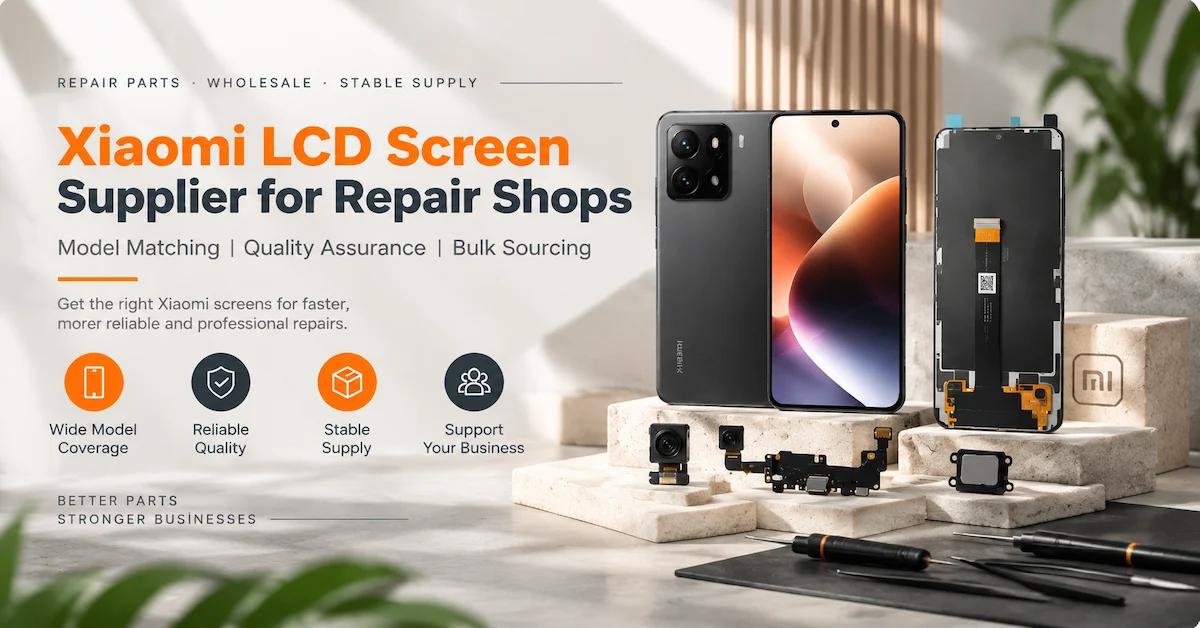
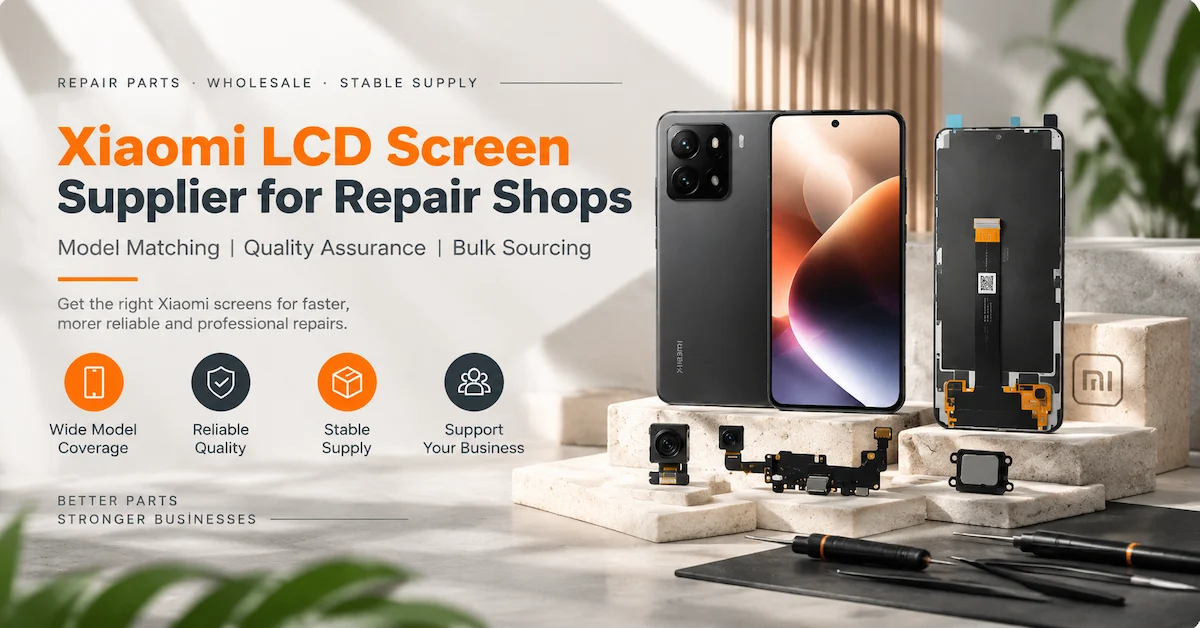
CPG organizes Xiaomi replacement displays through its Xiaomi LCD repair parts category, covering Xiaomi Mi, Redmi, and Redmi Note series. This category structure helps buyers discover available products, but each selected item should still be verified at SKU level before bulk purchasing.
Who Needs a Xiaomi LCD Screen Supplier for Repair Shops?
Different repair businesses have different purchasing priorities, even when they buy similar Xiaomi replacement screens.
Independent repair shops usually focus on popular Xiaomi and Redmi models that appear frequently in daily repair orders. Their main concerns are correct model matching, installation efficiency, and avoiding returns caused by incorrect parts.
Repair chains need more standardized purchasing records because multiple technicians or locations may handle the same models. They benefit from consistent product descriptions, approved samples, and clear SKU management.
Wholesale distributors and importers often purchase many Xiaomi models together. Their main requirements usually include product organization, packaging control, quantity management, and repeat supply planning.
Refurbishment businesses may require larger quantities of selected Xiaomi models and therefore need stronger control over product consistency between batches.
For all these buyers, choosing a Xiaomi LCD screen supplier for repair shops should focus on technical matching and purchasing control rather than only comparing the lowest unit price.
Confirm the Exact Xiaomi Model Before Ordering Screens
The first step in Xiaomi display sourcing is identifying the exact device. Xiaomi product families contain many similar names, including Mi series, Redmi series, and Redmi Note series. Different generations may have different screen sizes, connectors, frames, and assembly structures.
A professional RFQ should include:
| Information | Purpose |
|---|---|
| Xiaomi device model | Confirms the target phone |
| Model code if available | Helps distinguish similar versions |
| Series and generation | Prevents family-level mistakes |
| Required screen configuration | Defines the expected assembly |
| Quantity | Supports accurate quotation |
| Sample requirement | Establishes approval process |
| Destination | Helps confirm shipping requirements |
CPG’s Xiaomi repair-parts category includes examples such as Xiaomi Mi 10 5G, Mi Note 10 Lite, Mi 11 Ultra, Mi 14T, Redmi Note models, and Redmi series replacement displays. Because different models have different specifications, buyers should avoid approving products only by series name.
Understand Xiaomi LCD Assembly Configurations
A Xiaomi LCD screen supplier for repair shops should clearly explain what is included in each display assembly. Different listings may represent different configurations, such as display-only parts, touch screen assemblies, or assemblies with a frame.
Before purchasing, buyers should confirm:
- Whether the frame is included
- Whether the touch layer is included
- Whether the flex cable is included
- Whether additional transfer work is required
- Whether the assembly matches the intended repair process
For repair shops, the correct configuration depends on technician experience, equipment availability, repair volume, and total labor requirements.
A lower purchase price does not always mean a lower repair cost. A configuration that requires additional transfer work may increase labor time, while another configuration may better fit a high-volume workflow.
With Frame vs Without Frame: Choose Based on Repair Workflow
Frame selection is one of the most important factors when purchasing Xiaomi replacement screens.
| Configuration | Characteristics | Buyer Consideration |
|---|---|---|
| Screen assembly with frame | Includes the frame structure specified by the listing | May reduce transfer steps during repair |
| Screen assembly without frame | Requires existing frame or additional transfer work | Suitable for experienced technicians and specific workflows |
| Display and touch assembly | Focuses on display-related components | Requires confirmation of included parts |
Neither configuration is universally better. A repair shop with fast replacement requirements may prefer a configuration that reduces installation steps, while a refurbishment company may select another option based on equipment and labor cost.
The decision should consider the complete repair process instead of only the component price.
Create a Xiaomi Screen Specification Checklist
A standard specification checklist helps repair shops compare quotations from different suppliers more accurately.
| Specification Item | What to Confirm |
|---|---|
| Device model | Exact Xiaomi, Redmi, or Redmi Note model |
| Assembly type | With frame or without frame |
| Display components | Display, touch, flex cable, included parts |
| Screen size | Product-specific size information |
| Resolution | Product-specific resolution information |
| Connector | Flex and connector compatibility |
| Supplier SKU | Exact product reference |
| Packaging | Protection and labeling method |
| Sample status | Approved or pending evaluation |
| Quantity | Model-specific order quantity |
This structure prevents buyers from comparing different products as if they were identical.
Evaluate Xiaomi Screen Quality Through Practical Checks
Quality evaluation should focus on specific inspection points instead of general descriptions.
Appearance Inspection
Check whether the assembly arrives without visible damage, scratches, contamination, or abnormal physical deformation.
Display Function
Confirm the display output according to the repair shop’s agreed inspection process, including visible image quality and abnormal display behavior.
Touch Function
Check touch response across the usable area and confirm whether the assembly performs as expected on the target device.
Physical Fit
Verify whether the screen assembly matches the device housing, mounting points, and installation requirements.
Flex and Connector Condition
Inspect the flex cable position, connector condition, and visible assembly structure before installation.
These checks should become part of the buyer’s acceptance process instead of relying only on product descriptions.
Review Xiaomi LCD Supplier Information Carefully
A Xiaomi LCD screen supplier for repair shops may provide different types of information, including product descriptions, company information, and supporting documents. Buyers should understand what each type of information actually proves.
For example:
- A product page confirms the listed product information, but not necessarily every technical characteristic not mentioned.
- A company profile describes business information, but does not automatically verify every individual SKU.
- A quality statement should be connected with a defined inspection process.
Professional buyers should match each claim with the relevant product evidence before using it in purchasing decisions.
Compare Xiaomi LCD Screen Options by Application
Different buyers may choose different Xiaomi screen solutions depending on their workflow.
| Buyer Type | Main Priority | Key Evaluation Point |
|---|---|---|
| Repair shop | Fast and accurate replacement | Model matching and installation suitability |
| Repair chain | Standardized repairs | Consistent SKU and product records |
| Distributor | Multiple Xiaomi models | Packaging and inventory management |
| Refurbishment business | Repeat batch repairs | Sample approval and consistency |
| Online seller | Accurate listings | Compatibility information |
The correct sourcing decision depends on the buyer’s operation, not on one universal product ranking.
Why Sample Approval Matters for Wholesale Xiaomi Screens
Before placing a large order, repair businesses should consider approving samples, especially for unfamiliar models or new suppliers.
A useful sample record should include:
| Record | Purpose |
|---|---|
| Supplier SKU | Identifies the approved product |
| Xiaomi model | Confirms compatibility |
| Configuration | Records frame and assembly type |
| Photos | Provides visual reference |
| Test result | Records acceptance decision |
| Date | Tracks approval history |
Once approved, the sample becomes the reference for future purchasing. If the supplier changes packaging, configuration, or product details, the buyer can compare the new shipment against the approved record.
Manage Mixed Xiaomi Orders More Efficiently
Many repair shops and distributors purchase multiple Xiaomi models in one shipment. Mixed-SKU orders can improve purchasing efficiency, but they also increase the importance of product identification.
A professional mixed order should include:
- Separate lines for each Xiaomi model
- Individual supplier SKU references
- Clear quantity records
- Model-specific packaging labels
- Packing list verification
CPG’s broader mobile phone repair parts catalog includes multiple repair categories, allowing buyers to organize Xiaomi screens together with batteries, small parts, tools, and other components when preparing larger sourcing plans.
Packaging and Warehouse Control for Xiaomi Screens
Packaging is an important part of wholesale screen management because display assemblies can include delicate components and different Xiaomi models may look similar.
Buyers should confirm:
- Individual product protection
- Model identification labels
- Quantity per package
- Carton information
- Packing list accuracy
Good packaging helps prevent warehouse mistakes, especially for distributors handling many Xiaomi, Redmi, and Redmi Note replacement screens.
Compare Total Purchasing Cost Instead of Screen Price Alone
A Xiaomi LCD screen supplier for repair shops should be evaluated through total purchasing value, not only the quoted price.
A practical internal comparison may include:
- Product cost
- Shipping cost
- Inspection time
- Installation labor
- Wrong-model risk
- Return handling
- Rework cost
A lower-priced screen that causes repeated compatibility issues may create higher operating costs than a slightly higher-priced product with clearer specifications and better purchasing control.
MOQ, Stock, and Lead Time Should Be Confirmed Per Model
Xiaomi screen availability can vary between different models and generations. Buyers should confirm:
- Minimum order quantity per SKU
- Current availability
- Sample availability
- Preparation time
- Shipment arrangement
CPG’s FAQ page explains that MOQ varies by product category and should be confirmed according to the selected products. Buyers should request current information for specific Xiaomi screen models before placing wholesale orders.
Prepare a Xiaomi LCD Wholesale RFQ
A detailed RFQ helps suppliers provide more accurate information.
Include:
- Xiaomi model list
- Required screen configuration
- Quantity
- Destination
- Sample requirement
- Packaging needs
- Special inspection requirements
Buyers can review the Xiaomi LCD repair parts category, organize the required models, and submit detailed requirements through the CPG contact page.
Frequently Asked Questions
1. What Should Repair Shops Ask a Xiaomi LCD Screen Supplier?
Repair shops should confirm the exact Xiaomi model, assembly configuration, included components, supplier SKU, sample process, packaging, MOQ, and applicable commercial terms before ordering.
2. Are Xiaomi, Redmi, and Redmi Note Screens Interchangeable?
Do not assume compatibility between series. Each replacement screen should be matched to the exact device model and supplier reference.
3. Should I Buy Xiaomi Screens With Frame or Without Frame?
Choose according to your repair workflow, technician capability, equipment, and labor cost. The best option depends on your business process.
4. How Can I Avoid Wrong Xiaomi Screen Orders?
Provide complete model information, confirm supplier SKU, review product details, and use samples for important or high-volume orders.
5. Do Wholesale Xiaomi Screen Buyers Need Samples?
Samples are useful for new models, new suppliers, and large orders. They help buyers confirm compatibility before scaling purchases.
6. What Information Should Be Included in a Xiaomi Screen Quote?
A quotation should identify the model, configuration, supplier reference, quantity, packaging, and applicable commercial conditions.
7. Can I Order Multiple Xiaomi Models Together?
Yes, but each model should remain separately identified with its own SKU, quantity, and packaging information.
8. What QC Checks Are Important for Xiaomi Replacement Screens?
Common checks include appearance, display function, touch response, connector condition, and physical fit.
9. How Should Distributors Manage Xiaomi Screen Inventory?
Use clear SKU records, model labels, packing lists, and approved samples to prevent warehouse confusion.
10. How Can I Request a Xiaomi LCD Wholesale Quote From CPG?
Prepare your Xiaomi model list, quantities, configurations, and requirements, then contact CPG through the inquiry page for product confirmation.
Conclusion
Choosing a Xiaomi LCD screen supplier for repair shops requires accurate model matching, clear assembly specifications, sample approval, quality checks, and organized wholesale purchasing. Repair shops need reliable replacement workflows, distributors need SKU control and inventory clarity, and refurbishment businesses need consistent approved configurations. CPG’s Xiaomi LCD repair parts category provides a starting point for Xiaomi, Mi, Redmi, and Redmi Note replacement displays, while each selected product should still be confirmed according to the exact repair requirement. For wholesale sourcing, prepare your Xiaomi model list, quantities, configuration requirements, and destination details, then contact CPG through the contact page to discuss suitable replacement-part solutions.