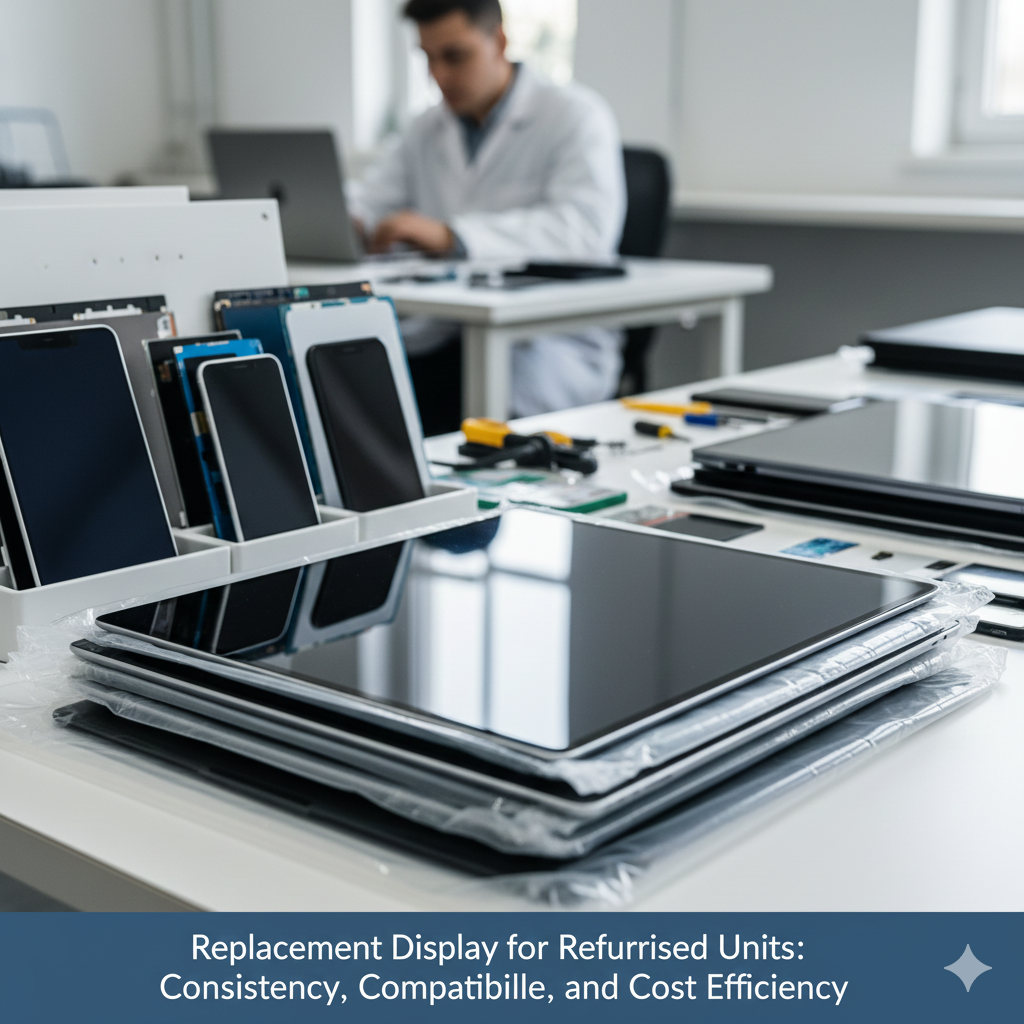

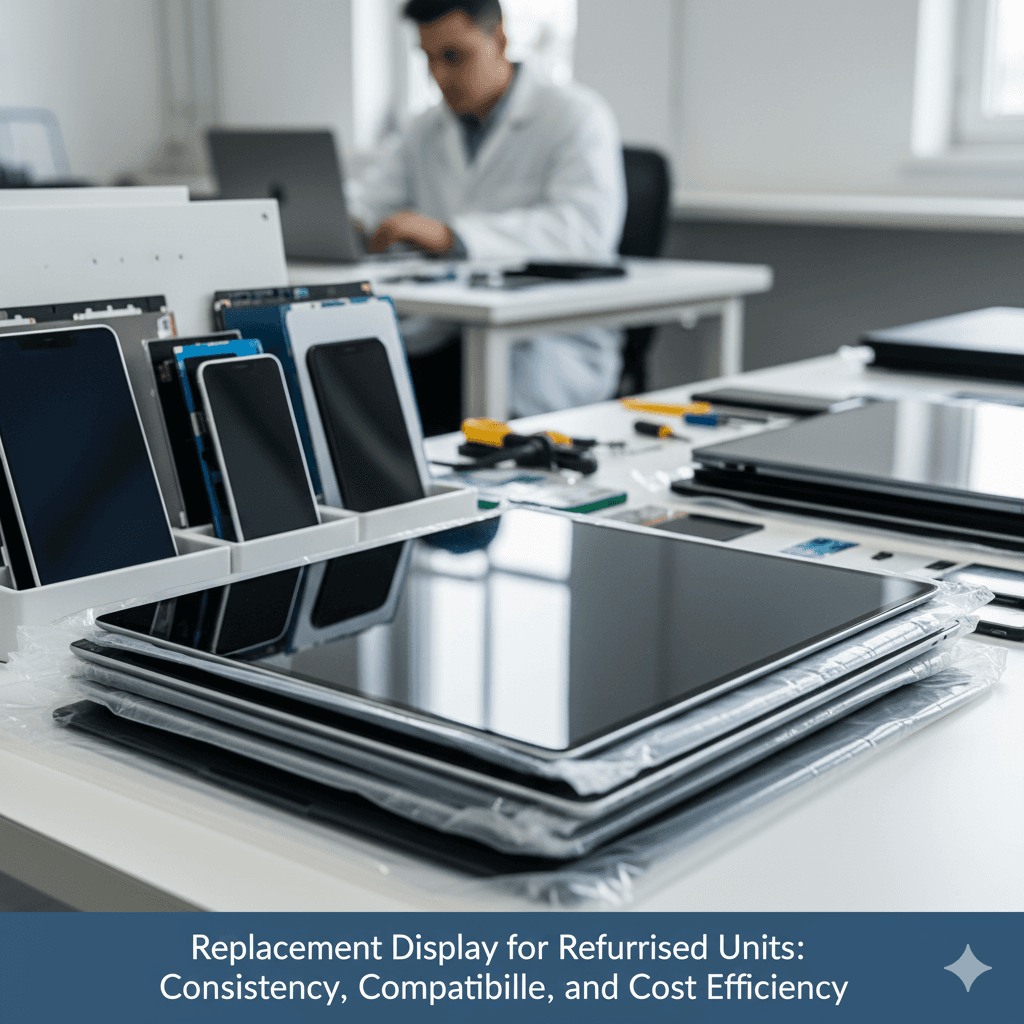
Replacement Display for Refurbished Units: Consistency, Compatibility, and Cost Efficiency
When the Screen Defines the Quality of a Refurbished Device
In the refurbishment business, the screen determines first impressions.
A device can have a flawless shell and a new battery—but if its display looks dim, oversaturated, or flickers, customers immediately recognize it’s not OEM.
Common issues faced by refurbishers include:
-
Brightness inconsistency across batches.
-
Inaccurate touch response after replacement.
-
High dead-pixel rates from unstable LCD sourcing.
-
Incompatible driver ICs causing ghost touch or display delay.
These aren’t isolated cases—they stem from non-standardized replacement displays that fail to synchronize with refurbished unit testing protocols.
Why Refurbished Devices Need Purpose-Built Displays
A refurbished unit differs from a repair:
-
It must pass a full functional check before resale.
-
It goes through mass testing and assembly lines.
-
It must maintain consistent quality across thousands of units.
Therefore, refurbished units require displays designed for high yield rates, OEM voltage mapping, and mechanical precision.
This is exactly what CPG’s replacement displays are engineered for—balancing cost efficiency and performance uniformity.
Inside CPG’s Display Engineering for Refurbished Units
Every CPG display module is built through a closed-loop production and testing process tailored for refurbishment operations:
-
Driver IC Matching
Each display uses pre-programmed ICs compatible with OEM firmware for brands like Apple, Samsung, Huawei, and Xiaomi. -
Uniform Backlight Calibration
Light distribution and color temperature are measured across 25 test zones to ensure consistent brightness. -
Touch Panel Sensitivity Testing
Verified under 10,000 touch cycles to simulate long-term usage. -
Mechanical Fit Verification
Frame thickness tolerance ≤0.05 mm for perfect housing alignment. -
Full-Panel Aging Test
Operated for 4 hours under 100% brightness to confirm stability and no flicker.
This process guarantees that each replacement display is refurbishment-ready, capable of sustaining industrial reassembly conditions.
Comparison: Generic Replacement vs. CPG Refurbishment Display
| Feature | Generic Replacement | CPG Display for Refurbished Units |
|---|---|---|
| Brightness (nits) | 350–420 | 480–550 |
| Color Uniformity | Variable | ±2.5 ΔE consistency |
| Touch Latency | 20–30 ms | <10 ms |
| Frame Fit Accuracy | ±0.2 mm | ±0.05 mm |
| Dead Pixel Rate | 3–5% | <0.5% |
| QC Documentation | None | Full electronic report |
For refurbishment partners, these details translate directly into higher yield, fewer reworks, and better resale margins.
Advantages for Refurbishment and Repair Centers
-
OEM brightness and color tone for premium resale presentation.
-
Batch-level consistency reduces calibration work during mass assembly.
-
Touch and display uniformity across multiple phone generations.
-
Lower power consumption through optimized IC drive efficiency.
-
Traceable batch codes and QC reports for after-sales transparency.
This allows refurbishers to achieve the OEM-like feel customers expect while keeping replacement costs under control.
Common Scenarios Where CPG Displays Excel
-
High-volume refurbishment lines handling mixed models.
-
After-sales repair providers seeking verified consistency.
-
Corporate recycling programs reselling upgraded devices.
-
Regional distributors bundling replacement screens with warranty coverage.
Across all scenarios, CPG ensures each refurbished phone delivers reliable display performance from the first touch to the final sale.
Selecting the Right Replacement Display for Refurbishment
When sourcing displays for refurbishment, consider these five criteria:
-
Brightness match (±5% OEM).
-
Touch IC compatibility with OEM firmware.
-
Frame alignment tolerance ≤0.1 mm.
-
100% testing certification before packing.
-
Batch traceability for QC audits.
CPG provides all these standards by default, ensuring a predictable production yield and consistent post-sale performance.
Frequently Asked Questions (FAQ)
Q1: Are refurbished displays different from repair-grade screens?
Yes. Refurbishment displays are optimized for mass production consistency and cost efficiency, while repair-grade screens focus on single replacements.
Q2: Can CPG displays be customized for corporate refurbishment projects?
Yes, including custom packaging, labeling, and testing reports.
Q3: What models are supported?
Full coverage for iPhone, Samsung, Huawei, OPPO, and Xiaomi lines.
Q4: How does CPG verify quality at scale?
Through automated optical inspection, brightness calibration, and digital traceability tracking.
Built for Refurbishment, Trusted by Professionals
Every refurbished unit deserves a screen that feels brand new.
With CPG’s replacement displays for refurbished units, you get OEM-level brightness, precise touch, and production-grade consistency—ready for assembly, resale, and long-term reliability.
For technical specifications or bulk purchase inquiries, visit CPG LCD’s homepage or contact the support team via the Contact Us page.