
What Should Buyers Expect From an iPhone Repair Parts Wholesale Supplier?
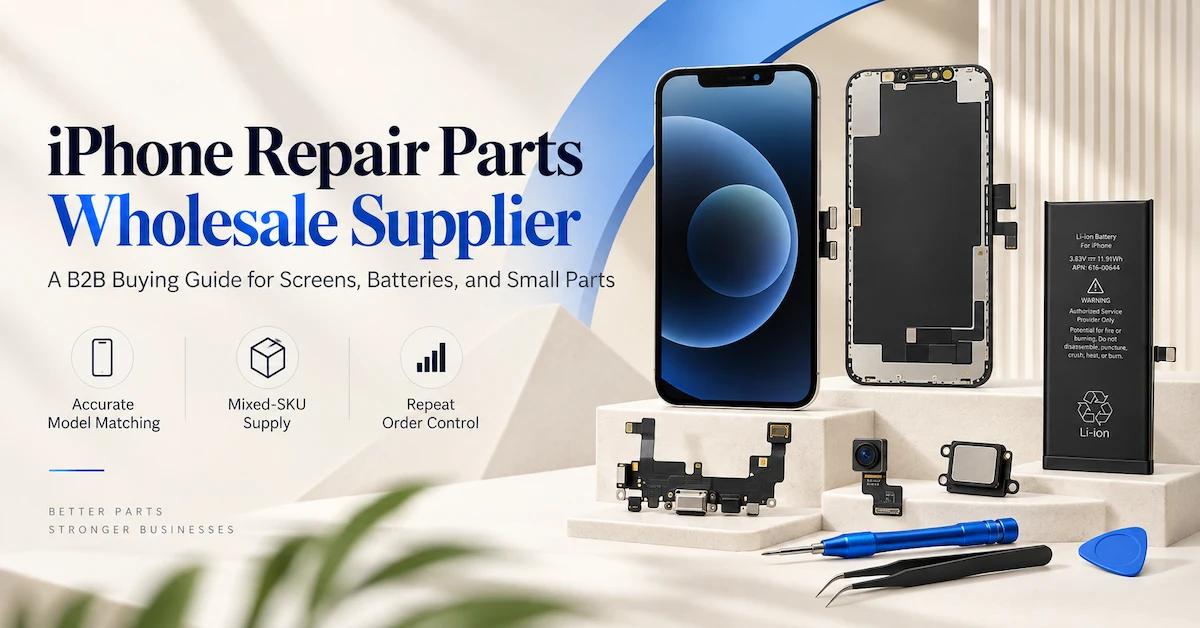
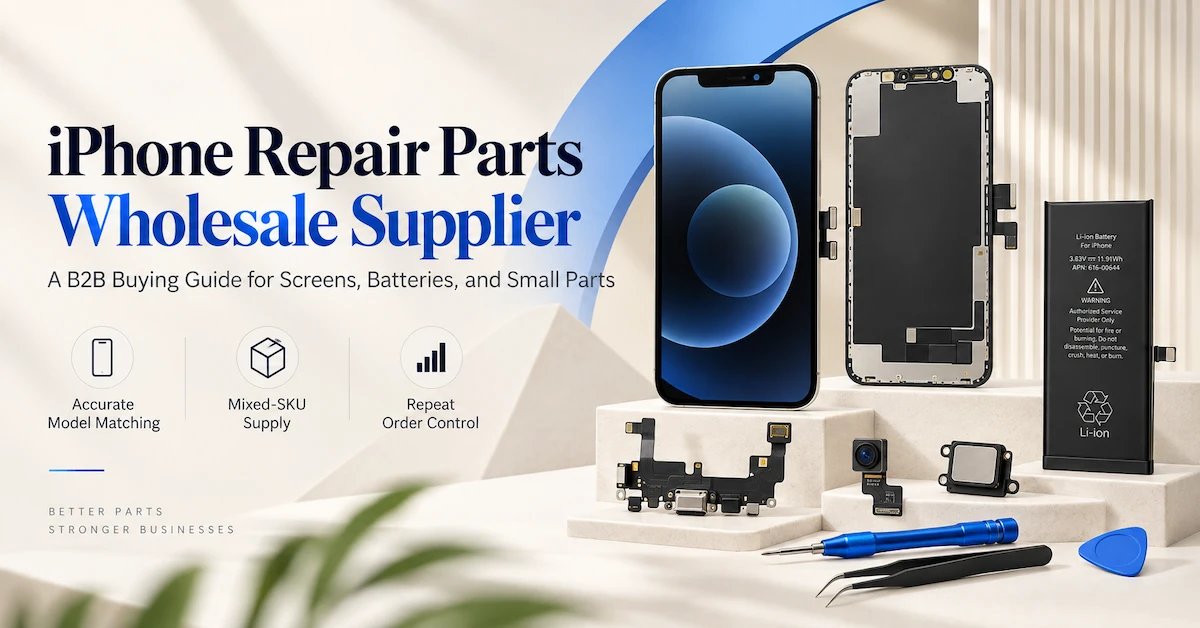
A professional iPhone repair parts wholesale supplier should help buyers identify the correct device variant, distinguish between different replacement-part configurations, organize many SKUs in one order, and preserve the approved specification for future purchases. The challenge is that “iPhone repair parts” describes several very different product families: display assemblies, batteries, charging flex cables, earpiece speakers, cameras, buttons, connectors, and other internal components do not use the same inspection criteria or installation process. CPG currently separates iPhone display products through its iPhone Repair Parts category while also maintaining a dedicated Small Parts for iPhone section and a broader Mobile Phone Battery category. For a B2B buyer, the value of this structure is not simply a wider catalog; it is the ability to build a model-by-model repair-parts list while keeping each component technically identifiable.
Which Buyers Need Wholesale iPhone Repair Parts?
The purchasing requirements differ significantly by buyer type. Independent repair shops usually need smaller batches of frequently repaired models and care about accurate model matching, manageable order quantities, and straightforward installation. Repair chains need standardized product references that technicians in different locations can use consistently. Wholesalers and regional distributors usually manage far more SKUs and therefore need clearer labels, packing lists, model separation, and repeat-order records. Refurbishment businesses may purchase larger quantities of fewer models but require stable configurations because one unexpected component change can affect an entire repair batch. Online replacement-parts sellers need precise compatibility descriptions because an incorrectly titled product can create returns even if the physical component itself functions correctly. An iPhone repair parts wholesale supplier should therefore be evaluated against the buyer’s operational model rather than by catalog size or lowest unit price alone.
Start With Exact iPhone Model and Variant Identification
Every RFQ should begin with the complete device model instead of a broad request such as “iPhone screen,” “iPhone battery,” or “iPhone charging port.” Current CPG iPhone display listings include separate entries for iPhone 17, iPhone 17 Pro, iPhone 17 Pro Max, iPhone 16-family products, iPhone 12 Pro Max, iPhone X, iPhone 7, and iPhone 6S, illustrating why generation and variant information should stay attached to the purchase line from inquiry through receiving. Some listings also distinguish specific assembly configurations, such as without-frame screens for newer models and with-frame assemblies for selected earlier models. A buyer should preserve the full model, supplier SKU, selected configuration, sample reference, and any relevant product photographs instead of approving one item and later reordering only by a shortened family name.
Do Not Treat All iPhone Repair Parts as One Product Category
An effective sourcing process separates parts by function because the main purchasing risk changes with the component. Displays require model, panel, frame, touch, flex, and fit verification. Batteries require model, physical configuration, capacity information, connector layout, and any device- or software-dependent behavior to be checked. Charging flex cables require connector position, board or flex layout, installed subcomponents, and installation method to be confirmed. Earpiece speakers, cameras, buttons, and other small components may appear simple but can still differ by device version. CPG’s current Small Parts for iPhone page includes examples such as iPhone 13 Pro earpiece speakers, iPhone 13 Pro charging flex cables, iPhone 8/SE 2020 charging flex products, and iPhone X/XS/XS Max earpiece replacements, showing why the buyer should identify the exact part as well as the phone model.
Use a Standard Purchasing Specification for Every SKU
A specification sheet makes quotations easier to compare and prevents missing information from silently becoming an assumption. The same basic structure can be reused across screens, batteries, charging flexes, cameras, speakers, and other iPhone replacement parts, while category-specific fields can be added when necessary.
| Specification Field | What the Buyer Should Confirm | Purchasing Purpose |
|---|---|---|
| Device model | Full iPhone generation and variant | Prevents family-level ordering errors |
| Product category | Screen, battery, flex, speaker, camera, etc. | Defines the repair component |
| Supplier SKU | Exact supplier product reference | Supports repeat-order traceability |
| Assembly scope | Components included and excluded | Prevents misunderstanding of product titles |
| Configuration | Frame/no frame, board/flex, or other format | Defines the supplied version |
| Key specifications | Product-specific technical information | Enables like-for-like comparison |
| Mechanical layout | Connector, flex, mounting and component position | Supports compatibility checking |
| Sample reference | Approved sample or item reference | Links bulk orders to qualification |
| Packaging | Individual protection, labeling and carton structure | Supports warehouse management |
| Quantity | Required amount per exact SKU | Prevents mixed-order quantity confusion |
| Open questions | Unconfirmed specifications or claims | Keeps uncertainty visible before ordering |
Evaluate iPhone Display Assemblies Separately From Other Parts
Display assemblies usually carry a higher purchasing value and require more technical comparison than many small parts. CPG’s current iPhone category shows several distinct display configurations, including iPhone 17-series assemblies listed without a frame, an iPhone X display-and-touch assembly listed with a frame and AMOLED wording, and selected iPhone 7 products listed with a frame. These titles demonstrate why buyers should not assume one universal screen configuration across iPhone generations. A display RFQ should therefore define the intended phone variant, actual offered display technology, frame status, included display and touch components, flex layout, physical condition, sample requirement, and packaging. Commercial wording such as “Ori,” “OEM,” “original quality,” or similar grade terminology should also be clarified before purchase; a product-title label should not be treated as proof of Apple authorization or a particular manufacturing origin unless corresponding documentation is supplied.
With Frame or Without Frame Should Be a Workflow Decision
The correct display configuration depends on the repair process. A with-frame assembly can reduce some transfer and bonding steps because the specified frame is included, while a without-frame assembly may suit refurbishment teams that already have the equipment and experience needed for additional assembly work. The lower component price is therefore not always the lower repair cost. A buyer should compare purchase price together with technician time, transfer work, adhesives or other consumables, equipment requirements, and the risk of damaging another component during installation. An iPhone repair parts wholesale supplier should identify the quoted configuration clearly so the purchasing department does not select one product while the repair team expects another.
Treat iPhone Batteries as a Separate Qualification Project
Battery sourcing requires a different approval record from display sourcing. Buyers should confirm the exact compatible model, supplier reference, stated capacity, electrical information where documented, battery dimensions, flex and connector position, label information, packaging, and any special device-recognition behavior. CPG’s battery catalog is separate from its iPhone screen and small-parts categories, which makes it practical to manage battery purchasing as its own technical product group. CPG also currently publishes a specific No Pop-Up Warning battery range covering iPhone 11 through iPhone 15 series; the associated product information includes conditions related to software versions around iOS 17.4, so professional buyers should validate the exact phone model, battery version, installation process, software environment, and resulting behavior before approving that type of product in bulk.
Charging Flex Cables Need More Than Connector Matching
A charging flex cable may carry more functions than the charging connector alone, depending on the exact assembly, so purchasing by connector appearance creates unnecessary risk. Buyers should confirm the device variant, flex outline, connector position, board or subcomponent layout, attachment points, and installation method. The CPG small-parts catalog currently lists charging-flex replacements for selected iPhone variants, including iPhone 13 Pro and iPhone 8/SE 2020 examples. When evaluating an iPhone repair parts wholesale supplier for charging components, ask whether the quoted item is a complete flex assembly or another component form, what is already fitted to the part, and which functions should be checked on the target device. Fast-charging or data-transfer performance should be treated as a defined acceptance requirement rather than inferred from the connector name.
Small Components Still Need Model-Specific Control
Earpiece speakers, cameras, microphones, button flexes, charging components, and other internal parts may cost less than screens, but a wrong small component can still stop a repair from being completed. The purchasing process should therefore preserve exact model references and photographs where useful. For example, CPG’s current iPhone small-parts category shows separate earpiece listings for an iPhone 13 Pro selection and for iPhone X/XS/XS Max devices. The practical lesson is that a familiar component name does not establish compatibility. Distributors handling hundreds of SKUs should create internal codes that connect supplier SKU, phone model, part type, and approved photograph so warehouse staff can distinguish visually similar components before they reach technicians or customers.
Compare iPhone Repair Parts by Their Main Procurement Risk
Different parts require different controls, so one generic quality checklist is not enough.
| Product Family | Primary Purchasing Risk | Recommended Verification |
|---|---|---|
| Display assemblies | Wrong variant or configuration | Exact model, panel description, frame, touch, flex, sample |
| Batteries | Wrong fit or unclear specification | Model, dimensions, connector, capacity data, functional sample |
| Charging flex cables | Similar layout but incompatible assembly | Flex routing, connector, board layout, device variant |
| Earpiece speakers | Physical or connector mismatch | Shape, contacts, mounting points, model |
| Camera modules | Wrong front/rear or device variant | Camera position, connector and exact device |
| Button/flex assemblies | Similar-looking generation differences | Model, flex shape, connector and mounting position |
| Repair tools | Tool or module not suited to the task | Supported function and compatible models |
Approve Samples With Written Acceptance Criteria
A sample becomes useful only when the buyer records what was actually approved. For a display, the sample evaluation might include physical fit, screen output, touch response, flex condition, frame configuration, and visible defects. For a battery, the record may include fit, connector, charging behavior, and any agreed recognition or software-related function. For a charging flex or speaker, the important checks may be fit, connector layout, and device function. The sample record should contain supplier SKU, exact iPhone model, product photographs, date, test device, relevant software or accessories where they affect the result, and a clear acceptance decision. The bulk order should then refer to the approved product rather than treating “sample passed” as approval for any later configuration supplied under a similar name.
Turn “QC Tested” Into Specific Questions
A quality statement only becomes useful when the buyer understands what was checked. Appearance inspection, display testing, touch testing, connector inspection, battery measurement, device installation, charging verification, and functional testing are separate activities. Ask which checks apply to the exact SKU, whether they are performed on every piece or through sampling, what rejection criteria are used, and whether results can be associated with a shipment or batch. A supplier may have an established general QC process, but that does not mean every product category receives the same inspection. This distinction is particularly important for an iPhone repair parts wholesale supplier handling displays, batteries, and small components from different product groups.
Check Product Claims and Documents at the Correct Level
If your business requires specific compliance records, product-origin documentation, brand authorization, cell information, or other supporting documents, review whether each document actually applies to the SKU being purchased. Company-level certificates cannot automatically prove the specification of an individual display; a distributor authorization for another product brand does not establish Apple authorization; and a supplier description using “original,” “Ori,” or “OEM quality” does not itself demonstrate a defined original-brand status. Buyers should record the document issuer, scope, applicable product, validity period where relevant, and how the evidence connects to the purchase requirement. When documentation does not support a stronger claim, use a narrower product description rather than filling the gap with assumptions.
Mixed-SKU Orders Need Better Warehouse Organization
One major reason to work with an iPhone repair parts wholesale supplier is to combine screens, batteries, charging flex cables, speakers, and other components into fewer purchasing and shipping processes. CPG’s broader product catalog currently includes iPhone repair displays, small parts, batteries, accessories, repair tools, and other categories, making multi-category sourcing possible from a catalog perspective. However, consolidation should reduce administration rather than reduce technical control. Every item should remain a separate order line with model, configuration, quantity, supplier SKU, packaging, and unresolved questions. Similar small parts should have readable labels, and the packing list should allow receiving staff to reconcile each SKU without opening or testing every package blindly.
Packaging Is Part of the Procurement Specification
Packaging should protect the part and preserve product identity. Display assemblies need protection against pressure, scratches, flex damage, and handling; batteries require appropriate individual protection and clear identification; small flexes and connectors need packaging that prevents bending, contamination, or mixing. For mixed-model shipments, ask how SKUs are separated, what information appears on individual labels, and how inner quantities relate to the carton packing list. If private-label packaging is required, approve the label or artwork separately from the technical component. Changing a box, sticker, barcode, or promotional insert does not mean that the underlying repair part has been technically customized.
Compare Cost per Usable Part Instead of Unit Price Alone
A useful supplier comparison includes the costs created after the purchase order as well as the quotation price. An internal measure can divide total purchasing and handling cost by the number of accepted, usable parts. Relevant costs may include the product price, allocated freight, incoming inspection, model-selection errors, confirmed defective items, sorting, rework associated with the purchased part, and claim administration. Causes should remain separated: a buyer ordering the wrong variant is not the same as a supplier shipping the wrong SKU, transport damage is not the same as a functional defect, and technician installation damage is not the same as a part arriving faulty. This distinction gives repair businesses a more accurate basis for comparing an iPhone repair parts wholesale supplier over several orders.
Ask About MOQ, Availability, and Lead Time Per SKU
A mixed iPhone order can contain fast-moving models, slow-moving components, and products with very different availability, so one overall MOQ or lead-time statement is usually not enough. Ask for minimum quantity by SKU, available quantity, replenishment requirements, preparation time, and shipment options. The CPG site provides a price-list and support page, but buyers should request current product-specific confirmation before issuing an order because catalog availability and commercial conditions can vary. Stock availability, order preparation, dispatch date, and carrier transit time should be recorded as separate values rather than summarized as one vague “delivery time.”
Use Repeat Orders to Test Supplier Consistency
The first order establishes the specification; repeat orders determine whether the approved product can be supplied consistently. Keep the supplier SKU, exact iPhone model, approved photographs, sample record, configuration, packaging, labels, quotation, and receiving notes. Before a repeat purchase, ask whether anything has changed. A product can retain a similar commercial name even if packaging, component sourcing, flex layout, or another characteristic changes. For wholesalers and repair chains, a controlled repeat-order file reduces the risk that a previously successful SKU is reordered by memory rather than by the exact specification that technicians originally approved.
How to Prepare a Quote-Ready iPhone Repair Parts RFQ
A quote-ready request should list one SKU requirement per row and contain the exact iPhone model, part name, configuration, quantity, destination, sample requirement, packaging requirement, and any technical question that must be resolved before approval. Screen requirements should state frame status and requested display configuration; battery lines should include the specifications that matter to the buyer; small components should identify the precise repair function and model variant. Buyers can first review the iPhone Repair Parts and Small Parts for iPhone categories, add battery requirements through the battery category, and then submit the completed model list through the CPG contact page. A structured RFQ gives both buyer and supplier a clearer basis for confirming products than a request for “your complete iPhone parts price list.”
Frequently Asked Questions
1. What Should I Check When Choosing an iPhone Repair Parts Wholesale Supplier?
Check whether the supplier can identify exact models and variants, explain the supplied assembly, provide model-specific product references, support sample verification where necessary, clarify QC scope, organize mixed-SKU orders, provide suitable packaging, and preserve product identity for repeat orders. Product range is useful, but traceability and specification control are what make the range practical for B2B purchasing.
2. What Types of iPhone Repair Parts Can Be Sourced From CPG?
The current CPG catalog separates iPhone display assemblies, iPhone small parts, and mobile phone batteries, while the broader site also includes repair tools and related mobile-phone components. The iPhone small-parts page currently shows charging flex cables and earpiece speakers among its visible listings. Buyers should confirm the exact current SKU and availability before ordering.
3. How Do I Avoid Ordering the Wrong iPhone Screen?
Use the complete device generation and variant, confirm the quoted assembly and frame configuration, retain the supplier SKU, and use photographs or a sample when necessary. Do not approve a product only because it appears under the same iPhone family name.
4. Are With-Frame and Without-Frame Screens Interchangeable Purchasing Choices?
They can address the same repair objective but create different installation workflows. Compare what is included, technician capability, transfer work, consumables, equipment, labor, and installation risk before choosing one configuration.
5. Should I Order a Sample Before Buying Wholesale iPhone Repair Parts?
Samples are particularly useful for a new supplier, unfamiliar SKU, high-volume model, or product with important software- or function-dependent behavior. Define what the sample must demonstrate and preserve the approved SKU and photographs for the bulk order.
6. What Should I Check When Buying iPhone Batteries Wholesale?
Confirm the exact device model, supplier reference, stated capacity and other documented specifications, physical configuration, connector, packaging, and any special recognition or software condition. Special battery claims should be verified on the intended device rather than generalized across all iPhone models.
7. Can Screens, Batteries, and Charging Flexes Be Combined in One Order?
They can be discussed in one mixed procurement program, but each exact SKU should remain a separate line with its own model, quantity, configuration, and approval status. Confirm MOQ, availability, packaging, and shipment conditions individually.
8. Does “OEM” or “Original Quality” Mean the Part Is Apple-Authorized?
Do not assume so. Ask what the terminology means for the specific product and request documentation if Apple authorization or a defined original-component source is a procurement requirement.
9. What Records Should Be Kept for Repeat Orders?
Keep the supplier SKU, complete compatible model, configuration, product photographs, sample approval, label information, packaging requirement, previous purchase order, receiving record, and any relevant test notes. Confirm changes before approving another shipment.
10. How Can I Request an iPhone Repair Parts Wholesale Quote?
Prepare a model-by-model list of screens, batteries, charging flexes, speakers, or other required parts with quantities, configurations, destination, and sample or packaging needs, then submit it through the CPG contact page for product-specific confirmation.
Conclusion
Choosing an iPhone repair parts wholesale supplier is primarily a process of controlling compatibility, product configuration, quality evidence, mixed-SKU organization, and repeat-order consistency. Repair shops need correct parts that fit their workflow, distributors need clear SKU and packaging control, and refurbishers need approved configurations that can be repeated across production batches. CPG’s current catalog provides dedicated iPhone repair displays, iPhone small parts, and mobile phone batteries, giving professional buyers a practical starting point for multi-category sourcing. Before placing a bulk order, build a line-by-line specification, approve critical samples, define the required QC evidence, and retain the approved SKU information for future purchases; when the list is ready, contact CPG with the exact models, quantities, configurations, destination, and packaging requirements for further confirmation.