
What Should Buyers Verify Before Ordering a Huawei LCD Assembly for Repair?
A Huawei LCD assembly for repair should be purchased against an exact device and an exact replacement configuration, not simply a Huawei series name. Before comparing prices, professional buyers should confirm the complete phone or tablet model, frame configuration, included display and touch components, flex-cable arrangement, supplier SKU, packaging, sample requirements, and any technical information that still needs verification. CPG currently organizes Huawei LCD repair parts across Huawei Y, P, Mate, and Nova series, while the same category also contains Huawei tablet replacement assemblies such as MatePad and MediaPad products. This broad coverage is useful for multi-model buyers, but it also makes accurate model identification more important because a product family name alone is not a complete purchasing specification.
Who Is This Purchasing Guide For?
This guide is intended for repair shops, service chains, mobile-parts wholesalers, regional distributors, importers, e-commerce parts sellers, and refurbishment businesses that purchase Huawei replacement screens repeatedly or in mixed-model orders. A repair shop may care most about installation efficiency and avoiding wrong-model purchases, while a distributor may need better SKU separation, packaging labels, and repeat-order consistency. A refurbishment business may place larger orders for fewer device models and therefore require a more disciplined sample-approval process. Buyers specifically requiring Huawei-authorized service parts, a defined original-component source, or a particular certification should request documentary confirmation for the exact product rather than interpreting a catalog title as proof of authorization or origin.
Do Not Treat “LCD Assembly” as a Complete Technical Specification
The phrase Huawei LCD assembly for repair is useful as a sourcing keyword and category description, but the words “LCD assembly” should not be treated as sufficient evidence of the actual panel technology, grade, construction, or origin of every SKU. Smartphone replacement-screen catalogs frequently organize products under broad navigation terms, while individual devices can require different display structures and configurations. A professional RFQ should therefore ask the supplier to confirm the actual product being offered instead of inferring technical details from the category name.
The same principle applies to words such as “original,” “OEM,” “premium,” or “high quality.” These terms can have different commercial meanings unless the supplier defines what they refer to. Buyers should translate them into checkable questions: What panel or assembly type is being supplied? What components are included? What device model is it intended for? Is a frame included? What sample can be approved? What inspection information is available? This approach creates a specification that purchasing staff can use again instead of relying on marketing terminology.
Start With Exact Huawei Model Identification
Huawei replacement-screen purchasing becomes much safer when device identification is written into every stage of the order. The CPG Huawei category currently includes products for phones such as P60 Pro, Nova 9, Y8s, Y6P 2020, P Smart Z/Y9 Prime 2019, and Nova Y60, as well as tablet products such as MediaPad M3 Lite, MediaPad M5 Lite, MatePad T10, and other MatePad models.
That means “Huawei P series screen” or “Huawei Nova display” is not specific enough for a wholesale order. Record the complete commercial model, any model code or relevant version available from the device, the required product configuration, and the supplier SKU. If the repair team has a damaged original screen or device label available, photographs can be attached to the RFQ when naming alone may cause ambiguity. Once a sample is approved, preserve that reference for later purchasing instead of reverting to a shorter family name.
Use a Specification Sheet for Every Huawei Display Order
A structured specification sheet helps the supplier understand the requirement and helps the buyer compare quotations on the same basis. It also exposes missing information before a purchase order is issued.
| Specification Field | What the Buyer Should Confirm | Why It Matters |
|---|---|---|
| Device model | Complete Huawei phone or tablet model | Reduces wrong-model ordering |
| Model/version code | Any relevant hardware or regional identifier | Distinguishes similar variants |
| Supplier SKU | Exact quoted product reference | Supports repeat-order traceability |
| Display assembly type | Supplier-confirmed panel/assembly description | Avoids relying only on category wording |
| Frame configuration | With frame or without frame | Changes installation workflow |
| Included components | Display, touch layer, flex cable and other supplied parts | Defines the actual delivery scope |
| Screen size | Product-specific value where provided | Supports specification matching |
| Resolution | Product-specific value where provided | Helps compare like-for-like offers |
| Flex/connector | Position, shape and connector arrangement | Critical for physical compatibility |
| Mechanical layout | Openings, mounting points and overall fit | Reduces installation problems |
| Sample reference | Approved item or sample identifier | Links bulk orders to qualification |
| Packaging | Individual protection, box and carton arrangement | Supports shipping and warehouse control |
| Open questions | Unconfirmed specifications or claims | Prevents assumptions from becoming order requirements |
With Frame or Without Frame: Choose According to the Repair Workflow
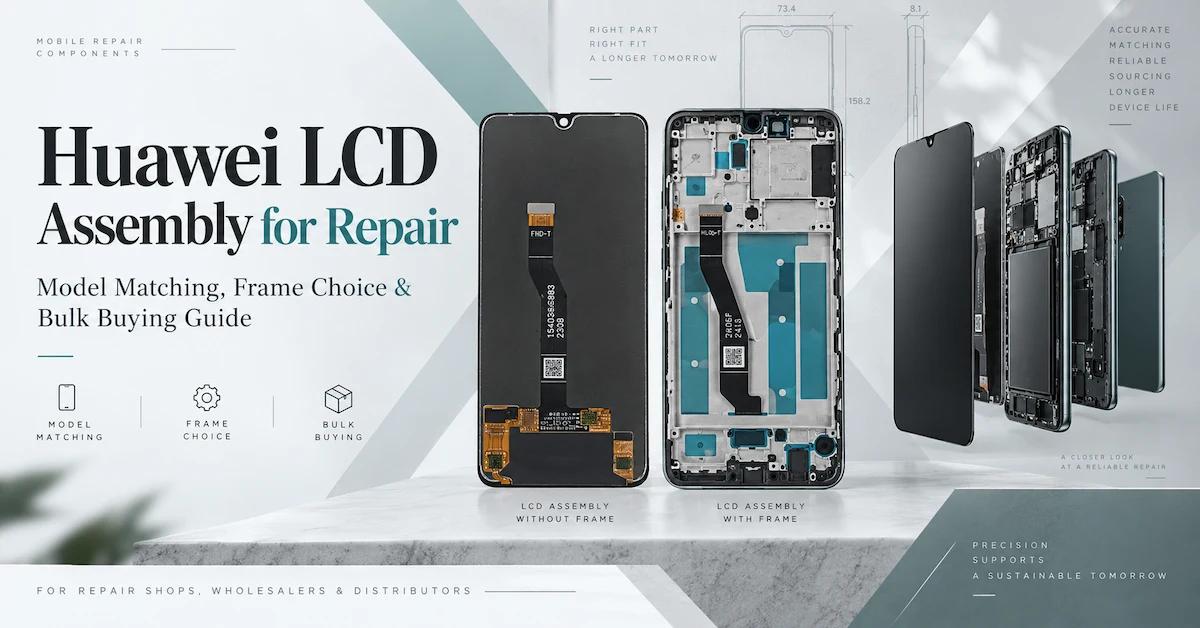
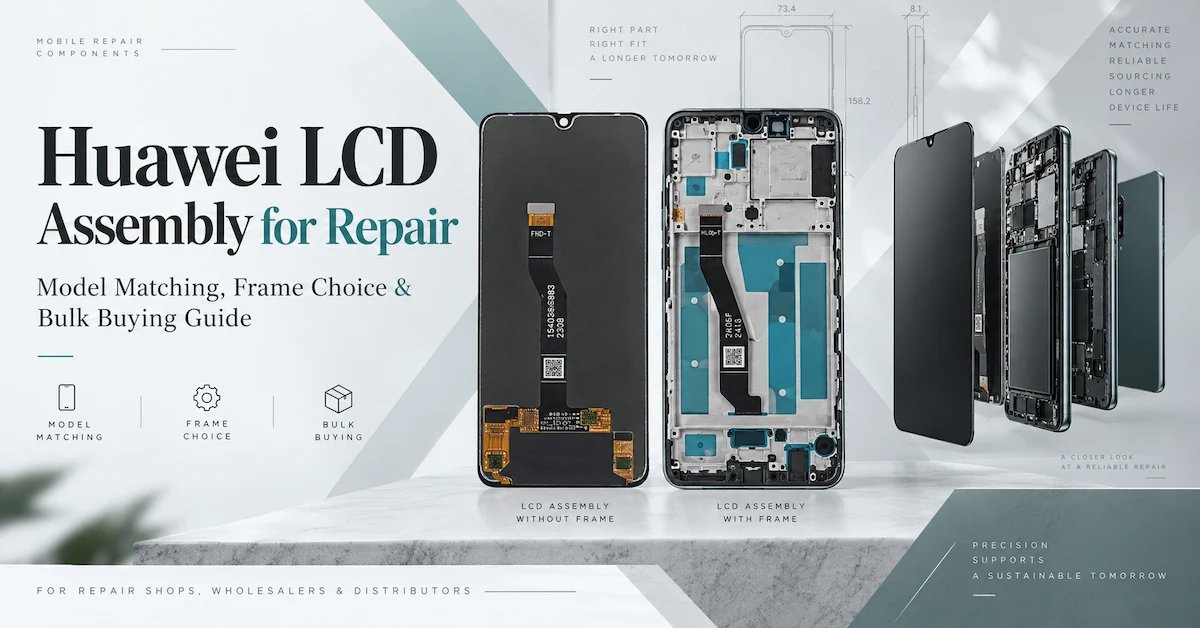
Frame configuration is one of the clearest purchasing differences within the Huawei replacement-screen catalog. A with-frame assembly includes the front frame specified by the product listing, while a without-frame assembly requires the repair process to use or transfer the relevant housing structure. Neither configuration should automatically be described as better.
A repair operation handling high throughput may prefer a configuration that reduces the amount of component transfer required, while an experienced refurbishment team may choose a different configuration because it already has suitable equipment, adhesives, fixtures, and technicians. Cost comparison should therefore include technician time, transfer work, risk of damage during installation, and any additional materials—not only the purchase price of the display assembly.
CPG’s Huawei category currently shows both approaches: listings such as Huawei Y8s, Y6P 2020, and P Smart Z/Y9 Prime 2019 are identified as with-frame products, while products such as Huawei P60 Pro, Nova 9, and several MediaPad models are listed without a frame.
A Real Product Example: Huawei P60 Pro Without Frame
The current Huawei P60 Pro replacement-screen product page provides a useful example of how a buyer should read a specific listing instead of relying only on a category title. The page identifies the item as black, with a 6.67-inch screen and a listed resolution of 1220 × 2700 pixels. It explicitly states that the front frame is not included, while the listed package contents are the display, touch screen, and flex cable. The page also lists bubble bag, paper box, and foam box packaging.
Those details can form part of an RFQ or sample sheet, but they should remain product-specific. They should not be copied automatically to another Huawei model. The listing’s use of “LCD” should also be treated as the terminology of that specific catalog page rather than a substitute for confirming the actual panel or assembly type required by the buyer.
Compare Huawei Assemblies by Configuration, Not by a Single Quality Label
The table below uses currently visible CPG Huawei listings to show how buyers can distinguish products before requesting detailed specifications. It is a purchasing comparison, not a claim that the products are interchangeable.
| Catalog Example | Listing Configuration | Main Buyer Check | Typical Purchasing Question |
|---|---|---|---|
| Huawei P60 Pro | Without frame | Exact model, assembly contents, panel specification | What must be transferred during installation? |
| Huawei Nova 9 | Without frame | Exact model and mechanical layout | Does the flex and connector match the intended version? |
| Huawei Y8s | With frame | Frame and complete assembly scope | Which components are already fitted to the frame? |
| Huawei Y6P 2020 | With frame | Model/year identification | Is this the exact 2020 device version required? |
| Huawei P Smart Z / Y9 Prime 2019 | With frame | Dual-name compatibility statement | Which exact device is being repaired and approved? |
| Huawei MediaPad M3 Lite 8 | Without frame | Tablet model and screen size | Is the order for the correct tablet variant? |
These configurations are visible in the current Huawei repair-parts category. Buyers should request the detailed product page, quotation, photographs, or sample for any specification not explicitly documented on the category page.
Check the Display, Touch Layer, Flex Cable, and Mechanical Fit Separately
A Huawei LCD assembly for repair is not adequately qualified simply because an image appears when the phone is powered on. A professional sample evaluation should separate the functions that matter to the repair business. Display inspection can record image stability, visible defects, abnormal lines, dark areas, brightness consistency, and other agreed visual criteria. Touch evaluation can check response across the usable area, edge response, gesture operation, and intermittent behavior. Flex and connector inspection can focus on physical condition, position, seating, routing, and visible reinforcement. Mechanical inspection can check whether the assembly sits correctly in the intended housing without abnormal gaps or pressure.
The purpose of separating these checks is not to claim that every shipment has already passed them. They are procurement criteria that the buyer and supplier can agree on. If CPG provides a test result or QC statement for a selected SKU, the buyer should ask what the test actually covers and whether it applies to each piece or to a sampling plan.
Do Not Invent Materials or Component Grades That Are Not Documented
The writing framework for B2B technical content calls for materials and component information, but that does not mean a buyer should fill every field with assumptions. If the product page does not identify the cover-glass grade, flex material, adhesive, driver IC source, panel manufacturer, or other component origin, those details should remain unconfirmed until documentation is provided.
For procurement, the correct question is not “What technical-sounding information can we add?” but “Which material or component characteristic affects this order?” A repair chain may care about consistent frame construction, while a distributor may need stable labeling and product identification. A refurbishment business may need the same flex layout across repeat batches. Asking only for information that supports a purchasing decision produces a more reliable technical file than copying unsupported specifications from other websites.
Use Sample Approval to Reduce Bulk-Order Risk
Before a large purchase of an unfamiliar Huawei LCD assembly for repair, buyers should consider approving a sample against a written checklist. Record the exact device used for testing, supplier SKU, frame configuration, listed components, photos, inspection date, technician notes, and final decision. If software version, housing condition, or installation materials may influence the result, note those conditions as well.
The approved sample should then become a reference for the bulk order. If the later quotation, product label, flex layout, frame, or other configuration changes, the supplier should be asked to clarify the change before shipment. This is particularly useful for wholesalers and refurbishment businesses because their risk is not limited to one defective piece; an undocumented change across a large batch can create repeated technician rework or inventory problems.
Define What “QC” Means Before the Purchase Order
“QC tested” is too broad to function as a purchasing specification by itself. Ask which checks are performed on the Huawei assembly being quoted. Appearance inspection, touch testing, display testing, connector inspection, installed-device testing, and mechanical-fit evaluation are different activities. The buyer should also ask whether the test is applied to every unit or to sampled units, whether results can be traced to a batch, and what happens if a shipment fails the agreed receiving criteria.
The general LCD display assembly supplier guide on the CPG website discusses display panels, touch digitizers, flex cables, and frame structures as separate elements of a replacement assembly. That component-based approach is useful for defining a QC checklist because it prevents one successful function from being used as evidence that every other part of the assembly has been verified.
Treat Certifications and Authorization as Product-Specific Evidence
If a buyer’s market or customer requires a particular certificate, authorization, or compliance document, the purchasing team should check its issuer, scope, validity period, applicable product, and relationship to the supplied SKU. A company-level certificate, distributor authorization, or tool-brand document should not automatically be used as evidence for an unrelated Huawei replacement screen.
The same principle applies to phrases that imply product origin. If the procurement requirement is specifically an original service part, a particular panel manufacturer, or a defined production source, request written evidence for that exact requirement. If the supplier cannot document the requested status, the commercial description should be adjusted rather than strengthened for marketing purposes.
Packaging Should Protect the Assembly and Preserve SKU Identity
Good packaging has two jobs in a wholesale screen order: protect the part and help the warehouse identify it correctly. The P60 Pro page currently lists bubble bag, paper box, and foam box packaging for that specific item. Other Huawei products may have different arrangements, so confirm packaging at SKU level rather than applying one page’s specification to the entire category.
For mixed-model orders, ask that product labels contain enough information to connect each package to the purchase order. The carton packing list should identify individual SKUs and quantities, particularly when several Huawei models have similar-looking assemblies. Distributors can also discuss customized labeling or packaging requirements separately from technical product approval. Changing a box or label is not the same as changing the display assembly itself.
Compare Total Procurement Risk, Not Just Screen Price
A cheaper Huawei LCD assembly for repair can become more expensive if the wrong model is ordered, an assembly requires unexpected transfer work, the frame does not match the intended workflow, or receiving staff cannot identify mixed SKUs. A useful internal cost calculation should therefore include unit cost, freight allocation, inspection time, installation labor, confirmed rework associated with the purchased part, documented returns, and claim-handling cost.
Keep failure causes separate. A buyer ordering the wrong model is not the same as a supplier shipping the wrong SKU. Shipping damage is different from an assembly that fails an agreed touch test. Technician installation damage is different from a pre-existing product defect. When those categories are recorded independently, purchasing teams can improve both supplier selection and their own internal ordering process.
Treat MOQ, Stock, and Lead Time as Order-Specific Variables
Do not assume that every Huawei screen has the same MOQ, inventory level, or preparation time. The product category covers older phones, newer phones, tablets, frame configurations, and multiple series, so availability can vary by SKU. Before committing to a customer delivery date, ask which products are available, which require replenishment, whether mixed-model quantities can be combined commercially, when the goods can be prepared, and when they are expected to be dispatched.
Buyers can use the CPG price-list and support page as a starting point, but the final purchase should use a current quotation tied to the exact model list and quantity. For an urgent order, separate “in stock,” “ready to dispatch,” and “estimated transit time” because they describe different stages of fulfillment.
Private-Label Packaging and Technical Customization Are Different Projects
A distributor building its own resale program may need branded labels, carton marks, product stickers, or other packaging support. Those requirements should be approved as packaging specifications. If the buyer instead requests a change to the screen assembly, frame, flex, component source, or another technical feature, that becomes a product-development question and should require separate feasibility confirmation and sample approval.
Do not use the general phrase OEM/ODM as a substitute for identifying what can actually be changed. For a Huawei replacement-screen project, ask the supplier to state whether the requested change affects packaging only, product labeling, component selection, assembly structure, or another technical characteristic.
Prepare a Quote-Ready Huawei Screen RFQ
A professional RFQ for Huawei LCD assembly for repair should give the supplier enough information to identify the product without guessing. Include the exact Huawei model, any model code or version available, with-frame or without-frame requirement, desired quantity, supplier SKU if already known, product photographs where useful, packaging needs, sample requirements, delivery destination, and any specific technical criteria that must be confirmed. Buyers sourcing other mobile-repair components at the same time can review the broader CPG product catalog, but each screen should remain a separate line item with its own specification. When the list is ready, submit it through the CPG contact page so the quotation can be prepared around identifiable models instead of a general request for “Huawei screens.”
Frequently Asked Questions
1. What Is a Huawei LCD Assembly for Repair?
In purchasing terms, it is a replacement display assembly listed for a specific Huawei phone or tablet. Depending on the SKU, the supplied item may include the display, touch layer, flex cable, frame, or a combination of those components. Buyers should use the exact product listing rather than assume all assemblies contain the same parts.
2. Does Every Huawei LCD Assembly Use the Same Display Technology?
Do not assume so from a catalog category name. Confirm the actual panel or display-assembly specification for the exact Huawei model being purchased. Category terminology is useful for website navigation but should not replace a product-level technical specification.
3. Should I Buy a Huawei Screen With Frame or Without Frame?
Choose according to the repair workflow. A with-frame configuration may reduce some transfer operations, while a without-frame assembly may suit workshops already equipped for screen transfer and bonding work. Compare technician time, equipment, materials, purchase price, and installation risk.
4. What Does the Huawei P60 Pro CPG Listing Include?
The current P60 Pro product page identifies a 6.67-inch black replacement assembly with a listed 1220 × 2700 resolution. It states that the front frame is not included and lists the display, touch screen, and flex cable as included components. Buyers should still confirm the current specification when ordering.
5. How Can I Avoid Ordering the Wrong Huawei Screen?
Record the complete model name, any model code or relevant version, required frame configuration, supplier SKU, and product photos where useful. Keep the same information on the quotation, purchase order, sample record, and repeat order instead of shortening the item back to a series name.
6. Should I Test a Sample Before Buying in Bulk?
Sample approval is useful for unfamiliar models, new suppliers, large orders, and configurations important to your repair workflow. Define the checks before testing and retain the approved product reference so the later bulk shipment can be compared with the same configuration.
7. What QC Checks Matter for a Huawei Replacement Screen?
Common purchasing checks can include appearance, image performance, touch response, flex and connector condition, mechanical fit, and the specific functions required by the repair process. Ask which of those checks the supplier performs and which should be completed by your own technical team.
8. Can I Order Huawei Phone and Tablet Screens From the Same Category?
CPG’s current Huawei category includes both phone and tablet products, including MatePad and MediaPad listings. Keep phone and tablet SKUs clearly separated in the RFQ because similar category placement does not imply similar dimensions, connectors, or assembly structures.
9. What Information Should I Keep for Repeat Orders?
Retain the supplier SKU, exact model, frame configuration, product photos, approved sample reference, listed specifications, packaging, previous purchase order, and inspection notes. Before a repeat order, confirm whether the supplied configuration has changed.
10. How Do I Request a Huawei LCD Wholesale Quote From CPG?
Prepare a model-by-model list showing quantities, frame requirements, destination, sample needs, and any technical questions, then submit it through the CPG contact page. A detailed RFQ gives the supplier a clearer basis for confirming the correct replacement assemblies and commercial terms.
Conclusion
Buying a Huawei LCD assembly for repair is primarily a model-control and specification-control task. Professional buyers should verify the exact device, frame configuration, included components, flex and connector layout, sample reference, QC requirements, packaging, and repeat-order identity before comparing bulk quotations. CPG’s Huawei LCD repair parts category currently covers multiple Huawei phone series and tablet models, including both with-frame and without-frame listings, which gives distributors and repair businesses a broad sourcing starting point but also makes SKU-level verification essential. If you are planning a wholesale order, send CPG your exact Huawei model list, quantities, configuration requirements, destination, and sample needs through the contact page so each assembly can be confirmed before purchase.